Live · Global · Independent
Live Feeds
PinkVilla
Forbes
NDTV
Hindustan Times
Video Shows Fleet Of Ferraris Stuck In Bengaluru Traffic, Ashneer Grover Reacts
onmynews.com

Video Shows Fleet Of Ferraris Stuck In Bengaluru Traffic, Ashneer Grover Reacts

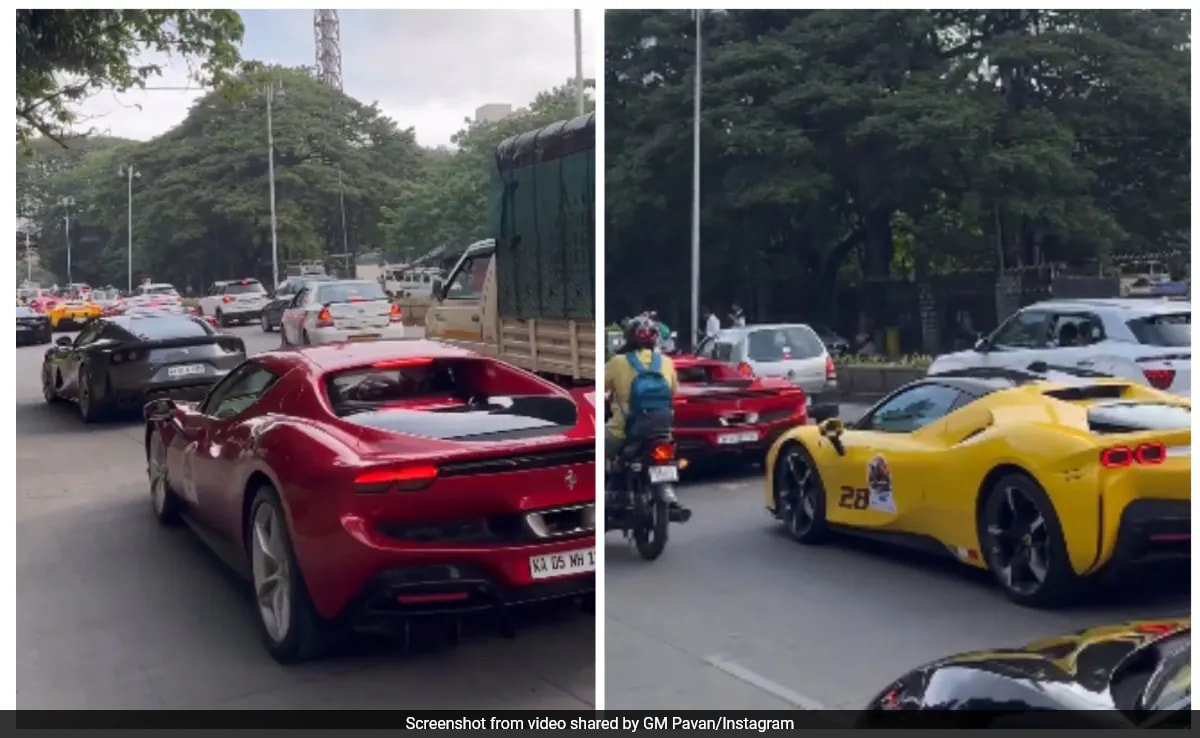
Bengaluru is infamous for its traffic, where it takes excruciatingly long to cover short distances. Every other day, commuters take to social media to share their traffic struggles and vent their frustration about being stuck in a jam. Recently, one user shared a video on Instagram that showed several Ferraris stuck in the lengthy Bengaluru traffic. Yes, not even the high-end cars are immune from the city’s traffic jam.

In the video, a fleet of luxurious Ferrari supercars is caught in the midst of a lengthy traffic jam on Church Street Bel Road. While some cars are patiently waiting behind other vehicles, others are seen crawling through the city’s congested streets. 

The video was posted on Instagram by user @pavangamemaster. ”FERRARI’s traffic in Bangalore,” the text on the video reads.

Watch the video here:

This ironic sight quickly gained traction on social media, sparking much chatter and amusement. Since being shared, the clip has garnered 4.9 million views, and close to 2.5 lakh likes. 

The video also captured the attention of the entrepreneur and former Shark Tank India judge. He wrote, ”More like Bengaluru takes down Ferrari! I feel the pain of having so many horses and being stuck in traffic.”

Reacting to the video, one user wrote, ”Imagine spending 6 Cr just to be stuck in traffic with the rest of before.” Another commented, ”Dream sight of every automobile enthusiast.” A third said, ”Bengaluru never stops in traffic. Amazing video. Shows the reality.”

A fourth added, ”Bengaluru never stops in traffic. Amazing video. Shows the reality.”

 According to the latest report by Greenpeace India, the average commute time for car users in Bengaluru is typically observed to be a minimum of one hour when covering a standard travel distance of 10 kilometers. Meanwhile, another report has revealed that Bengaluru suffered a loss of ₹ 19,725 crore per year due to its traffic delays, congestion, stoppage of signals, time loss, fuel loss, and related factors.

Last month, Karnataka Deputy Chief Minister DK Shivakumar said a 190-km tunnel has been proposed to ease traffic congestion in the city, and 8 companies qualified for it.  These companies will study and report on how the tunnel road should be, whether it should be four or six lanes, from where it should begin and end, and a decision also needs to be taken on whether it should be expanded across the city, he said.
Read full article
Researchers Warn We Could Run Out Of Data To Train AI By 2026. What Then?
onmynews.com

Researchers Warn We Could Run Out Of Data To Train AI By 2026. What Then?

As artificial intelligence (AI) reaches the peak of its popularity, researchers have warned the industry might be running out of training data – the fuel that runs powerful AI systems. This could slow down the growth of AI models, especially large language models, and may even alter the trajectory of the AI revolution.

But why is a potential lack of data an issue, considering how much there are on the web? And is there a way to address the risk?

Why high-quality data are important for AI

We need a lot of data to train powerful, accurate and high-quality AI algorithms. For instance, ChatGPT was trained on 570 gigabytes of text data, or about 300 billion words.

Similarly, the stable diffusion algorithm (which is behind many AI image-generating apps such as DALL-E, Lensa and Midjourney) was trained on the LIAON-5B dataset comprising of 5.8 billion image-text pairs. If an algorithm is trained on an insufficient amount of data, it will produce inaccurate or low-quality outputs.

The quality of the training data is also important. Low-quality data such as social media posts or blurry photographs are easy to source, but aren’t sufficient to train high-performing AI models.

Text taken from social media platforms might be biased or prejudiced, or may include disinformation or illegal content which could be replicated by the model. For example, when Microsoft tried to train its AI bot using Twitter content, it learned to produce racist and misogynistic outputs.

This is why AI developers seek out high-quality content such as text from books, online articles, scientific papers, Wikipedia, and certain filtered web content. The Google Assistant was trained on 11,000 romance novels taken from self-publishing site Smashwords to make it more conversational.

Do we have enough data?

The AI industry has been training AI systems on ever-larger datasets, which is why we now have high-performing models such as ChatGPT or DALL-E 3. At the same time, research shows online data stocks are growing much slower than datasets used to train AI.

In a paper published last year, a group of researchers predicted we will run out of high-quality text data before 2026 if the current AI training trends continue. They also estimated low-quality language data will be exhausted sometime between 2030 and 2050, and low-quality image data between 2030 and 2060.

AI could contribute up to US$15.7 trillion (A$24.1 trillion) to the world economy by 2030, according to accounting and consulting group PwC. But running out of usable data could slow down its development.

Should we be worried?

While the above points might alarm some AI fans, the situation may not be as bad as it seems. There are many unknowns about how AI models will develop in the future, as well as a few ways to address the risk of data shortages.

One opportunity is for AI developers to improve algorithms so they use the data they already have more efficiently.

It’s likely in the coming years they will be able to train high-performing AI systems using less data, and possibly less computational power. This would also help reduce AI’s carbon footprint.

Another option is to use AI to create synthetic data to train systems. In other words, developers can simply generate the data they need, curated to suit their particular AI model.

Several projects are already using synthetic content, often sourced from data-generating services such as Mostly AI. This will become more common in the future.

Developers are also searching for content outside the free online space, such as that held by large publishers and offline repositories. Think about the millions of texts published before the internet. Made available digitally, they could provide a new source of data for AI projects.

News Corp, one of the world’s largest news content owners (which has much of its content behind a paywall) recently said it was negotiating content deals with AI developers. Such deals would force AI companies to pay for training data – whereas they have mostly scraped it off the internet for free so far.

Content creators have protested against the unauthorised use of their content to train AI models, with some suing companies such as Microsoft, OpenAI and Stability AI. Being remunerated for their work may help restore some of the power imbalance that exists between creatives and AI companies.

Rita Matulionyte, Senior Lecturer in Law, Macquarie University

This article is republished from The Conversation under a Creative Commons license. Read the original article.

Read full article
Nandamuri Balakrishna’s ‘NBK 109’ first poster with blood bath and violence out!
onmynews.com

Nandamuri Balakrishna’s ‘NBK 109’ first poster with blood bath and violence out!

Tollywood actor Nandamuri Balakrishna, last seen in ‘Bhagavanth Kesari’, is now working on his next film, tentatively titled ‘NBK 109’. Directed by Bobby, the film is expected to be action-packed with mass appeal. The makers announced the project through a poster featuring a box of weapons and an axe, hinting at Balakrishna’s role. The movie is set to go on floors soon and is anticipated to have a mix of masala elements.

Read full article
Link copied!