Lebanon’s political system is deeply entrenched in sectarian divisions. The country is a confessional democracy, meaning that key political and military positions are reserved for representatives of specific religious sects.
The President must always be a Maronite Catholic, the Prime Minister a Sunni Muslim, and the Speaker of the Parliament a Shia Muslim. While the Deputy Speaker of Parliament and the Deputy Prime Minister are always Greek Orthodox Christians, the Chief of the General Staff of the Armed Forces is always a Druze. This delicate balancing act extends to the composition of the Lebanese Parliament, which maintains a ratio of 6:5 in favour of Christians to Muslims (including Druze).
The current political system was largely imposed by France in 1920 when it was the colonial power in the Levant region. Ironically, France, one of the most secular nations in Europe, created a state system in Lebanon that is wholly dependent on religious identities, said
The roots of this system lie in a proposal from the Maronite Church, as Muslims, particularly the Sunnis, initially refused to accept the creation of a separate Lebanese entity and preferred instead to merge with Syria. Thus, the state that emerged lacked solid foundations, setting the stage for its current troubles.
Today, Hezbollah, a militant group backed by Iran, has emerged as the de facto ruler of Lebanon, operating with more power and influence than the official government and threatening all-out war with Israel.
On Tuesday, a series of explosions from pagers used by Hezbollah members in Lebanon resulted in at least nine deaths and approximately 2,800 injuries. The Iran-backed group attributed the blasts to Israel. While Israel has not commented, the operation’s sophistication has led many to suspect the involvement of its intelligence agency, Mossad.
Inside Lebanese Politics
“Lebanon is an illiberal democracy. That is, the Lebanese do go to the polls fairly regularly, but they are expected to choose from a set of pre-determined ideas that do not interfere with the existing structure as was designed by the oligarchs, and now taken over by Hezbollah,” said Hussain Abdul-Hussain, veteran journalist, Middle East expert and research fellow at the Foundation For Defense of Democracy in Washington DC, told NDTV.
The power-sharing arrangement that forms the bedrock of Lebanon’s government is not just an outdated relic; it is a carefully maintained system designed to preserve the status quo. The shadow state within the official state has now become the norm, with the real power held not by elected officials but by Hezbollah and its allies. The militia group, which pledges allegiance to Iran’s Supreme Leader, operates outside of the traditional state structures but holds ultimate authority.
Lebanon’s capital Beirut during the 1982 war.
Photo Credit: Getty
“Suppose you want to run on a platform that demands unconditional and immediate peace with Israel, you will either be disqualified or suffer violence by non-state actors (Hezbollah). Even though the country has a hybrid presidential/parliamentary system, its rulers have been pretty much the same people over the past 40 or more years,” Mr Abdul-Hussain added.
The political elites who drafted Lebanon’s constitution in 1926, mainly Christian business leaders, ensured that state powers were decentralised, effectively granting various religious sects immunity from state prosecution and accountability.
This arrangement created a system where the political and business elite thrived while national identity and state institutions remained weak. The sectarian affiliation has, for decades, overridden national identity, resulting in a fractured society and a government that struggles to maintain order.
Hezbollah: From Militia To De Facto Ruler
Hezbollah’s journey from a militia group to Lebanon’s most powerful political and military entity started in 1982 following Israel’s invasion of the country. Initially perceived as a resistance movement against Israeli occupation, Hezbollah has since transformed into a big game player in Lebanese politics. Today, it is not just a political party but a state within a state – a powerful armed militia that supersedes the Lebanese Armed Forces (LAF) in strength and authority.
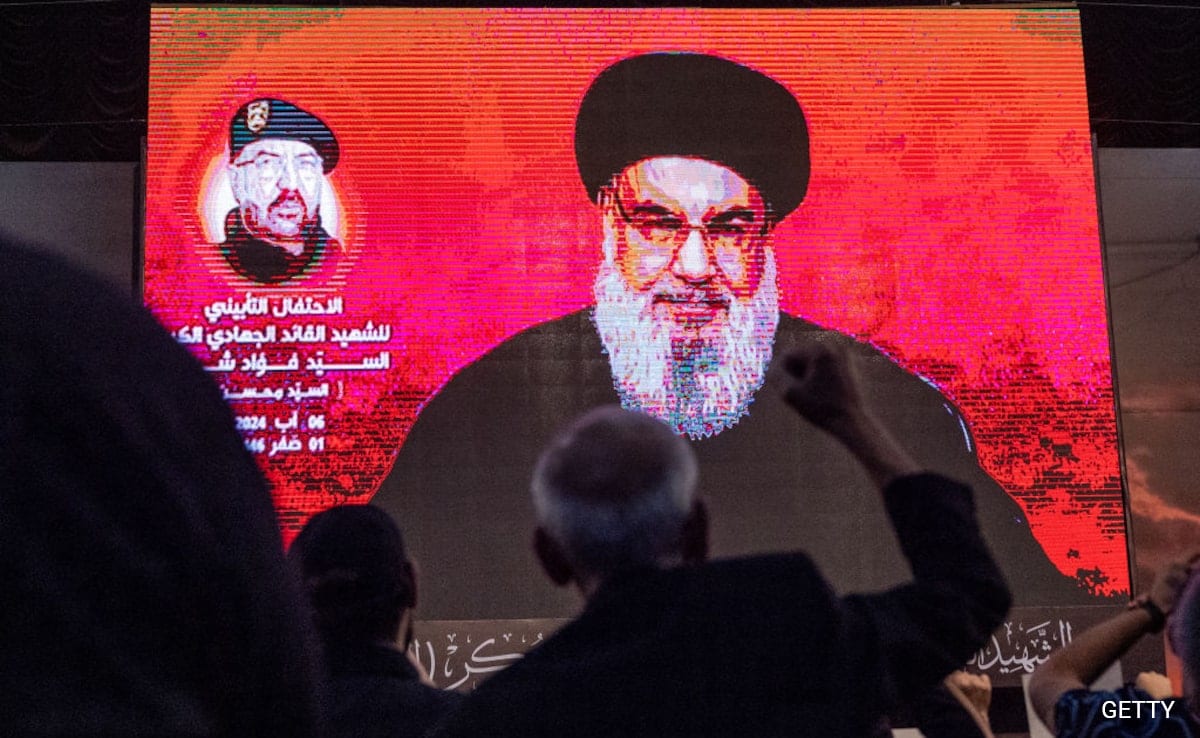
Hezbollah chief Hassan Nasrallah during one of his televised speeches.
Photo Credit: Getty
“Hezbollah chief Hassan Nasrallah does not hold any public office, but he is the de facto ruler of Lebanon. He rules by televised speech. The rest of the state (even when there was a president and prime minister), learn the fate of their country and tailor their policies in accordance with what they hear Nasrallah saying,” Mr Abdul-Hussain told NDTV.
Hezbollah’s Role In Lebanese Government
The group has successfully infiltrated various branches of the Lebanese government and security apparatus, ensuring its interests are safeguarded.
“Hezbollah started in 1982 during Israel’s occupation of Beirut, splitting from the original Shia militia, Amal, which was more secular. Amal and Hezbollah fought for turf but ultimately came to a living arrangement since both of them were pro-Syria,” said Nizar Farsakh, lecturer at the Elliott School of International Affairs at George Washington University in Washington DC, told NDTV.
“While both were active in the resistance, having been part of the Palestine Liberation Organization (PLO) militias before getting formed, Hezbollah took on most of the resistance, effectively monopolising it by the end of the 1990s,” he added.
Israeli forces invaded Lebanon in 1982.
Photo Credit: Getty
Hezbollah gained widespread recognition in the 2000s when Israel unilaterally withdrew from Lebanon after years of resistance. This victory was historic, marking the first time an Arab military force successfully forced Israel out of occupied territory, unlike Egypt’s success, which came through diplomacy rather than combat. The triumph elevated Hezbollah’s status not only in Lebanon but across the Arab and Muslim worlds, where it became a symbol of resistance against Israeli aggression.
“Coupled with very strong relations with Iran and Syria, it got flooded with weapons and got extensive training in addition to creating a very well-oiled political movement that was theocratically totalitarian,” Mr Farsakh explained.
The 2006 Lebanon War further solidified Hezbollah’s role as a key player in the region. Although Israel inflicted severe damage on Lebanon’s infrastructure, Hezbollah’s ability to hold off the Israeli Defense Forces (IDF) for over a month was seen as a success by many in the Arab world.
Hezbollah’s power was again demonstrated in 2008 when the anti-Syrian camp in Lebanon attempted to dismantle its separate telecommunications network, sparking a brief conflict. Hezbollah quickly asserted its dominance, establishing itself as the de facto military power in Lebanon. This marked a turning point, showing that no force in Lebanon could challenge Hezbollah’s authority.
“Some Hezbollah members are MPs and some are cabinet ministers. And while Lebanon has a mostly non-sectarian professional army, it does not challenge Syria nor Hezbollah, and the two coordinate to ensure they co-exist without clashes. Some Lebanese feel that even the army is controlled by Hezbollah. Therefore, nothing happens in Lebanon that Hezbollah is not on board with,” Mr Farsakh told NDTV.
Hezbollah vs Lebanese Armed Forces
The last Lebanese security official who dared to defy Hezbollah, Brigadier General Wissam al-Hassan, was assassinated after exposing the armed group’s role in the 2005 assassination of Prime Minister Rafic Hariri. al-Hassan was the chief of Lebanon’s intelligence agency and a leading Sunni figure in the country. In 2012, al-Hassan was killed along with seven others in a massive car bombing that also injured 80 others.
Former Lebanon Prime Minister Rafic hariri with ex US President George Bush at the White House.
Photo Credit: Getty
The Lebanese security agencies, riddled with Hezbollah loyalists, are often seen as mere extensions of Hezbollah’s influence rather than independent state bodies.
“Hezbollah is multifold and more powerful than the Lebanese Armed Forces (LAF). Hezbollah also infiltrates the LAF and other security agencies by planting its loyalists at high levels. These security agencies do Hezbollah’s bidding, and never go against it,” said Mr Abdul-Hussain.
Since the 1989 Taif Agreement, which ended the Lebanese civil war, the LAF’s role has increasingly been to counter Hezbollah’s narrative that it alone can defend Lebanon against external threats. This is particularly evident in the context of US military aid to the LAF, which has totalled over $2.29 billion since 2005.
Political Stalemate: A Vacant Presidency
Currently, Lebanon’s presidential post is vacant, which is emblematic of the country’s political paralysis. The two main contenders for the presidency – Gebran Bassil and Suleiman Frangieh – are both allied with Hezbollah, but the group has refrained from endorsing either candidate to avoid alienating one faction of its support base.
“The anti-Hezbollah parliamentary opposition has its own candidates, but even if it manages to get the majority of the vote, Hezbollah breaks the session midway. The speaker of the Lebanese assembly, Nabih Berri, is Shia like Hezbollah and heads the Amal movement, a Hezbollah ally,” said Mr Abdul-Hussain.
Lebanon’s government is thus paralysed, unable to elect a president or move forward on critical national issues. This paralysis is compounded by an economic crisis that has seen the country’s currency collapse and basic services like electricity and water cut off for weeks at a time. Yet Hezbollah, impervious to the country’s plight, continues to prepare for potential conflicts, such as a war with Israel, as seen in its support for Hamas during recent regional tensions.
“Iran has replicated its model in Lebanon in which two states are expected to coexist: A weak official state, usually elected, and a strong shadow state, unelected but holding the reigns of power through non-state militias that report to a cleric Supreme Leader. In Iran, the shadow state dictates routine elections. In Lebanon, Hezbollah always balances out the degree of dictation and the will of its oligarch allies. Since Hezbollah is allied with many oligarchs, and since many of them have competing interests, whenever there is a deadlock, the Iran-backed militia refrains from intervening,” Mr Abdul-Hussain explained.
Main Drivers Of Conflict
Hezbollah’s position as the dominant force in Lebanese politics shows no signs of weakening, despite economic pressures and dwindling financial resources due to cuts in Iranian funds and US sanctions. The U.S. considers Hezbollah not only a regional threat but a global one, labelling it a transnational criminal organization due to its extensive network of sleeper cells across continents.
However, the idea that Lebanon could see a significant shift away from Hezbollah’s control seems unlikely. Mr Abdul-Hussain argues that the chances of a full-blown conflict between the LAF and Hezbollah are slim, as the army command has already ruled out initiating such a conflict due to the heavy human and political toll it would take. Instead, the focus remains on containing Hezbollah’s influence within Lebanon through economic and political pressure.
“Two trends have been competing in Lebanon since its independence in 1948. The Christian-led bloc demands Lebanese regional neutrality and openness to the West. The Muslim-led bloc insists that Lebanon should be involved in regional conflicts, such as fighting for the liberation of Palestine. This fault line caused a civil war in 1975, which only ended when Muslims committed that Lebanon would become neutral. Hezbollah never agreed to this arrangement and as it took over the country in 2008, has proven it,” Mr Abdul-Hussain said.
Potential Full-Blown War With Israel
Ever since Hezbollah, and Iran, entered Israel’s ongoing conflict with Hamas in Gaza, frequent skirmishes along the Israel-Lebanon border have resulted in multiple deaths on both sides.
On August 25, Hezbollah and Israel both announced large-scale military operations against each other today. According to a statement from Hezbollah, “more than 320” Katyusha rockets were launched, targeting key Israeli military sites.
In response to the threat, the Israeli military initiated pre-emptive strikes on targets in Lebanon. The IDF announced these strikes early Sunday, stating that they had detected preparations by Hezbollah for “large-scale” attacks on Israeli territory. Israeli Air Force fighter jets were deployed to neutralise these threats, focusing on Hezbollah positions that posed an immediate danger to Israeli civilians.
But is Hezbollah, backed by Iran, ready for a full-scale battle with Israel, backed by the US?
“Lebanon will be destroyed and Iran will not enter the war. Iran will only fight if Israel goes after the Iranian nuclear facilities,” Mr Abdul-Hussain claimed.
Mr Farsakh believes that the general Israeli population fears any escalation with Hezbollah given how the Israeli military is fighting Hamas, considering it is a group that is ten times smaller than Hezbollah in both personnel and equipment.
“Literally no one but Benjamin Netanyahu and his coalition want a regional war. Iran, Hezbollah, and the US are all doing their best to avert any escalation,” he claimed. “But Netanyahu has been provoking both by killing very senior military and political figures in Iran and Lebanon. Particularly, military commanders with battle experience fighting in Syria. By eliminating enough of them, Israel would weaken Hezbollah’s command and control structure as well as strategic capacity. Making a land invasion a bit less difficult for Israel. Netanyahu is trying to soften them up as much as possible before the inevitable ground war.”