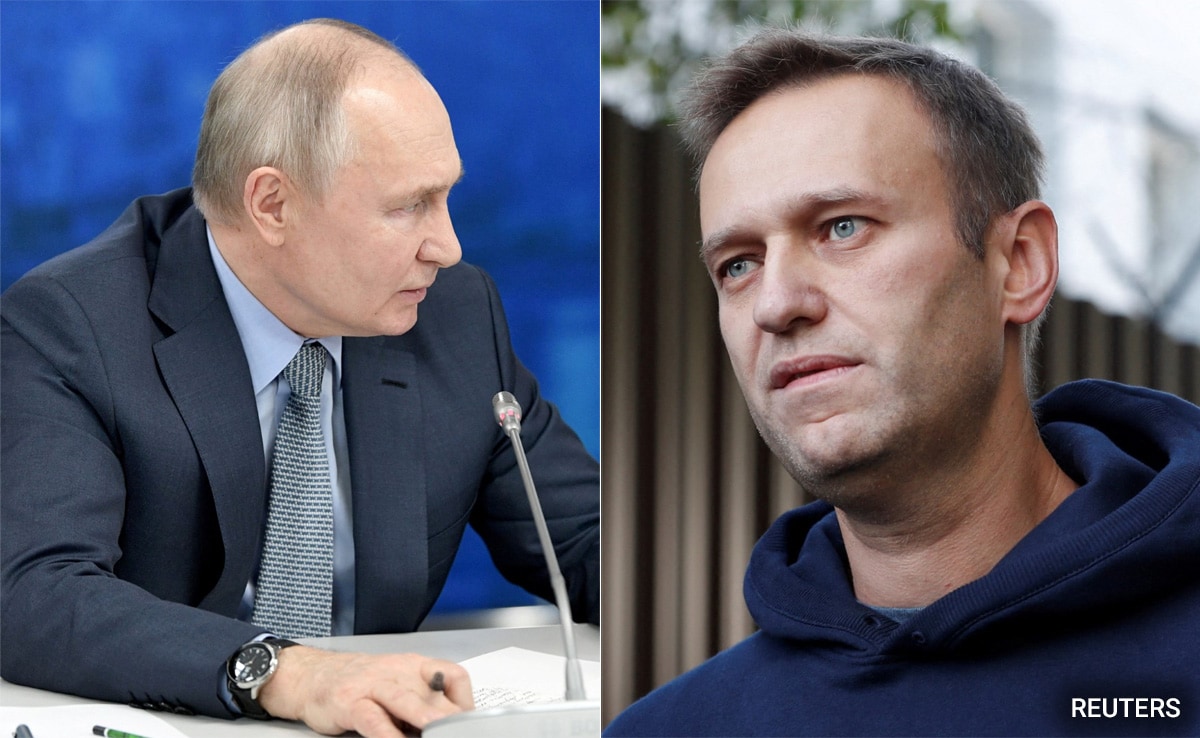
Alexey Navalny’s death removes the most prominent opponent of President Vladimir Putin, and sends another unmistakable signal of the dangers of standing up to the Russian leader’s increasingly repressive regime.
Ever since he rose to international prominence in massive pro-democracy protests in Russia in 2011-2012, it was evident to both the Kremlin and Putin’s opponents that the charismatic and witty Navalny had the potential to become a serious political challenge.
It was equally clear that Navalny was living on borrowed time after he returned to Russia in early 2021 and defied warnings of imprisonment.
Navalny’s death had been confirmed in an “official message” to his mother, said Kira Yarmysh, his spokesperson, on the X social media platform and in a video statement on Saturday.
The fate of the opposition activist follows a fatal plane crash that killed Wagner mercenary group leader Yevgeny Prigozhin last year. Prigozhin, who became a hero to Russian nationalists for his part in fighting in Ukraine, was reported killed in August, exactly two months after leading a mutiny against the Defense Ministry’s leadership that spiraled into the biggest threat to Putin’s nearly quarter-century rule.
The two incidents serve to remove figures who publicly opposed Putin, though from very different perspectives. That alone sends a powerful message to Russians and to the world as the second anniversary nears of Putin’s full-scale invasion of Ukraine that triggered a wave of sanctions and prompted the US and its allies to supply weaponry to Kyiv.
Navalny’s death was announced on the eve of official campaigning for the March 17 presidential election in which Putin is seeking a fifth term. Government leaders quickly accused the Kremlin and some directly blamed Putin, the former KGB officer who’s on course to equal Soviet tyrant Josef Stalin’s record term as ruler in Moscow.
Russian authorities have yet to disclose a cause of death, saying Navalny felt unwell after a walk and lost consciousness. Just a day earlier, he’d appeared on video from prison at a court hearing, joking cheerfully with officials.
Putin was so hostile to Navalny that he refused to use his name when reporters asked questions about the activist, a trend followed by Kremlin spokesperson Dmitry Peskov. Russian state television, which for years had banned any mention of Navalny, briefly reported his demise.
With relations between Russia and the West already largely severed over Putin’s attack on Ukraine on Feb. 24, 2022, it’s unclear if US and European condemnation of Navalny’s death will turn into more concrete penalties against the Kremlin.
Friends and allies of Navalny had worried constantly for his safety in prison as the Kremlin engaged in the biggest crackdown on dissent in decades to crush opposition to the war.
That concern intensified when Navalny, 47, was transferred to a remote Arctic prison colony, IK-3, in late December from a jail outside Moscow. In his last post on X, formerly Twitter, on Feb. 14, he reported that he’d been sentenced to 15 days in a punishment cell for the fourth time since he’d arrived there.
He’d been advocating from prison on social media for a nationwide protest during the presidential election, encouraging people to arrive at polling stations at exactly midday to vote against Putin. Navalny had also condemned the invasion of Ukraine.
His death is the latest in a string of incidents involving leading critics of the Kremlin.
Boris Nemtsov, a former deputy prime minister, was assassinated in Moscow within sight of the Kremlin walls in February 2015. Campaigning journalist Anna Politkovskaya was shot dead in the lift of her Moscow apartment building on Putin’s birthday in October 2006.
Vladimir Kara-Murza, another prominent opposition figure sentenced to 25 years for treason in April after he condemned the invasion of Ukraine, has accused the Russian authorities of twice poisoning him in the past.
In his early years at least, Navalny courted controversy by reaching out to nationalist elements who were hostile to the Kremlin as well as to foreigners and minorities. Navalny justified the ties by arguing he was trying to build a broad coalition against Putin, but many liberal activists remained suspicious of him.
Fearless and Internet-savvy, Navalny gained a huge online following in Russia with investigations exposing corruption at state companies and among top officials, using social media posts to bypass the blackout on state television. In January 2021, he caused a storm with a video exposing a lavish $1.3 billion Black Sea palace that he said was built for Putin.
The video, which has been viewed more than 129 million times on YouTube, was released after Navalny was detained when he returned to Russia from Germany, where he’d been treated for a nerve-agent poisoning in Siberia in 2020 that he and the West blamed on the Kremlin. Russia denied involvement.
Later that year, Russia outlawed Navalny’s nationwide network of campaign groups as “extremist,” forcing activists to disband and many to flee abroad. Navalny himself was suffering from worsening health in prison and looked gaunt at court hearings after spending 24 days on hunger strike to demand better medical care.
The fate of the opposition leader and his movement, made up of mostly young professionals, contrasted starkly with the early optimism of the massive protests in 2011-2012 against Putin’s return to the presidency in place of Dmitry Medvedev. The Kremlin crackdown that had followed failed to dim their determination.
When Navalny was unexpectedly allowed to contest Moscow mayoral elections in September 2013, following widespread protests in support of his release from detention, he came within a whisker of forcing a run-off against Sergei Sobyanin, the incumbent Putin ally. He got 27% against 51% for Sobyanin.
That was the last time Navalny was permitted to run. When he mounted a campaign to challenge Putin in the 2018 presidential election, officials barred him from the ballot because of a fraud conviction that Navalny, the US, and the European Union had criticized as politically motivated.
“Navalny was essentially killed when he was arrested years ago,” said Thad Troy, managing director of Crumpton Global and a former CIA officer in Moscow. “It’s an inevitable next step for Putin to strengthen his hold over Russia.”
In prison, Navalny continued his defiance of Putin. He also disclosed that he’d developed a belief in God after years of atheism, surprising many of his supporters.
“Our country is built on injustice. But tens of millions of people want the truth,” he told a court during a failed 2021 appeal hearing. “And sooner or later they’ll get it.”
(Except for the headline, this story has not been edited by NDTV staff and is published from a syndicated feed.)