onmynews.com
OnMyNews.com
Live · Global · Independent
Live Feeds


onmynews.com
Why Israel’s Ground Invasion Of Gaza Is Delaying
Israel has not launched a ground invasion of Gaza, despite announcing its imminence, a delay media reports and experts attribute to international pressure, political-military divisions and concerns over hostages.
Eighteen days after the deadliest attack ever launched into Israel by the Palestinian Islamist movement Hamas that rules Gaza, the Israeli military is relentlessly pounding the territory.
But apart from some relatively minor incursions, the much-vaunted land offensive has not been unleashed.
“There’s a crisis of confidence between (Israeli Prime Minister) Benjamin Netanyahu and the IDF (army),” noted editorial writer Nahum Barnea in the daily Yedioth Ahronoth.
“The government is having difficulties taking decisions that everyone agrees on about the top issues,” he wrote.
According to government and military sources cited by Barnea, “Netanyahu is angry at the generals and blames them for what happened” during what Israelis are calling “the October 7 fiasco”.
On that day, the country was left stunned after Hamas militants stormed across the Gaza border and went on a rampage that Israeli officials say has killed more than 1,400 people.
They also snatched more than 220 hostages in the worst-ever attack in Israel’s history, which has prompted a ferocious Israeli bombardment of Gaza which Hamas officials say has killed 5,791 people.
Unanimity has brought together the left and right wings of mainstream Israeli politics.
“Disputes over these operations are creating tensions, especially between Prime Minister Benjamin Netanyahu and Defence Minister Yoav Gallant,” wrote columnist Amos Harel in Tuesday’s left-leaning Haaretz daily.
State radio noted “dissent between the premier and senior ranks in the military”, with mutual accusations of failing to prevent the bloody attack by Hamas militants.
– ‘Mutual trust’ –
Commentators say the fact that official statements often mention convergence of views at the highest level means the opposite, revealing the artificial nature of a united front.
“The prime minister, the defence minister and the IDF chief of staff are working in close and full cooperation, around the clock, to lead the State of Israel to a decisive victory over Hamas,” said a communique on Tuesday from the Government Press Office.
“There is total and mutual trust between the prime minister, the defence minister and the IDF chief of staff; the unity of the goal is clear.”
Patrick Bettane, an intelligence specialist at Israel’s International Institute for Counter-Terrorism (ICT) think tank, confirmed “disagreement about a ground offensive”.
“But the fact that there are hostages being held in the Gaza Strip complicates everything,” he said.
“Israel is waiting to see how this problem can be resolved before it acts.”
Relatives of those seized and taken to Gaza have staged daily demonstrations outside Gallant’s home in Tel Aviv.
Akiva Eldar, an expert on Israeli politics, asserted that “after the emotions aroused by this terrible massacre, Bibi (Netanyahu) and the generals are starting to think differently”.
He said the presence in Israel of US military personnel was aimed at preventing any move that could mean the death of hostages, including Americans.
This, Eldar said, sheds new light on pledges by both Netanyahu and Gallant that Hamas will have been eradicated when the war is over.
– ‘Nice’ words –
Nevertheless, army chief Herzi Halevi repeated overnight that his aim was the complete removal of Hamas and its leaders.
“We are well prepared for the ground operations in the south,” he told troops according to a statement released by an army spokesperson.
Political analyst Daniel Bensimon said: “Disagreement or not, it’s a fact that Americans and the Europeans are coming to Israel to caress it with honeyed words with the aim of preventing a ground offensive.”
French President Emmanuel Macron on Tuesday became the latest foreign leader to visit the region and meet with Israeli premier Netanyahu.
“The international community fears a ground operation would spark a chain reaction that could engulf the whole region, and maybe even further afield,” Bensimon said.
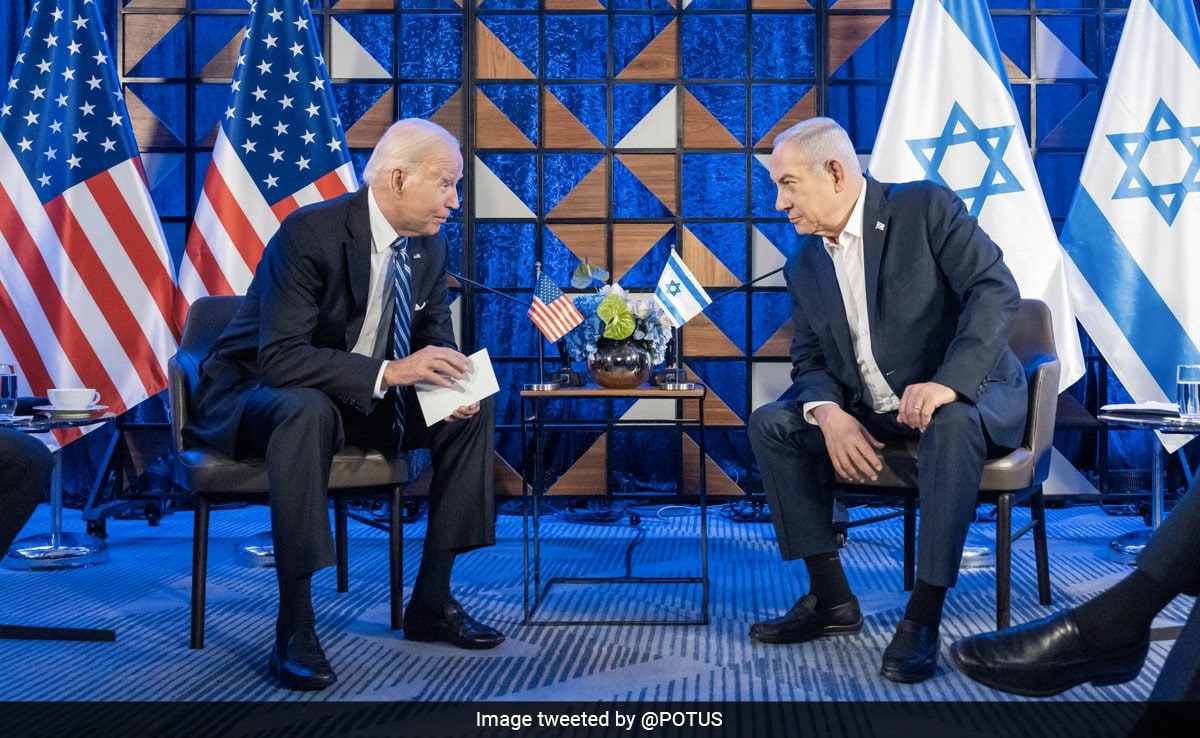
Israelis have been touched by expressions of compassion and solidarity from several leaders to visit the country over the past two weeks, including US President Joe Biden who came on October 18.
Macron told Israelis they were not alone in the “fight against these terrorist groups” but cautioned against “enlarging this conflict”.
For Bensimon, “Biden and Macron say nice things.”
“But in the end they want to stop Israel from going into Gaza and prevent Iran from becoming involved” through the Shiite Hezbollah movement, its proxy in Lebanon, he said.
onmynews.com
Biden’s Israel Stance Angers Muslim-Americans; Could Jeopardize 2024 Votes
Arab and Muslim Americans and their allies are criticizing President Joe Biden’s response to the Israel-Hamas war, asking him to do more to prevent a humanitarian crisis in Gaza or risk losing their support in the 2024 election.
Many Arab Americans accuse Biden of failing to push for any humanitarian ceasefire even as Palestinians are killed fleeing Israel’s bombardment of the Gaza Strip, more than a dozen academics, activists, community members and administration officials said.
Their growing frustration could impact Democrat Biden’s reelection bid, which opinion polls show is likely to be a rematch with the Republican frontrunner, former President Donald Trump.
In hotly contested Michigan, Arab Americans account for 5% of the vote. In other battleground states Pennsylvania and Ohio, they are between 1.7% to 2%, said Jim Zogby, president of the Arab American Institute.
Biden won Michigan with 50.6% of the vote in 2020, compared to 47.8% for Trump, and Pennsylvania with 50.01% to Trump’s 48.84%, a difference of less than 81,000 votes.
Arab and Muslim Americans are unlikely to back Trump but could sit out the election and not vote for Biden, some activists said.
“I do think it will cost him Michigan,” said Laila El-Haddad, a Maryland-based author and social activist from Gaza.
While condemning the Oct. 7 attacks by Hamas on civilians in Israel that killed 1,400 people, Arab Americans said the Israeli response was disproportionate and Biden’s failure to condemn the bombardment has many questioning his promise of a “human rights centered” foreign policy.
DEMANDS FOR POLICY CHANGE
Abdullah Hammoud, the first Arab-American mayor of Dearborn, Michigan, home to the largest Muslim per capita population in the U.S., decried Biden’s failure to condemn Israeli threats to cut off water, electricity and food for over 2 million Palestinians in Gaza.
“Nothing could have prepared us for the complete erasure of our voices and radio silence from those whom we elected to protect and represent us,” he wrote on X, formerly known as Twitter. “Our family members trapped in Gaza have been ignored, our calls for a ceasefire drowned out by the drums of war.”
Linda Sarsour, a former executive director of the Arab American Association of New York, told hundreds of attendees at a Council on American-Islamic Relations (CAIR) event on Saturday that Muslim-Americans should make any political donations contingent on a change in policies.
Many are pressuring Biden to push Israel to temporarily halt its attacks on the Gaza Strip that have killed thousands of Palestinians.
Israel’s bombing of Gaza is “now in the realm of genocide targeting the entire Palestinian population,” said CAIR, the largest Muslim civil rights group in the U.S., adding that government officials will be “complicit in the ethnic cleansing of Gaza” unless they intervene.
Biden’s push for more than $14 billion in new U.S. aid to Israel is also drawing fire.
“If you look at his rhetoric, it’s unbelievable, and now they are trying to pump billions and billions of dollars militarily into Israel, with some $100 million in humanitarian aid for the Palestinians,” said Sa’ed Atshan, a Quaker Palestinian-American who teaches peace and conflict studies at Pennsylvania’s Swarthmore College.
Even Biden’s former boss, President Barack Obama, usually a staunch backer of Biden’s policies, offered some pointed public advice on Monday, calling on the U.S. to continue leading the world “in accelerating critical aid and supplies to an increasingly desperate Gaza population.”
RESPONDING TO CRITICISM SAYS WHITE HOUSE
Biden has appointed more Arab-Americans and Muslims to political posts than any predecessor, as well as the first two Muslim federal judges, but that diversity has not impacted policy for the self-described “Zionist” President.
Some Arab American and Muslim appointees are scared of backlash and reprisals and worried about family members in the region, said one White House official, who is Arab-American.
“There are very vocal people in the administration who have concerns,” the official said. U.S. officials with family in the region are doubly stressed by the “ambassadorial” role they play as they field agitated messages from relatives and others angry at Biden’s Israel strategy.
The White House said it was aware of and responding to criticism of its policies by meeting with administration officials and community members. Biden has made forceful speeches since taking office on the need to confront Islamophobia and hate of all kinds, it said.
Biden’s chief of staff Jeff Zients and adviser Anita Dunn are meeting staffers and community members and urging cabinet secretaries to do the same, White House officials said.
National security adviser Jake Sullivan and his principal deputy Jon Finer met with Arab and Muslim American community leaders on Oct. 13, and the White House officials hosted 30 Palestinian American youth on Friday.
Secretary of State Antony Blinken acknowledged the personal difficulties some staff are facing in a Thursday letter, and met Monday with Palestinian and Arab American community leaders and Jewish American groups.
One 11-year State department veteran, the director of congressional and public affairs for its Bureau of Political-Military Affairs, Josh Paul, quit his job last week. Top officials refused to respond to his concerns about “blindly rushing lethal arms to Israel while the people of Gaza face obliteration,” he said in a posting on LinkedIn.