Live · Global · Independent
Live Feeds
PinkVilla
Forbes
NDTV
Hindustan Times
‘I Could Have Never…’: Lady Gaga Reveals Mom Cynthia Told Her She’d Marry Michael Polansky Right After They Met
onmynews.com

‘I Could Have Never…’: Lady Gaga Reveals Mom Cynthia Told Her She’d Marry Michael Polansky Right After They Met

In a candid October Vogue cover story, Lady Gaga opened up about her relationship with her fiancé, Michael Polansky, revealing that her mother, Cynthia Germanotta, had a premonition about their future together before they even met. Gaga, 38, was initially surprised by her mother’s foresight, but as their love story unfolded, it became clear that Cynthia’s instincts were spot on.

Cynthia Germanotta’s Matchmaking Role in Gaga and Polansky’s Relationship

Lady Gaga, born Stefani Germanotta, shared that her mom met Polansky through their philanthropic work and quickly predicted he would become her husband. “My mom met him and said, ‘I think I just met your husband,’” Gaga recalled. Shocked at first, the Born This Way singer admitted she wasn’t ready for such a commitment at the time. However, as fate would have it, Gaga and Polansky were introduced at Sean Parker’s birthday party in December 2019, and the connection was immediate.

A Relationship Born During the Pandemic

Gaga and Polansky’s relationship deepened during the COVID-19 pandemic, as he moved into her Malibu home for quarantine. Gaga reflected on how the downtime allowed her to focus on their relationship, saying, “I met this totally supportive, loving human being who wanted to get to know me — outside of Lady Gaga.” Polansky, a tech investor, even encouraged her to return to pop music, telling her, “Babe, I love you. You need to make pop music.”

Now engaged after five years of dating, Gaga and Polansky have kept much of their relationship private. However, the A Star Is Born actress expressed her happiness with her fiancé, saying, “He’s not with me for any other reason than that we are right for each other. I’m just, like, so happy.” Their engagement was first shared at the 2024 Paris Olympics, where Gaga performed at the opening ceremony.

ALSO READ: Joker: Folie à Deux Star Lady Gaga Reveals How She Met Her Partner Michael Polansky; ‘We Had The Most Amazing…’

Read full article
Visfot Movie Review: Itâs a morality play with noir elements
onmynews.com

Visfot Movie Review: Itâs a morality play with noir elements

Visfot, meaning “explosion” in Hindi, plunges viewers into a slow-burning Mumbai noir experience that mirrors the gritty style of producer Sanjay Gupta’s directorial pedigree. Directed by Kookie Gulati, this Hindi remake of the Venezuelan film Rock, Paper, Scissors (2012) immerses us in the dark and contrasting realities of Mumbai’s underbelly. The film begins with a high-stakes premise: Shoeb Khan (Fardeen Khan), a down-to-earth taxi driver from Dongri, inadvertently misplaces a jacket stuffed with drugs belonging to a dreaded female don, Tai (Seema Biswas). Meanwhile, Akash (Riteish Deshmukh), an airline pilot, finds his world turning upside down when he discovers his wife Tara (Priya Bapat) is having an affair. As the day unfolds, a seemingly simple error spirals into a high-stakes, chaotic mess. Shoeb’s misplaced jacket triggers a deadly chain reaction, intertwining his fate with Akash’s as both men are pulled into a treacherous game involving the ruthless mafia, corrupt police, and their unsuspecting families. The narrative builds on the intersection of their lives, revealing how their individual crises converge into a dramatic confrontation with fate, exposing the vulnerabilities and moral ambiguities.

Despite its intense premise, the film struggles to sustain its gripping momentum after a while. The editing is at fault here. The hook points of the plot are not synced the way they should have been and that totally jars the viewer’s attention. The film hints towards a bloody climax and when it happens, you see so many bodies falling down that it borders on the ridiculous. And mind you, our two heroes do manage to not get killed amidst the melee. But then, that’s always been the norm in Hindi films and the director was just following tradition.

Sheeba Chadha delivers a standout performance as Fardeen’s mother, whose grief-stricken portrayal elevates the film to new heights. Her powerful depiction of a woman overwhelmed by the loss of her husband is deeply moving. Seema Biswas also makes a memorable impact with her hauntingly nuanced portrayal of the female don, Tai. It takes some doing seeing Fardeen as a Dongi lad but once he gets into the groove, he wins you over with his sincere effort. He manages to capture his character’s desperation and makes Shoeb sound real. Riteish Deshmukh adds significant depth to Akash, skillfully conveying both vulnerability and inner conflict. He’s the very picture of a father whose heart belongs to his son. This was supposed to be Fardeen Khan’s comeback vehicle, before Heera Mandi and Khel Khel Mein, where he played a nawab and a gay man respectively. He’s surely showcasing his versatility, what with playing a reformed thug here. Riteish Deshmukh is as reliable as ever and has shown that there’s more to his repertoire than comedy. One can sense that Akash would go to any length for the safe return of his son. Priya Bapat’s portrayal of Tara effectively conveys the tragedy of a conflicted relationship. Though she loves her son and respects her husband, there’s no love remaining between them anymore, forcing her to take a lover and Priya brings all these layers into her performance with aplomb. Krystle D’Souza brings a captivating charm to Lucky. She’s the good girl caught in the wrong place with the wrong man and much could have been made of her struggles. Sadly, her role seems somewhat underwritten.

Visfot is a thriller but it is also a morality tale of sorts, pitting human greed against love and innocence. The universal appeal of the story gets somewhat dimmed due to the uneven execution. The film, which was initially set for a theatrical release, was released without any fanfare on Jio Cinema. It remains true to the original in most parts and would remind you of the Guy Ritchie brand of films. Kookie Gulati is no Guy Ritchie though he comes close to being Sanjay Gupta 2.0.

Read full article
Video: Ukraine’s ‘Dragon Drone’ Rains Molten Metal On Russian Positions
onmynews.com

Video: Ukraine’s ‘Dragon Drone’ Rains Molten Metal On Russian Positions

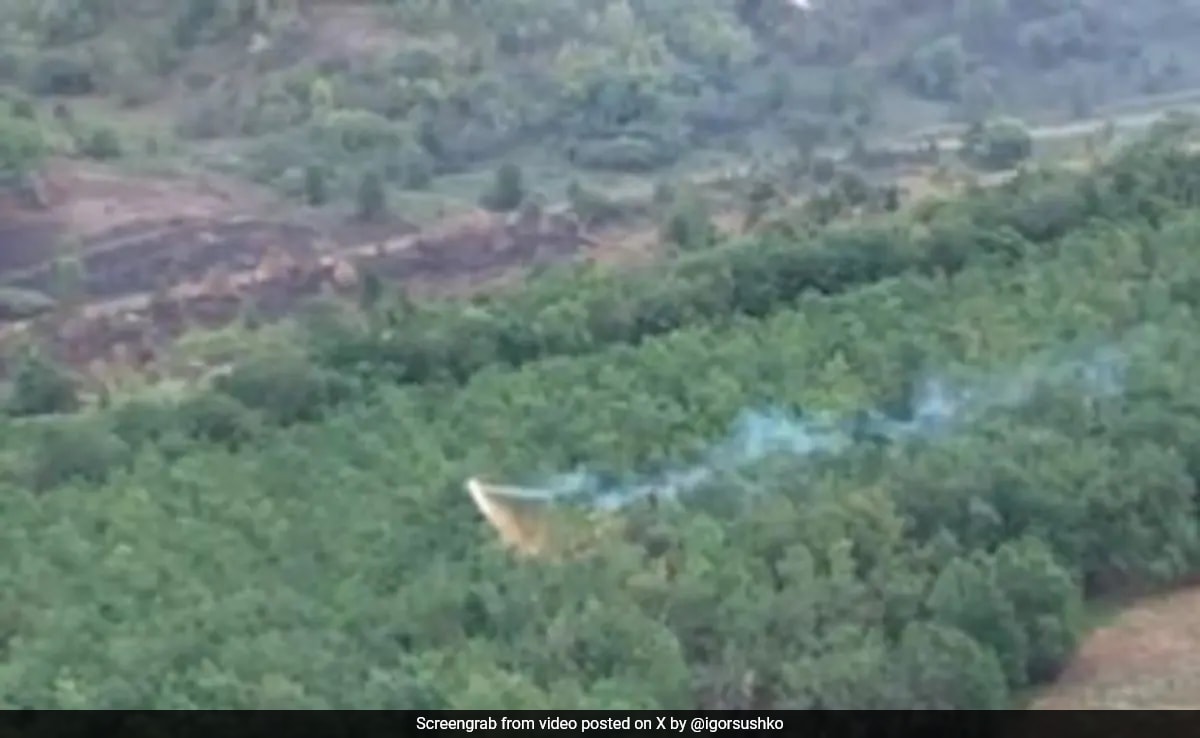
Fire rained on Russian-held positions in the occupied Kharkiv region when Ukrainian drones dropped thermite incendiary bombs, burning trees and reportedly some Russian military vehicles. Footages of fire-spewing ‘Dragon Drone’ have emerged on various Telegram channels.

A Telegram channel named Khorne Group shared the undated footage of a low-flying drone dropping thermite – A mixture of aluminium powder and iron oxide that burns at a very high temperature. The molten metal can quickly burn trees, fortifications and metals, rendering military vehicles, and armour useless.

The 60th Mechanized Brigade of Ukraine shared drone footage of the thermite bombing and said, “Strike Drones are our wings of vengeance, bringing fire straight from the sky! They become a real threat to the enemy, burning his positions with an accuracy that no other weapon can achieve. When our “Vidar” works – the Russian woman will never sleep.” These weapons are considered one the most dangerous in the world.

Vidar is associated with the god of vengeance in Scandinavian mythology.

The Ukrainian military began using the Dragon drone, which burns the area underneath with thermite 🥰🥰🥰 Thermite is a mixture of burning granules of iron oxide and aluminum. About 500 grams of thermite mixture can be placed under a standard FPV drone. The chemical reaction is… pic.twitter.com/3XIzc3LLHN

— Anastasia (@Nastushichek) September 5, 2024

The use of incendiary bombs – munitions that are designed to cause fire – has brought focus on their potential use on civilian populations, and establishments apart from the military. In 2023, Russia used thermite bombs over the eastern Ukrainian town of Vuhledar after the defeat in a tank battle. The Russians spew thermite over the border town.

The Russians reportedly used 122mm Grad 9M22S rockets launched from the Soviet-era B-21 multi-rocket launcher system with a thermit warhead.

Several videos have emerged where Russian and Ukrainian troops have used such weapons on the frontline. Thermite, unlike conventional bombs that rely on a blast effect, generated intense heat. It is widely used in welding steel, iron, and railway tracks.

“The widespread use of thermite bombs increases the likelihood of these weapons being deployed in populated areas. The result could be catastrophic, with horrific injuries and loss of life among civilians,” Dr Iain Overton, Executive Director of Action on Armed Violence (AOAV), a British advocacy group, said.

Ignition of thermite is slow and it requires very high temperature to ignite. These temperatures cannot be reached with conventional black powder fuses or nitrocellulose rods. They are often achieved by Magnesium metal strips that are used as fuses.

Use Of Incendiary Bombs In The Past

World War I was witness to incendiary weapons when Germans and the Allied troops used such munitions against their adversary. The American Thermite Hand Grenade Mark I and the French Model 1916 incendiary grenades were weapons used during World War 1.

The Germans developed B1.3E, 1938, incendiary bombs just before World War 2. The Luftwaffe (German Air Force) used it extensively to bomb British cities. The Imperial War Museum said, “During 1940-41, the Luftwaffe caused serious damage by dropping large quantities of incendiary bombs on British towns and cities, either using containers that were carried on bomb racks and released to open at a predetermined point, or from very large containers holding up to 700 bombs that remained on the aircraft.”

A German B1E 1 kg incendiary aircraft bomb
Photo Credit: Image credit: Imperial War Museum © IWM (MUN 3291)

The Allied troops used Napalm – a flammable mixture of gasoline and a gelling agent – for bombings and throwing flames. The US used Napalm to target Japanese cities. Almost 60% of Tokyo was burnt during the Napalm bombings. It has been massively used since its creation in 1942.

During the Vietnam War, the use of Napalm and The Dow Chemical Company which produced it, caught the world’s attention on how dangerous such weapons when unleashed on civilians which caused severe burns.

International Regulations On Use Of Incendiary Weapons

Efforts to address the issue of incendiary weapons started in the 1970s, notably with a growing concern over the use of napalm. In 1972, the UN General Assembly adopted a resolution referring to incendiary weapons as ‘a category of arms viewed with horror’.

In 1980, the Convention on Prohibitions or Restrictions on the Use of Certain Conventional Weapons Which May Be Deemed to Be Excessively Injurious or to Have Indiscriminate Effects was adopted with the aim to ban or restrict the use of certain types of weapons considered to cause unnecessary or unjustifiable suffering to combatants or to indiscriminately affects civilians.

The Protocol on prohibitions or restrictions on the use of incendiary weapons (Protocol III) aims at protecting civilians and civilian objects from the use of this type of weapons. It prohibits targeting civilians and restricts targeting military objects located within populated areas. The Protocol also prohibits the use of incendiary weapons on forest or other plants unless the vegetation is used to conceal military objects.

Read full article
Link copied!