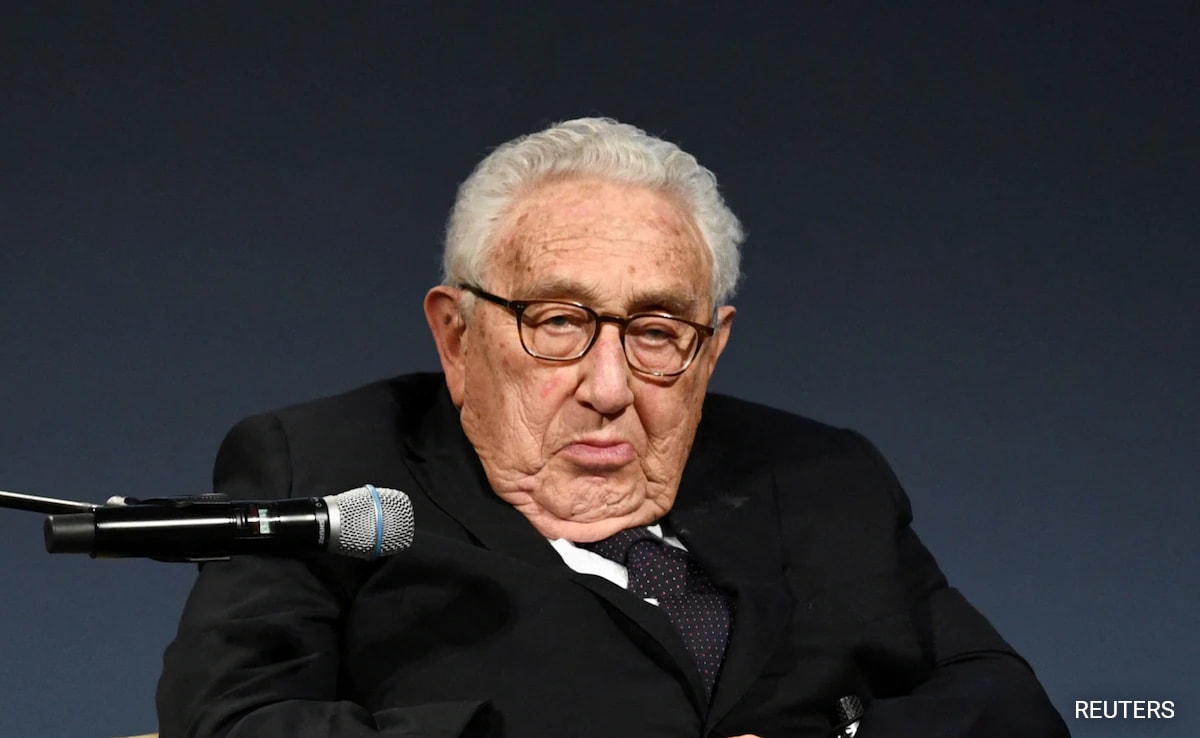
Henry Kissinger, a controversial Nobel Peace Prize winner and diplomatic powerhouse whose service under two presidents left an indelible mark on U.S. foreign policy, died on Wednesday, according to Kissinger Associates Inc.
Kissinger died at his home in Connecticut, Kissinger Associates said.
Kissinger had been active past his centenary, attending meetings in the White House, publishing a book on leadership styles, and testifying before a Senate committee about the nuclear threat posed by North Korea. In July 2023 he made a surprise visit to Beijing to meet Chinese President Xi Jinping.
In the 1970s, he had a hand in many of the epoch-changing global events of the decade while serving as secretary of state under Republican President Richard Nixon. The German-born Jewish refugee’s efforts led to the diplomatic opening of China, landmark U.S.-Soviet arms control talks, expanded ties between Israel and its Arab neighbors, and the Paris Peace Accords with North Vietnam.
Kissinger’s reign as the prime architect of U.S. foreign policy waned with Nixon’s resignation in 1974. Still, he continued to be a diplomatic force under President Gerald Ford and to offer strong opinions throughout the rest of his life.
While many hailed Kissinger for his brilliance and broad experience, others branded him a war criminal for his support for anti-communist dictatorships, especially in Latin America. In his latter years, his travels were circumscribed by efforts by other nations to arrest or question him about past U.S. foreign policy.
His 1973 Peace Prize – awarded jointly to North Vietnam’s Le Duc Tho, who would decline it – was one of the most controversial ever. Two members of the Nobel committee resigned over the selection and questions arose about the U.S. secret bombing of Cambodia.
Ford called Kissinger a “super secretary of state” but also noted his prickliness and self assurance, which critics were more likely to call paranoia and egotism. Even Ford said, “Henry in his mind never made a mistake.”
“He had the thinnest skin of any public figure I ever knew,” Ford said in an interview shortly before his death in 2006.
With his dour expression and gravelly, German-accented voice, Kissinger was hardly a rock star but had an image as a ladies’ man, squiring starlets around Washington and New York in his bachelor days. Power, he said, was the ultimate aphrodisiac.
Voluble on policy, Kissinger was reticent on personal matters, although he once told a journalist he saw himself as a cowboy hero, riding off alone.
HARVARD FACULTY
Heinz Alfred Kissinger was born in Furth, Germany, on May 27, 1923, and moved to the United States with his family in 1938 before the Nazi campaign to exterminate European Jews.
Anglicizing his name to Henry, Kissinger became a naturalized U.S. citizen in 1943, served in the Army in Europe in World War Two, and went to Harvard University on scholarship, earning a master’s degree in 1952 and a doctorate in 1954. He was on Harvard’s faculty for the next 17 years.
During much of that time, Kissinger served as a consultant to government agencies, including in 1967 when he acted as an intermediary for the State Department in Vietnam. He used his connections with President Lyndon Johnson’s administration to pass on information about peace negotiations to the Nixon camp.
When Nixon’s pledge to end the Vietnam War won him the 1968 presidential election, he brought Kissinger to the White House as national security adviser.
But the process of “Vietnamization” – shifting the burden of the war from the half-million U.S. forces to the South Vietnamese – was long and bloody, punctuated by massive U.S. bombing of North Vietnam, the mining of the North’s harbors, and the bombing of Cambodia.
Kissinger declared in 1972 that “peace is at hand” in Vietnam but the Paris Peace Accords reached in January 1973 were little more than a prelude to the final Communist takeover of the South two years later.
In 1973, in addition to his role as national security adviser, Kissinger was named secretary of state – giving him unchallenged authority in foreign affairs.
An intensifying Arab-Israeli conflict launched Kissinger on his first so-called “shuttle” mission, a brand of highly personal, high-pressure diplomacy for which he became famous.
Thirty-two days spent shuttling between Jerusalem and Damascus helped Kissinger forge a long-lasting disengagement agreement between Israel and Syria in the Israeli-occupied Golan Heights.
In an effort to diminish Soviet influence, Kissinger reached out to its chief communist rival, China, and made two trips there, including a secret one to meet with Premier Zhou Enlai. The result was Nixon’s historic summit in Beijing with Chairman Mao Zedong and the eventual formalization of relations between the two countries.
STRATEGIC ARMS ACCORD
The Watergate scandal that forced Nixon to resign barely grazed Kissinger, who was not connected to the cover-up and continued as secretary of state when Ford took office in the summer of 1974. But Ford did replace him as national security adviser in an effort to hear more voices on foreign policy.
Later that year Kissinger went with Ford to Vladivostok in the Soviet Union, where the president met Soviet leader Leonid Brezhnev and agreed to a basic framework for a strategic arms pact. The agreement capped Kissinger’s pioneering efforts at detente that led to a relaxing of U.S.-Soviet tensions.
But Kissinger’s diplomatic skills had their limits. In 1975, he was faulted for failing to persuade Israel and Egypt to agree to a second-stage disengagement in the Sinai.
And in the India-Pakistan War of 1971, Nixon and Kissinger were heavily criticised for tilting toward Pakistan. Kissinger was heard calling the Indians “bastards” – a remark he later said he regretted.
Like Nixon, he feared the spread of left-wing ideas in the Western hemisphere, and his actions in response were to cause deep suspicion of Washington from many Latin Americans for years to come.
In 1970 he plotted with the CIA on how best to destabilize and overthrow the Marxist but democratically-elected Chilean President Salvador Allende, while he said in a memo in the wake of Argentina’s bloody coup in 1976 that the military dictators should be encouraged.
When Ford lost to Jimmy Carter, a Democrat, in 1976, Kissinger’s days in the suites of government power were largely over. The next Republican in the White House, Ronald Reagan, distanced himself from Kissinger, who he viewed as out of step with his conservative constituency.
After leaving government, Kissinger set up a high-priced, high-powered consulting firm in New York, which offered advice to the world’s corporate elite. He served on company boards and various foreign policy and security forums, wrote books, and became a regular media commentator on international affairs.
After the Sept. 11, 2001, attacks, President George W. Bush picked Kissinger to head an investigative committee. But outcry from Democrats who saw a conflict of interest with many of his consulting firm’s clients forced Kissinger to step down from the post.
Divorced from his first wife, Ann Fleischer, in 1964, he married Nancy Maginnes, an aide to New York Governor Nelson Rockefeller, in 1974. He had two children by his first wife.
(This story has not been edited by NDTV staff and is auto-generated from a syndicated feed.)