Live · Global · Independent
Live Feeds
PinkVilla
Forbes
NDTV
Hindustan Times
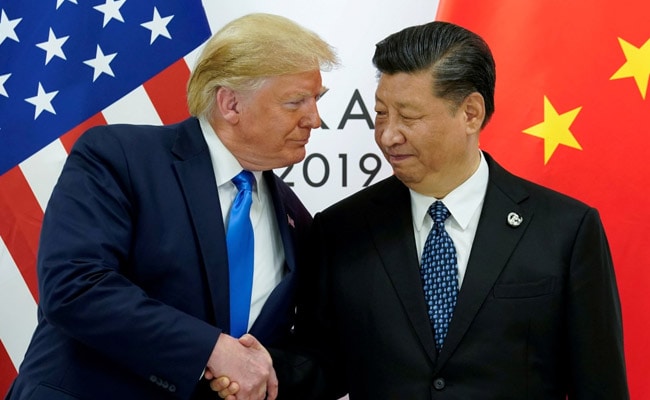
An Invitation, A Rejection, Now What? Trump And Xi Jinping Play Mind Games
onmynews.com

An Invitation, A Rejection, Now What? Trump And Xi Jinping Play Mind Games

Sun Tzu, A Chinese military general, strategist, and philosopher who lived approximately in the 5th Century BC, is best known for his famous book ‘The Art Of War’. In it, he wrote a proverb well-known to the world even today – “Keep your friends close, but your enemies closer”. US President-elect Donald Trump seems to have taken a leaf out of Sun Tzu’s book when he invited Chinese President Xi Jinping to his inaugural ceremony in Washington DC scheduled for January 20th.

President Xi, who perhaps is also familiar with Sun Tzu works, read right through Donald Trump’s invite and has politely declined it, as per the latest reports.

Donald Trump’s unprecedented decision to invite the Chinese President astonished officials in Washington and many others beyond. “A foreign leader has never attended the inauguration of a US President,” said the US State Department after hours of looking up official records dating back to 1874.

“It is, however, common for Ambassadors and other diplomats to attend the President’s swearing-in ceremony,” the US State Department added.

Amid all the hustle and bustle  at the White House – and chaos behind the scenes – Donald Trump’s spokesperson Karoline Leavitt decided to give an interview to Fox News. Confirming the invite to Xi Jinping, Ms Leavitt said “This is an example of President Trump creating an open dialogue with leaders of countries that are not just allies but our adversaries and our competitors too.”

She also said that an invite for Donald Trump’s oath taking ceremony was sent to several other foreign leaders besides just Xi Jinping, but did not reveal who they were. It is not known yet if these “other invites” were sent on the same day as the one extended to Xi Jinping, or after Washington learnt about the Chinese President’s decision not to attend.

Meanwhile, on the other side of the planet, officials in Beijing have remained tight-lipped over the issue. President Xi though, had, as recently as Tuesday, warned Washington about the expected tariff, trade, and tech wars once Trump becomes President. Expecting economic trouble in the weeks and months ahead, President Xi held a crucial meeting with heads of 10 major international organisations, including the World Bank, the International Monetary Fund, and World Trade Organisation (WTO) in Beijing.

There will be no winners,” he cautioned the United States in his speech at that meeting while he spoke about tariff hikes, tech-bans, and trade clampdowns that Donald Trump has vowed to impose on China once he takes charge.

With such war of words and aggressive posturing by both Trump and Xi, the former’s decision to invite the Chinese President for his inauguration ceremony does indeed seem both misplaced and rather unusual.

Donald Trump has blown hot and cold in his views about Xi Jinping – calling him “a brilliant guy” on one occasion, and describing him as his nemesis on another. An invite sent, as one would, to an ally, on the one hand, and calling China “the greatest threat” on the other.

Speaking about President Xi in his pre-election podcast with Joe Rogan, Trump had said, “He controls 1.4 billion people with an iron fist. I mean, he’s a brilliant guy, whether you like it or not.” But in two other interviews he called Xi Jinping the “biggest threat to the world” and labelled China as the “threat of the century”.

Donald Trump has also appointed Marco Rubio as his Secretary of State and Mike Walz as his National Security Adviser – both staunch critics of China who have kept a hawk’s eye on every move Beijing makes – so much so, that the Chinese government has placed sanctions on Marco Rubio, and in 2020 had banned him from ever entering the country again – something Beijing would need to reconsider when he takes office as Secretary of State.

Weeks before the Trump Administration takes over, NSA-designate Mike Waltz has already urged President-elect Trump to “urgently end the conflicts in Ukraine and the Middle East in order to counter the greater threat from the Chinese Communist Party”.

All eyes are now on what will be Trump’s next move after the invitation snub, and what will be Xi Jinping’s counter. The endgame is far from sight.
 

Read full article
Switzerland Revokes India’s Most-Favoured-Nation Status Over Nestle Verdict
onmynews.com

Switzerland Revokes India’s Most-Favoured-Nation Status Over Nestle Verdict

Switzerland has taken a unilateral stand after the Supreme Court of India’s ruling in the Nestle case. It has revoked the ‘Most Favoured Nation’ or MFN status accorded to India under the Double Taxation Avoidance Agreement or DTAA treaty.

Switzerland’s move marks a significant shift in bilateral treaty dynamics and will result in a big impact on Indian companies operating in Switzerland as well as on Swiss investments in India.

In its official statement on December 11, the Swiss finance department named the Supreme Court of India and cited its 2023 ruling as the reason for its decision to remove India’s MFN status. In its order, the Supreme Court had said that the MFN clause between two nations does not apply automatically when a country joins the OECD, especially if the Indian government already had a prior tax treaty with that country before joining the grouping.

The OECD or Organisation for Economic Co-operation and Development was established in 1961 and is headquartered in Paris. It calls itself a forum and knowledge hub for data, analysis, and best practices in public policy to build stronger, fairer, and cleaner societies – helping to shape better policies for better lives. It works closely with policy makers, stakeholders and citizens to establish evidence-based international standards and to find solutions to social, economic and environmental challenges.

A HISTORY TO THE CASE

India had signed tax agreements with Lithuania and Colombia under which the tax rates on certain types of income were lower than the rates it provided to OECD countries. Both countries later joined the OECD.

Under the OECD, the effect of an MFN clause is that one country obligates itself to its treaty partner with respect to offering it a ‘more favourable’ tax treatment.

Switzerland assumed that Colombia and Lithuania joining the OECD meant a 5 per cent rate for dividends would apply to the India-Switzerland tax treaty under the MFN clause, instead of the 10 per cent which was mentioned in it.

But the Supreme Court ruling meant otherwise — that the MFN clause between two nations does not apply automatically when a country joins the OECD, and that the prior tax treaty takes precedence, unless the MFN clause is specifically mentioned in a ‘notification’ in accordance with Section 90 of the Income Tax Act.

WHAT THIS MEANT FOR THE NESTLE CASE

According to the statement by Switzerland’s finance department, in 2021, the Delhi High Court while hearing the case against Nestle, upheld the applicability of the residual tax rates after taking into account the MFN clause under the Double Taxation Avoidance Agreement. This was in line with how Switzerland had interpreted it.

However, in a ruling dated October 19, 2023, the Supreme Court reversed the high court’s judgement and stated that, the applicability of the MFN clause was not triggered automatically. The top court ruled that the MFN clause “was not directly applicable in the absence of ‘notification’ in accordance with Section 90 of the Income Tax Act” – a ruling that impacted Nestle and in-turn went against what Switzerland had hoped for.

SWITZERLAND’S RESPONSE

Switzerland has now responded by unilaterally revoking India’s MFN status and squarely named the “Indian Supreme Court” as the reason for its decision.

This means that from January 1, 2025, Switzerland will levy a 10 per cent tax (instead of the current 5 per cent) on dividends payable to Indian tax residents and entities who claim refunds for Swiss withholding tax and for Swiss tax residents who claim foreign tax credits.

The Swiss Finance Department released a statement in which it announced “Suspension of the application of the MFN clause of the protocol to the agreement between the Swiss Confederation and the Republic of India for the avoidance of double taxation with respect to taxes on income.”

The statement cited the “2023 ruling by Indian Supreme Court” in a case relating to Nestle for its decision to withdraw the MFN status.

WHAT EXPERTS SAY

Some see Switzerland’s move as a retaliatory measure to the Supreme Court ruling, while others see this as a measure of reciprocity.

Nangia Andersen M&A Tax Partner Sandeep Jhunjhunwala called Switzerland’s move unilateral and said “This suspension may lead to increased tax liabilities for Indian entities operating in Switzerland, highlighting the complexities of navigating international tax treaties in an evolving global landscape.”

“It also underscores the necessity of aligning treaty partners on the interpretation and application of tax treaty clauses to ensure predictability, equity, and stability in international tax framework,” Mr Jhunjhunwala told news agency Press Trust of India.

AKM Global Tax Partner, Amit Maheshwari, said that “The main reason behind the decision to withdraw MFN is of reciprocity, which ensures that taxpayers in both countries are treated equally and fairly.”

“Swiss authorities announced in August 2021 that based on the MFN clause between Switzerland and India, the tax rate on dividends from qualifying shareholdings would be reduced from 10 per cent to 5 per cent, effective retroactively from July 5, 2018. However, the subsequent Supreme Court ruling in 2023 contradicted the same,” Mr Maheshwari told PTI.

He added that “This could impact Swiss investments in India as dividends would be subject to higher withholding now and income accruing on or after January 1, 2025, may be taxed at the rates provided for in the original double taxation treaty between Switzerland and India, regardless of the MFN clause.”

JSA Advocates & Solicitors Partner Kumarmanglam Vijay said “This would especially impact Indian companies having ODI (overseas direct investment) structures with subsidiaries in Switzerland and will raise the Swiss withholding tax on dividends from 5 per cent to 10 per cent from January 1, 2025.”

(Inputs from PTI)
 

Read full article
Hyderabad stampede case: Actor Allu Arjun released from Chanchalguda Jail
onmynews.com

Hyderabad stampede case: Actor Allu Arjun released from Chanchalguda Jail

Actor Allu Arjun, arrested for his alleged role in a stampede during the ‘Pushpa 2’ premiere, was released on Saturday. The Telangana High Court granted him interim bail after a lower court’s 14-day remand. Arjun spent Friday night in jail due to late arrival of bail documents, following a day of legal proceedings and a medical examination.

Read full article
Link copied!