300 Killed, Sheikh Hasina Under Fire: Violent Bangladesh Protests Explained
In the two separate terms and 20 years that she has been the Prime Minister of Bangladesh, the ongoing protests that have seen over 300 people killed, is perhaps Sheikh Hasina’s biggest test. The 76-year-old has fled Ganabhaban, the palatial residence of the Bangladeshi PM and protesters have stormed the premises.
At least 98 people were killed and hundreds injured in Bangladesh on Sunday as police used tear gas and rubber bullets to disperse tens of thousands demanding the resignation of PM Hasina. The violence marked one of the deadliest days in Bangladesh’s recent history of civil unrest, surpassing the 67 deaths reported on July 19 when students protested against the quota system for government jobs.
But what has led to the deadly unrest across Bangladesh?
The protests, which began late last month, escalated dramatically when student activists at Dhaka University, the largest in the country, clashed violently with police and pro-government counter-protesters. The roots of these protests lie in a controversial quota system, which reserves up to 30 per cent of government jobs for family members of veterans from Bangladesh’s 1971 war of independence against Pakistan.
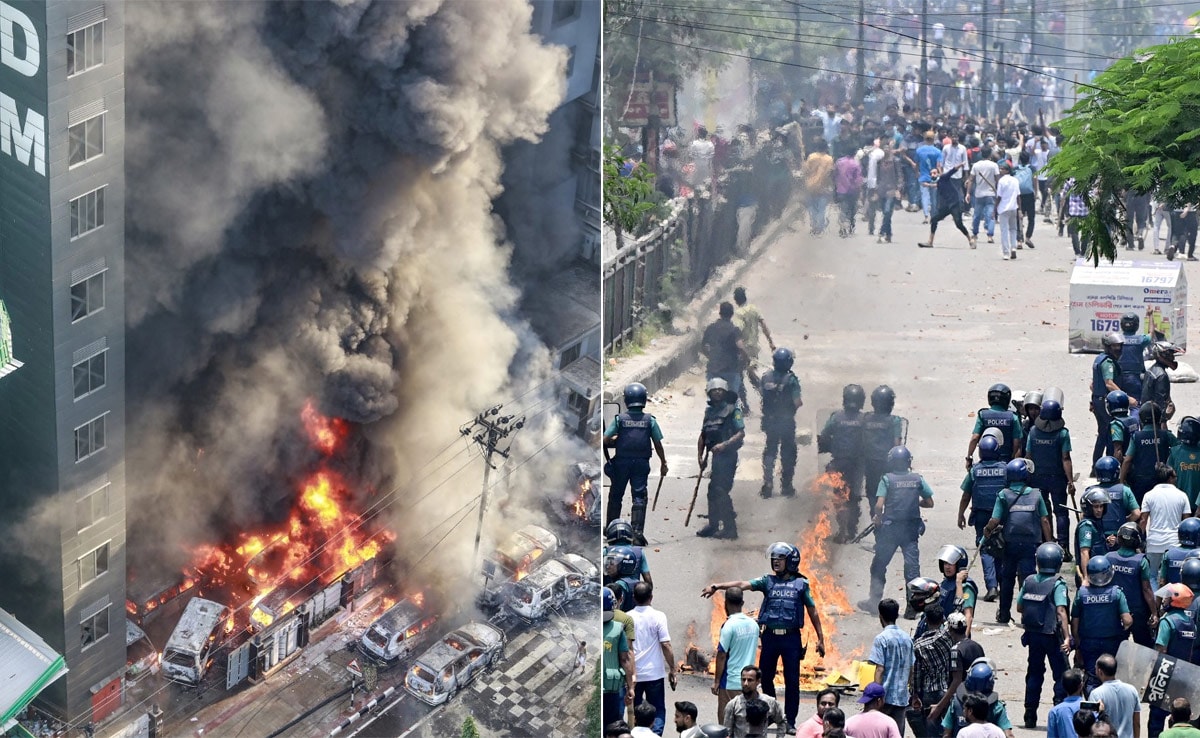
Bangladesh Police uses tear gas against protesters.
Photo Credit: AFP
Protesters argue that this system is discriminatory and favours supporters of Prime Minister Hasina’s Awami League party. They advocate for a merit-based system to replace the existing quota.
The quota system, established in 1972 and briefly abolished in 2018 before being reinstated, has been a persistent source of contention. Critics claim it unfairly benefits Awami League supporters and limits opportunities for other qualified candidates. Prime Minister Hasina’s public remarks further inflamed the situation, leading to intensified protests.
The protests have evolved beyond the quota issue into a broader anti-government movement, drawing support from diverse sections of society, including film stars, musicians, and even garment manufacturers. Rap songs and social media campaigns have amplified the calls for Hasina’s resignation.
Prime Minister Hasina, who has ruled since 2009 and secured a fourth consecutive term in January through elections boycotted by the main opposition Bangladesh Nationalist Party, faces accusations of entrenching power through state institutions and suppressing dissent. The recent violence highlights the growing dissatisfaction and demands for change among the Bangladeshi populace.
Rapid Escalation
The protesting students have announced a “March To Dhaka” programme today.
Houses of public representatives, 20 Awami League offices, police stations and other government installations were attacked, vandalised and torched in 39 districts. Clashes between protesters and leaders of the Awami League and its associate organisations were reported in several districts.
Residences and offices of ruling party ministers, state ministers, parliamentarians and Awami League leaders were vandalised in at least 14 different locations.
Several buildings were set on fire during the ongoing protests.
Photo Credit: AFP
In response to the unrest, the government declared an indefinite nationwide curfew starting at 6 pm on Sunday, the first such step during the current wave of protests. A three-day general holiday was also announced starting Monday. Additionally, the government shut down internet services.
Demonstrators blocked major highways and launched a non-cooperation program, escalating the violence nationwide. Police stations and ruling party offices became targets, with reports of severe clashes and significant casualties. Thirteen policemen were beaten to death in Sirajganj, and homes of two lawmakers were set on fire.
The unrest was not confined to Dhaka but spread across the country. In the central district of Munsiganj, two construction workers were killed, and 30 injured during a three-way clash involving protesters, police, and ruling party activists.
Further clashes in Pabna, Feni, Lakshmipur, Narsingdi, Rangpur, Magura, and other districts resulted in additional casualties. In Dhaka, a hospital was vandalised, and four garment factories were set on fire. The government’s decision to shut down high-speed internet services, including social media platforms, added to the chaos.
Government Orders
Bangladesh’s telecom providers were instructed to shut down 4G services, effectively disabling internet access. The protests initially paused after the Supreme Court scrapped most quotas, but resumed sporadically, demanding justice for those killed.
Bangladesh’s Chief of Army Staff General Waker-Uz-Zaman directed officers to ensure the security of lives, properties, and state installations. Despite this, protesters continued to defy the curfew, leading to further clashes and casualties.
The international community, including India, has advised nationals against travelling to Bangladesh.