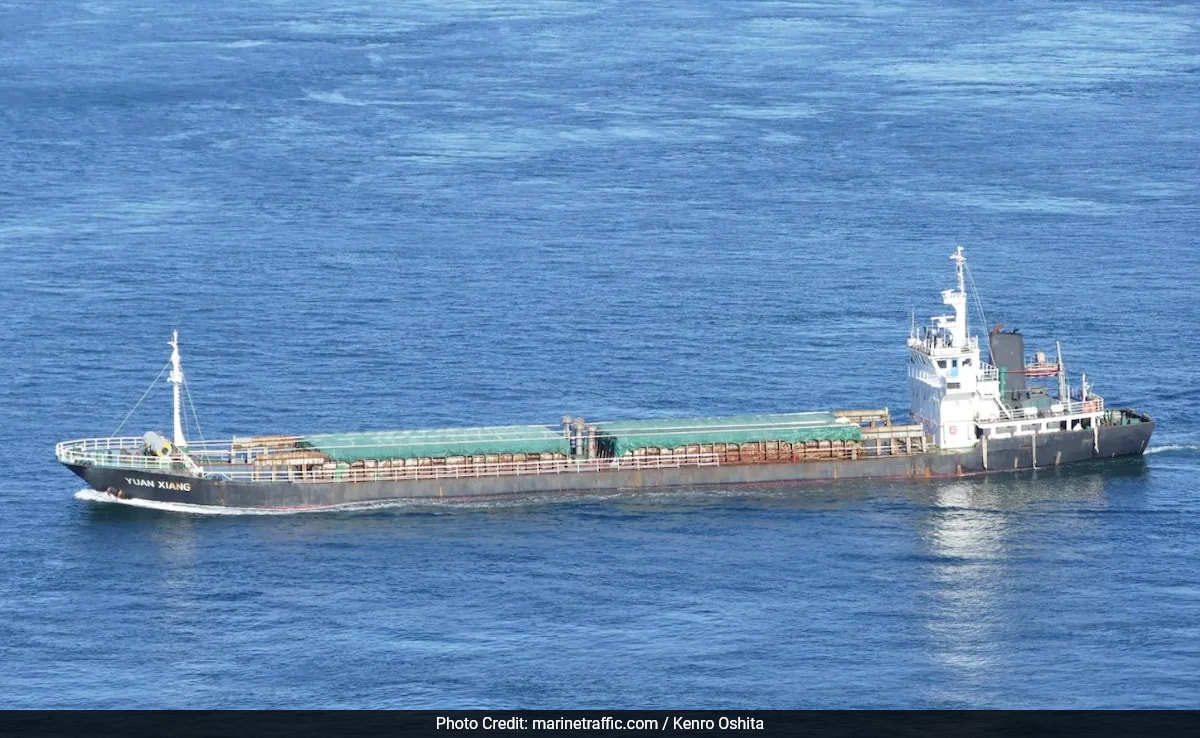
A Pakistani cargo ship docked at Bangladesh’s Chittagong port last week, marking the first-ever direct maritime contact between the two countries in over five decades. The vessel from Karachi has successfully unloaded its containers at Bangladesh’s southeastern coast, port officials told news agency AFP on Sunday, as both sides seek to rebuild ties frosty since the 1971 Bangladesh Liberation War.
The direct maritime links between Pakistan and Bangladesh underscores a historic shift in the traditionally complex relationship between India’s western and eastern neighbours. It also has implications on New Delhi’s security establishment especially due to Bangladesh’s proximity to India’s northeastern states.
Docking Of Pakistani Vessel In Bangladesh
The Panama-flagged Yuan Xiang Fa Zhan, an 182-metre (597-foot) long container ship, had sailed from Pakistan’s Karachi to Bangladesh’s Chittagong. The ship had offloaded its cargo in Bangladesh on November 11 before leaving port, AFP reported quoting top Chittagong official Omar Faruq.
Chittagong port authorities reportedly said the ship brought goods from Pakistan and the United Arab Emirates, including raw materials for Bangladesh’s key garment industry and basic food items.
Pakistani goods were previously transferred onto feeder vessels, usually in Sri Lanka, Malaysia or Singapore, before being transported to Bangladesh. However, in September, Bangladesh, under the new interim government led by Muhammad Yunus, eased import restrictions on Pakistani goods, which previously required a mandatory physical inspection on arrival resulting in long delays.
The opening of the direct maritime link is being seen as an attempt by Bangladesh’s interim government to have robust ties with Pakistan.
There has been widespread discussion on social media in Bangladesh after a post by Pakistan’s envoy to Dhaka, Syed Ahmed Maroof, about the direct shipping route being “a major step” in boosting trade between the two nations.
The route will “promote new opportunities for businesses on both sides”, Mr Maroof wrote on Facebook.
Bangladesh-Pakistan Relations And Shadow Of 1971 Liberation War
Pakistan and Bangladesh – once one nation – split in 1971 following Mukti Juddho (Liberation War). The memory of the brutal war, which saw the killing of some 3 million people and the rape and torture of tens of thousands of others, remained deeply imprinted in Bangladesh’s national psyche till recently.
Formerly known as East Pakistan, Bangladesh became an independent nation after a nine-month war with West Pakistan in 1971 in which India aided Bengali freedom fighters.
The bilateral ties between Pakistan and Bangladesh have remained sour since the Liberation War, more so under Sheikh Hasina’s regime in Dhaka, whose central political agenda had been to seek justice for atrocities committed by Pakistan during the brutal war.
Ms Hasina, who ruled Bangladesh from 1996-2001 and 2009-2024, set up the International Crimes Tribunal in 2010 to prosecute war criminals or razakars for their war crimes in 1971. She also banned the historically pro-Pakistan Jamaat-e-Islami, whose leader Abdul Quader Mollah was convicted by the ICT in 2013 for war crimes. Mollah became the first of many razakars to be executed during Ms Hasina’s reign.
India-Bangladesh Relation Post-1971
Meanwhile, Ms Hasina kept bringing Bangladesh closer to India over the year. India already held a close bond with Bangladeshis, courtesy of New Delhi’s assistance in the Bangladesh Liberation War.
The ousted former Prime Minister and her family reportedly enjoyed a close personal relationship with the Nehru-Gandhi family, but her government’s clampdown on terrorism and religious extremism proved to be a strategic glue that bound successive Indian governments to her regime.
Her relationship with New Delhi helped her flee to India on August 5 after a student-led revolution against her regime escalated. But, Bangladesh’s ties with New Delhi frayed after the toppling of her autocratic Hasina regime.
Hasina’s Ouster
For years, Ms Hasina reaped political mileage from her party and family’s contribution to Bangladesh’s liberation, however, the recent protests across the nation seem to indicate that the sentiment does not echo many.
So, when Ms Hasina branded the protestors as “razakars” in July, it backfired, leading to outrage amidst real social and economic concerns plaguing the country.
Furthermore, there was reportedly resentment among Bangladeshis against Ms Hasina for “cozying up” to New Delhi. As per a report by Indian Express, many in Bangladesh felt that India was too involved in the country’s matters. The growing “anti-India” sentiment in Bangladesh was on display when a mob in August vandalised and torched the Indira Gandhi Cultural Centre (IGCC), the hub of Indian cultural activity in the Bangladeshi capital for over five decades.
The Jamaat-e-Islami, which opposed the creation of Bangladesh, has a strong presence in the post-Hasina dispensation in Dhaka.
Growing Pakistan and Bangladesh Ties
After Ms Hasina’s ouster, Mr Yunus’ interim government has shown a shift towards closer ties with Pakistan. Prime Minister Shehbaz Sharif of Pakistan and Mr Yunus discussed strengthening bilateral cooperation on the sidelines of the United Nations General Assembly in September this year.
“The maritime link is essential for reviving our relations,” Mr Yunus recently said, calling for a “new page” in Pakistan-Bangladesh ties to enhance cooperation in different sectors.
Bangladesh also seems to be going the Pakistan way with the country’s Attorney General Md Asaduzzaman calling for removing the words “socialism” and “secularism” from Bangladesh’s constitution. The proposal has sparked fears the predominantly Muslim nation could be shifting toward an Islamic state.
Moreover, Bangladesh is also seeking the extradition of ousted Ms Hasina, who remains in exile in India. Dhaka has already issued an arrest warrant for the 77-year-old and has summoned her to appear in court in Dhaka to face charges of “massacres, killings, and crimes against humanity”.
Mr Yunus said his administration was focused on ensuring those guilty of cracking down on the protests to oust Ms Hasina faced justice.
The 84-year-old Nobel Peace Prize winner was appointed to lead the government as “chief advisor” on August 9, days after the end of Ms Hasina’s 15 years of iron-fisted rule. Mr Yunus, in a speech to the nation marking 100 days in power since a student-led revolution, said he had spoken to Karim Khan, chief prosecutor of the International Criminal Court.
“We will seek the extradition of the ousted autocrat from India,” Mr Yunus said, referring to Ms Hasina.
Earlier this month, Bangladesh said it would request an Interpol “red notice” alert for fugitive leaders of Ms Hasina’s regime. Red notices issued by the global police body alert law enforcement agencies worldwide about fugitives.
India is a member of Interpol, but the red notice does not mean New Delhi must hand Ms Hasina over. Member countries can “apply their own laws in deciding whether to arrest a person”, according to the group, which organises police cooperation between 196 member countries.
Impact On India
With increasing narcotics trade linked to Pakistan, growing ties between Islamabad and Dhaka could become a national security concern for India Another security concern for New Delhi is the involvement of Pakistan’s spy agency ISI in activities that destabilise the region.
Over the years, India has used its relationship with Ms Hasina to keep an eye on the activities at Chittagong port, where in 2004, around 1,500 boxes of Chinese ammunitions were confiscated. The consignment, reportedly worth an estimated USD 4.5-7 million, was allegedly masterminded by Pakistan’s intelligence agency, the Inter-Services Intelligence (ISI).
The consignment was allegedly meant to be delivered to banned terrorist outfit ULFA (United Liberation Front of Asom) in India.
Mr Yunus however, has assured that Dhaka-Delhi relations should be “very close” despite the recent regime change in the country, asserting that it is in the interest of both countries.
“Relations between the two countries must be very close. There can be no alternative to this. They need this, we need this. This is essential from any angle, whether it’s about economics, security or water,” he was quoted as saying by Bengali language daily Prothom Alo in October.
When asked for his comments on recent tensions in bilateral ties, Mr Yunus said the recent incidents in Bangladesh might have “disheartened” India and “they were not pleased with the changes.” He did not mention the incidents.
“It will be difficult for us to move along without each other. It is only natural that we have close ties and good relations in every sphere,” he said.
India has urged the interim Bangladesh government to ensure peaceful religious events for the Hindu community in the South Asian country. More than 600 persons, including Hindus, were killed during violent protests in Bangladesh following the ouster of Hasina-led government, according to a UN report.
“Things will be clear to them when they see that the entire world is accepting us, how can they not accept us?” he added.
He said as far as South Asian diplomacy was concerned, his interim government placed high importance on strengthening ties with India and “at the same time, strengthening SAARC (South Asian Association for Regional Cooperation”.