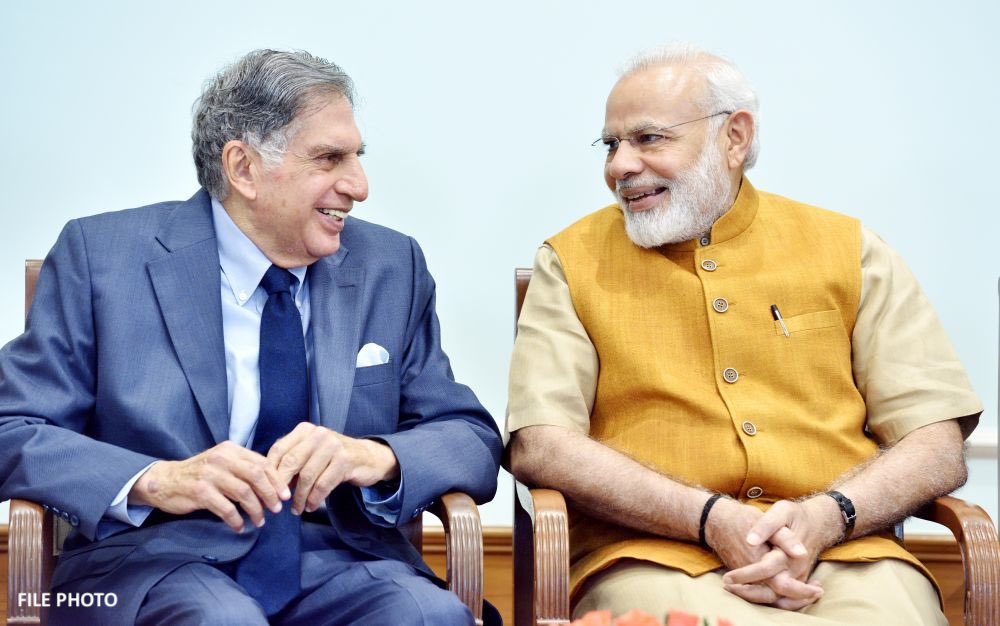
Ratan Tata – few names carry more weight and evoke more reverence amongst India’s 145 crore people and, in a land no stranger to scandals, fewer still do so with such little blemish.
Born December 28, 1937, Ratan Tata was the eldest son of Naval Tata, who was the adopted son of Sir Ratanji Tata. He was educated at some of India’s finest schools and he graduated with a degree in architecture from Cornell, an Ivy League institution, in New York.
His parents separated when he was 10 years old and young Ratan was brought up by his grandmother, Navajbai Tata, a redoubtable figure by all accounts and one who instilled in him a sense of dignity and a strong moral core.
He began his career on the Telco (now Tata Motors) shopfloor – an unglamorous job scooping limestone into blast furnaces. It was hot, sticky, and back-breaking work.
But his grandmother taught him well; Mr Tata persevered, and, in 1991, he replaced JRD Tata as Chairperson of Tata Sons, the Tata Group’s parent company.
He held that position twice – from 1991 to 2012, when he retired the first time, and from 2016 to 2017, when he was an interim appointee following the sacking of Cyrus Mistry.
Mr Tata was awarded a flood of medals and accolades, including India’s third- and second-highest civilian honours – the Padma Bhushan in 2000 and the Padma Vibhushan in 2008. He was also feted by the governments of Singapore, Italy, France, Japan, and Australia, and made an honorary knight of the British Empire by Queen Elizabeth II.
Business Legend
Mr Tata was an astute businessman and industrialist who transformed the Tata Group – from an India-centric and largely disparate collection of companies into a streamlined and (hugely) profitable corporate behemoth with global interests and revenue sources.
Under his stewardship the Tata Group – even then an Indian brand recognised worldwide – became home to British automotive giants Jaguar, and Land Rover, American luxury hotels chain Ritz Carlton, and Italian aerospace manufacturer Piaggio (sold in 2015), among others.
There were, of course, more, including the $407 million acquisition of Tetley Tea and the (frankly frightening) $12 billion purchase of European steelmaking goliath Corus Group.
In 22 years as Chairperson of the Tata Group, profits and revenues grew a staggering 50 and 40 times; in 2011-12 the latter breached the $100 billion mark for the first time.
The years, though, were not without controversy.
At the head of that particular list is probably the Tata Tapes scandal, and then there was the political battle over land in Bengal for a factory to build the Tata Nano microcar.
When he finally stepped back, he did so from the business world and not from his many (many) charitable causes, which included supporting education and healthcare development through the 105-year-old Tata Trusts, one of India’s oldest grant-bestowing foundations.
The Philanthropist Years
And thus began the second innings of his life – as a philanthropist and beloved national leader praised for his simplicity and humanity, all too rare traits amid the frenzy of the day.
In a world where talk is plentiful, and always hyperbolic, Mr Tata acted.
In March, at a sprightly 86, he opened a state-of-the-art Rs 165 crore hospital spread across 20+ acres for small animals, including dogs, which held a special place in his large heart.
Mr Tata’s love for dogs is the stuff of legend. Ask the strays at the Tata Group’s Mumbai HQ or, better, the scruffy and portly canine that now calls the city’s Taj Mahal Hotel home.
Under Ratan Tata’s watchful eye, the Tata Group and Tata Trusts have also invested in improving the country’s healthcare systems, as well as the fight against diseases like cancer.
Over the years Mr Tata and his family’s companies have also donated billions of dollars in grants to educational institutions, including $70 million to the University of California, San Diego and $50 million to his alma mater; the latter doesn’t include the $28 million for a scholarship fund to help Indian undergraduate students study at the prestigious school.