Live · Global · Independent
Live Feeds
PinkVilla
Forbes
NDTV
Hindustan Times
ISRO Launches Mission To Study Black Holes, 2nd After NASA To Do So
onmynews.com

ISRO Launches Mission To Study Black Holes, 2nd After NASA To Do So

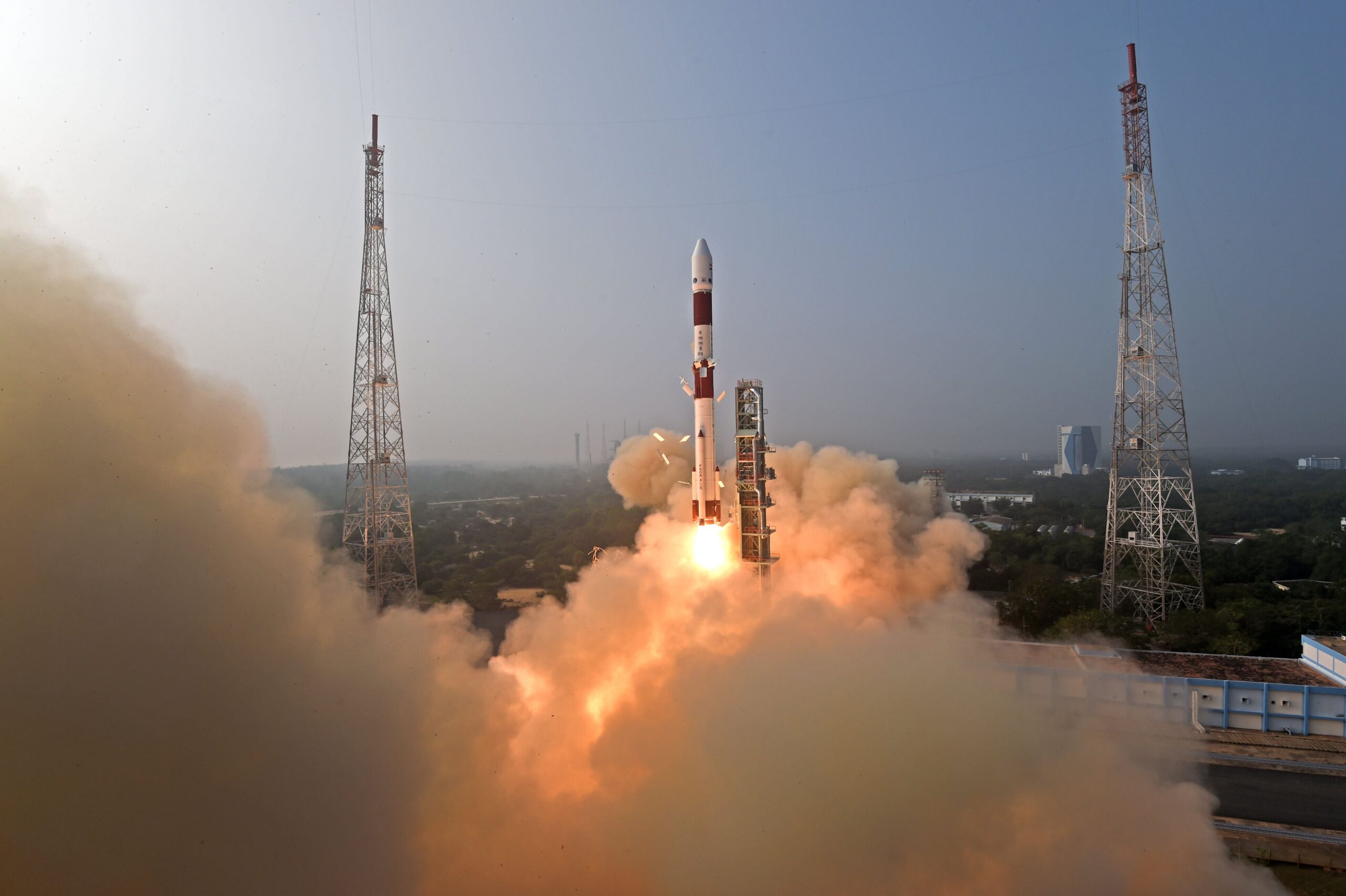
At 9.32 am, ISRO announced that the lift-off of the Polar Satellite Launch Vehicle (PSLV) was normal and XPoSAT was launched successfully. “PSLV-C58 vehicle placed the satellite precisely into the intended orbit of 650 km with 6-degree inclination. The POEM-3 is being scripted,” ISRO posted in X. Soon after, ISRO chief S Somanath announced the successful launch.
Astrophysicist Dipankar Bhattacharya told NDTV that today’s launch was a “textbook launch”. “The expected orbit has been achieved. Now all the expected science is hopefully going to work as planned,” he said.
The XPoSAT mission launch also marked the 60th flight of the Polar Satellite Launch Vehicle (PSLV). The 260-tonne rocket carries an advanced astronomy observatory meant to study black holes and neutron stars. With this, India is set to become only the second country after the US to have an ‘observatory’ to study black holes.
Using X-ray photons and their polarisation, XPoSAT will help study the radiation from near black holes and neutron stars. It carries two payloads — POLIX (Polarimeter Instrument in X-rays) and XSPECT (X-ray Spectroscopy and Timing).
The satellite will measure polarisation of X-rays in the energy band 8-30keV emanating from about 50 potential cosmic sources through Thomson Scattering by POLIX payload.
It will carry out long term spectral and temporal studies of cosmic X-ray sources. It will also carry out polarisation and spectroscopic measurements of X-ray emissions from cosmic sources through POLIX and XSPECT payloads.
When stars run out of fuel and ‘die’, they collapse under their own gravity and leave behind black holes or neutron stars. Black holes have the highest gravitational force in the universe, and neutron stars have the highest densities. Gathering more information on this, the mission will help unravel mysteries of ultra-extreme environments in space.
The XPoSat satellite cost around Rs 250 crore (approximately $30 million). The NASA IXPE — which is on a similar mission since 2021 — cost $188 million. The Indian satellite is expected to last more than five years, compared to the two-year life span of the NASA IXPE.
Former ISRO chairman G Madhavan Nair has said the PSLV rocket system has evolved as the most reliable and cost-effective one in the global scenario. “When we look back in history, we started this journey in 1993 and since then, most of the missions have been successfully completed,” he told news agency ANI.
2023 was a great year for ISRO and the country. The success of the Chandrayaan mission put India into the elite space club, with the distinction of being the only country to achieve a soft landing near the South Pole of the moon. As 2024 begins, ISRO has its eyes focused on the Gaganyaan launch, India’s first human spaceflight programme.

Read full article
Randeep Hooda enjoyed the last sunset of 2023 with his wife Lin Laishram in Kerala. See pics:
onmynews.com

Randeep Hooda enjoyed the last sunset of 2023 with his wife Lin Laishram in Kerala. See pics:

Randeep Hooda married the love of his life Lin Laishram on November 29, 2023. With just a few close industry friends and family members being part of their big day, it was a culturally rich wedding and the pictures looked lovely.

The two were seen jetting off to their honeymoon a day ago. They were headed to Kannur in Kerala to enjoy some quality time and were all smiles at the airport as they got photographed.

Randeep took to his social media account a little later in the day yesterday and shared two beautiful pictures with his wife Lin Laishram. He captioned it, “Last sunset of 2023.” The two were seen enjoying the pool and witnessing a stellar sunset.

Read full article
First Tsunami Waves Hit Japan After 7.5 Quake, 5-Metre Waves Expected Too
onmynews.com

First Tsunami Waves Hit Japan After 7.5 Quake, 5-Metre Waves Expected Too

A powerful 7.5 earthquake hit central Japan on Monday, the USGS said, prompting tsunami warnings and authorities to urge people in the area to move to higher ground.”All residents must evacuate immediately to higher ground,” national broadcaster NHK said after the quake hit the Noto region in Ishikawa prefecture around 4:10 pm (0710 GMT).

Hazardous tsunami waves were possible within 300 kilometres (190 miles) of the quake’s epicentre along the Japan coast, the Hawaii-based Pacific Tsunami Warning Center said.

A tsunami of 1.2 metres was confirmed to have arrived in Wajima city in Ishikawa prefecture.

But a much higher tsunami of five metres was expected to arrive in Noto in the same region, the Japan Meterological Agency (JMA) said.

The JMA said the Noto region, on the Sea of Japan side of Japan’s main island of Honshu, experienced a rapid succession of quakes, starting with a 5.7 magnitude tremor at 4:06 pm local time.

This was followed by a 7.6-magnitude quake at 4:10 pm, a 6.1 magnitude quake at 4:18 pm, a 4.5 magnitude one at 4:23 pm, a 4.6 magnitude quake at 4:29 pm, and 4.8 magnitude quake at 4:32 pm.

Another quake with a magnitude of 6.2 hit soon after, the US Geological Survey said.

The largest of the quakes prompted broadcasters to switch to special programming and make urgent calls for affected residents to leave for higher ground.

“We realise your home, your belongings are all precious to you, but your lives are important above everything else. Run to the highest ground possible,” a presenter on broadcaster NHK told viewers.

Japan has strict construction regulations intended to ensure buildings can withstand strong earthquakes and routinely holds emergency drills to prepare for a major jolt.

But the country is haunted by the memory of a massive 9.0-magnitude undersea quake off northeastern Japan in March 2011, which triggered a tsunami that left around 18,500 people dead or missing.

The 2011 tsunami also sent three reactors into meltdown at the Fukushima nuclear plant, causing Japan’s worst post-war disaster and the most serious nuclear accident since Chernobyl.

In March 2022, a 7.4-magnitude quake off the coast of Fukushima shook large areas of eastern Japan, killing three people.

The capital Tokyo was devastated by a huge earthquake a century ago in 1923.

(Except for the headline, this story has not been edited by NDTV staff and is published from a syndicated feed.)

Read full article
Link copied!