Live · Global · Independent
Live Feeds
PinkVilla
Forbes
NDTV
Hindustan Times
Ajit Pawar’s Faction Real NCP, Can’t Disqualify Its MLAs: Maharashtra Speaker
onmynews.com

Ajit Pawar’s Faction Real NCP, Can’t Disqualify Its MLAs: Maharashtra Speaker

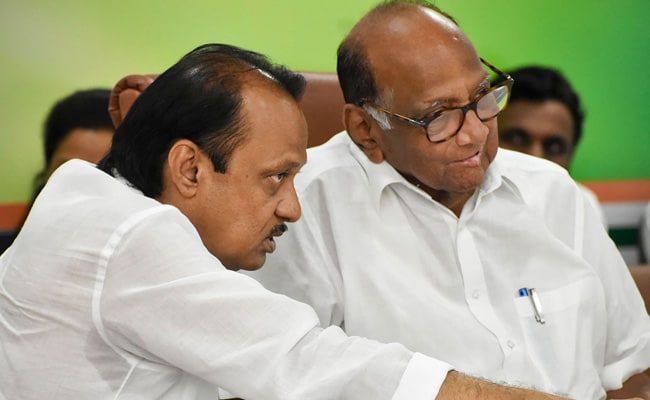
Maharashtra Speaker Rahul Narwekar on Thursday cited last week’s Election Commission order – recognising Deputy Chief Minister Ajit Pawar as the leader of the ‘real Nationalist Congress Party‘ – to reject petitions seeking disqualification of 41 MLAs who rebelled against Sharad Pawar in June last year, triggering a split and a battle for control of the NCP.

Mr Narwekar said the MLAs who joined Ajit Pawar in rebelling against his uncle – and allied with the BJP and a similar breakaway faction of the Shiv Sena – to form a new state government, could not be disqualified as they constituted the “will of the party”.

“I hold that (the) Ajit Pawar-led NCP is the real political party. Ajit Pawar has the legislative majority with 41 MLAs. This is undisputed,” he said, “All petitions seeking disqualification of are rejected.”

The Supreme Court last month gave Mr Narwekar till February 15 to decide on disqualification petitions against MLAs affiliated to Ajit Pawar’s group.

Before the split the NCP had 53 MLAs. 

After the dust settled, 41 of them sided with Ajit Pawar, leaving only 12 with Sharad Pawar as he tried to re-assert control over the party he helped found in 1999, and has since led.

Last week the Election Commission said the Ajit Pawar faction would be recognised as the ‘real NCP’, thereby giving it control over the party name and symbol (a clock) weeks before the Lok Sabha election and polls to fill six to-be-vacant Rajya Sabha seats in the state.

READ | Ajit Pawar’s Faction Named Real NCP In Setback For Sharad Pawar

The poll panel gave Sharad Pawar mere hours to decide on a new name, and his faction was eventually renamed as the Nationalist Congress Party Sharadchandra Pawar.

READ | Sharad Pawar’s Party Assigned New Name By Election Commission

Sources said the Commission’s decision was based on the numerical strength of the two factions, something Mr Narwekar referred to, and relied on, in this instance too.

A furious NCP called the Election Commission’s actions “murder of democracy”.

“The whole world knows who founded the NCP. So what the Election Commission did, despite that, is the murder of democracy…” Anil Desmukh, a former Minister, said.

Sharad Pawar’s camp has approached the Supreme Court over the EC order.

The decision played out like the Sena Vs Sena fight, in which the faction led by Eknath Shinde (made Chief Minister after rebelling and allying with the BJP) was called the ‘real Sena’, leaving Uddhav Thackeray racing, weeks before an election, to find a new identity for the party his father founded.

NDTV is now available on WhatsApp channels. Click on the link to get all the latest updates from NDTV on your chat.

Read full article
Rakul Preet Singh celebrates Valentines Day with Jackky Bhagnani and her tribe ahead of her wedding
onmynews.com

Rakul Preet Singh celebrates Valentines Day with Jackky Bhagnani and her tribe ahead of her wedding

Rakul Preet Singh posted an adorable photo with her boyfriend Jackky Bhagnani on Valentine’s Day on her Instagram stories ahead of her wedding, with the caption “Everyday, Forever Valentine.” Along with expressing her love for her partner, she also sent heartfelt wishes to her friends and family.

The actress conveyed her affection for her loved ones, whom she fondly called her support system, by posting a charming photo.

Check out the pictures here:

Read full article
2 Key Issues Took Centre Stage As Court Struck Down Electoral Bonds Scheme
onmynews.com

2 Key Issues Took Centre Stage As Court Struck Down Electoral Bonds Scheme

The Supreme Court has declared the Electoral bond Scheme – launched in 2018 with much fanfare – as unconstitutional on several counts. They violate people’s right to information and Article 14 of the Constitution guaranteeing equality. They also infringe on the principle of free and fair elections as stipulated in the constitution, the court argued.

The Electoral Bond Scheme was launched in 2018 after a series of amendments to financial rules in 2016 and 2017. The petitioners had argued that their effect was to enable political parties to not disclose the contributions received through electoral bonds, allow companies to make unlimited funding and not disclose the details of contributions made in any form.

The petitions filed on the matter had asked the court to resolve two issues: — Whether amendments violate the Right to Information under Article 19(1)(a) and whether unlimited corporate funding violates principles of free and fair elections.

Answering in the affirmative, Chief Justice of India DY Chandrachud said two judgments — one by him and one by Justice Sanjeev Khanna, who was part of the five-judge constitution bench — had arrived the same conclusion, though their reasonings were slightly different.

While Indian election system involves secret ballot, the cloak of anonymity cannot be extended to political donations above the Rs 2000 threshold, the court said. This is because for voters, information about funding of political parties is essential for making electoral choices.

“Political contributors get access… this access leads to policy making… because of the nexus between money and voting. Financial supports to political parties can lead to quid pro quo arrangement,” Justice Chandrachud said, meaning corporate funding of political parties can include quid pro quo in terms of policy making — so policies can be tweaked to favour the donors.

“Courts have maintained that the citizens have right to hold the government to account. Crucial aspect of expansion of right to information is that it is not confined to state affairs but also includes information necessary for participatory democracy,” the Chief Justice added.

The lack of information also violates the rights of shareholders of a donor company.

The field is further skewed as only the voters are left in the dark about the donors, since there is no rule that stops the donor from informing the party about the donations.

The curbing of the right to information cannot be defended in the name of public interest — weeding out black money as the Centre had argued — the court said, pointing out that “public interest’ is not among the very few instances the Constitution has allowed such a violation.

That short list includes a threat to the sovereignty and integrity of India; the security of the State; friendly relations with foreign states; public order; decency or morality; contempt of court; defamation and incitement to an offence.

There are other methods of curbing black money, the court said.

The top court also criticised the legal provision that allowed unlimited political contribution, saying it allowed companies with deep pockets to influence policy. It also encouraged loss-making companies to throw their hat in the ring by contributing through shell companies.

On the whole, “The deletion of the proviso to Section 182(1) of the Companies Act permitting unlimited corporate contributions to political parties is arbitrary and violative of Article 14 (pf the Constitution that guarantees the Right to Equality),’ the judgment read.

The court also pointed out that the while Article 324 of the Constitution puts the Election Commission in charge of the entire electoral process, it is not the sole duty of the election body to secure the “purity and integrity of the electoral process”.

“There is also a positive constitutional duty on the other organs of the government, including the legislature, executive and the judiciary, to secure the integrity of the electoral process,’ the judgment read.

Read full article
…
Link copied!