“World Won’t See Excess Of Labour Anytime Soon”: Bill Gates On AI
As one of the world’s richest men who has worked at the intersection of technology and philanthropy, Bill Gates possesses a unique worldview that he brings to bear on trying to solve some of the world’s most pressing problems.
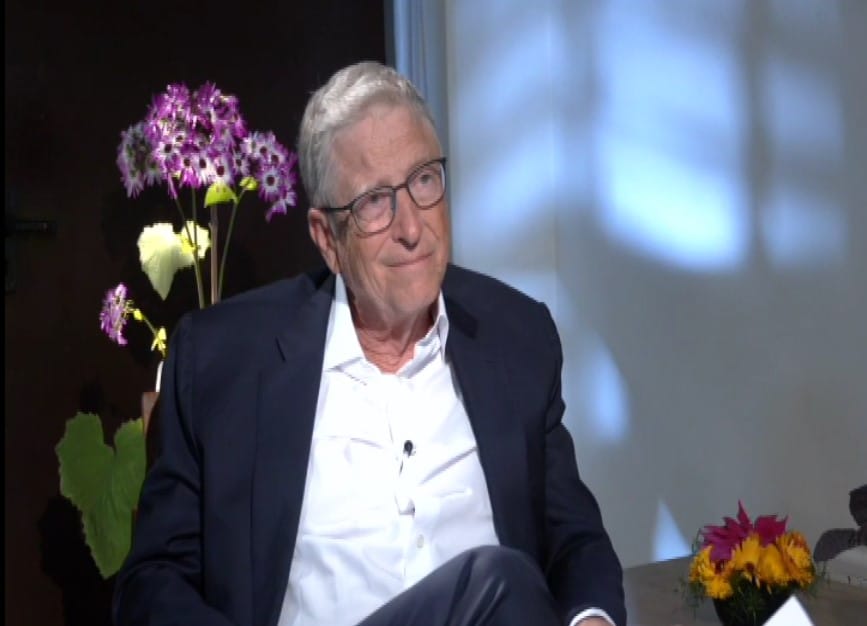
In an exclusive interview with NDTV on Thursday, the founder of Microsoft and the Bill and Melinda Gates Foundation spoke on a wide range of issues, from India’s leadership in digital infrastructure and the country’s “brilliant work” in the field of vaccines to artificial intelligence and the cup of tea he had in Hyderabad, which was prepared by social media sensation Dolly Chaiwala.
On India’s digital economy and its contribution to the country’s growth story, Mr Gates said transferring government payments directly to bank accounts is a big step as beneficiaries get money directly, without intermediaries taking any of it away. It has also brought significant savings for the government, which can be used in other areas.
“For example, I saw in Odisha where they (the government) had registered the farmers and they understood their land and their crops. So they are sending them a regular bulletin and they are communicating about what (farmers) need to do. So this is a case where India has been out in the lead, you know, India did this thing at scale. They made it work,” the Microsoft founder said.
“So, right now, there are 15 other countries at various stages of adoption. A lot of that was kicked off by the way Prime Minister Narendra Modi made that a centrepiece of the G20 meeting,” he added.
Increasing Vaccine Duration
Emphasising that the Gates Foundation is the “biggest supporter” of the Indian vaccine industry, Mr Gates said the country’s companies played a key role in developing vaccines during the pandemic.
“All of them put their brilliant work into trying to help out with Covid and the majority of vaccines got made here in India. We have a lot of new things we want in vaccines, we want (vaccines for) tuberculosis, HIV. We are working with these companies to help them adopt mRNA, which is a technology that we think will be very useful. And so the fact that they are very high quality (and) when they get volume, they are very low cost, they are a treasure to the world,” the technologist said.
Mr Gates said he would like to see the duration of protection afforded by vaccines, including the one for Covid, to increase so that the same features can be used for other diseases.
“We also need those same features, particularly duration, to use it for measles, tuberculosis and HIV. And a lot of this mRNA work is going for cancer vaccines… so the technology has a lot of promise. If we ever have a future pandemic, the ability to adapt is much more rapid,” he asserted.
Job Loss Fears?
To a question on fears of job loss because of the quantum leap in artificial intelligence, the Microsoft founder said the world is not going to see an excess of labour anytime soon and increasing productivity could lead to a broader group being able to access things like their children getting individual tutoring, which is only affordable to a select few now.
“The world has more jobs today than it had 100 years ago, when you had to toil in a backbreaking way just to barely get enough to eat. 80% of people were farmers… So the advances have made our lives a lot richer. We have reduced the work week, but that hasn’t been the primary thing. Primarily, the food we are offered, the entertainment… you know, it is just way richer than what our previous generations could even dream up,” he said.
On sentience and whether the world is getting to a stage when AI systems are essentially acting as human beings, Mr Gates said significant strides have been made in the sector, especially in the past two years, but machines have a different approach from humans.
“Computers have always been superhuman at things like calculations, and we have reached milestones like when a computer was the best at chess, or when the computer was the best at Go (a board game). Now, if you had a contest to write poems or composes songs, the computer would be (at), you know, 99% of humans. And so that threshold of where it adds value and what it can do keeps going up,” he said.
“And that can be a good thing. It is clearly different than we are, it makes different mistakes than we tend to make,” he pointed out.
Anaemia Breakthrough
On India’s disease burden, the philanthropist said anaemia and malnutrition are two of the Gates Foundation’s top priorities for the world and the country is also facing a challenge in that area. He added, however, that India is also prioritising these issues and there have been some breakthroughs.
“For anaemia, we have always known that a woman would come in a lot of times during pregnancy and get an infusion. We could help get rid of that anaemia, but it is too expensive and too complex. The recent breakthrough is that there’s a formulation that a woman could come in only one time, and then we are using AI to help place the needle,” he said.
Striking an optimistic note, Mr Gates said, “We are working with Indian partners to get the price of that one infusion down below $10 (approximately 800 rupees). And it appears the benefit to the mother… her mental state is dramatically better. And the brain development of the baby is also quite a bit better. Anaemia has to be reduced dramatically and this has great promise.”
Climate Crisis
Mr Gates said he is involved in both mitigation of the climate crisis as well as helping countries adapt, the latter of which is done by the Gates Foundation. Mitigation, he said, is done through things like coming up with new crops that can withstand higher temperatures and droughts.
Pointing to the outsized role of developed countries in climate change, he said, “India is a very climate-affected country. It is kind of funny, in a way… the temperate zone countries that are the most responsible for the problem are not the most affected, because the absolute temperatures are not so high. And, you know, we have air conditioners, in our cars and in our homes, so we are somewhat already adapted.”
He pointed out that good practices are being adopted in other countries, including India, that are showing that preparedness can make regions resilient to the effects of climate change.
‘Fantastic Chai’
On a lighter note, Mr Gates was also asked about the tea he had, made by Dolly Chaiwala, and how it tasted.
“Well, I don’t consider myself the best judge of it, but it was fantastic. It was a beautiful view of Hyderabad in the morning and they told me they had brought a great teawallah guy in, and he was very photogenic, so that was fun,” the billionaire said.