Live · Global · Independent
Live Feeds
PinkVilla
Forbes
NDTV
Hindustan Times
LK Advani, MM Joshi “Requested Not To Come” To Jan Event: Ram Temple Trust
onmynews.com

LK Advani, MM Joshi “Requested Not To Come” To Jan Event: Ram Temple Trust

BJP veterans LK Advani and Murli Manohar Joshi who were at the forefront of the agitation for the Ram temple in Ayodhya are unlikely to attend next month’s consecration ceremony due to their health and age, the temple trust said in Ayodhya on Monday.

“Both are elders of the family and considering their age, they were requested not to come, which was accepted by both,” Ram Temple Trust general secretary Champat Rai told reporters.

Mr Rai said preparations are in full swing for the consecration ceremony on January 22, which will be attended by Prime Minister Narendra Modi.

The preparations would be completed by January 15 and the puja for ‘praan pratistha’ will start from January 16 and will continue till 22nd January, he added.

Giving a detailed list of the invitees, Mr Rai said Mr Advani and Mr Joshi might not attend the consecration ceremony due to health and age-related reasons.

Mr Advani is now 96 and Mr Joshi will turn 90 next month.

A three-member team has been formed to visit former prime minister Deve Gowda and invite him to the ceremony, Rai said.

“Shankaracharyas of six darshanas (ancient schools) and around 150 saints and sages and will participate in the ceremony,” Mr Rai said.

He added that about 4,000 saints and 2,200 other guests have been invited for the ceremony.

Heads of major temples like Kashi Vishwanath, Vaishno Devi, and representatives of religious and constitutional institutions have also been invited, he said.

Spiritual leader Dalai Lama, Mata Amritanandamayi of Kerala, yoga guru Baba Ramdev, cine stars Rajnikanth, Amitabh Bachchan, Madhuri Dixit, Arun Govil, film director Madhur Bhandarkar and prominent industrialists such as Mukesh Ambani, Anil Ambani, famous painter Vasudev Kamat, ISRO Director Nilesh Desai and many other eminent personalities have been invited to the function, Rai said.

After the consecration ceremony, ‘mandal puja’ will be held from January 24 for 48 days as per ritual traditions. The temple will be opened for devotees on January 23, he added.

Mr Rai said that proper arrangements have been made for the guests to stay at more than three places in Ayodhya. Apart from this, 600 rooms have been made available by various monasteries, temples and household families.

Meanwhile, authorities of the Ayodhya Municipal Corporation said they have begun preparing for the consecration ceremony.

Speaking to PTI, Municipal Commissioner Vishal Singh said that fibre toilets will be installed for devotees and changing rooms will be set up for women at designated places.

The ‘Ram Katha Kunj’ corridor will be built in the Ram Janmabhoomi complex which would showcase tableaux displaying 108 events from Lord Ram’s life, he said.

(Except for the headline, this story has not been edited by NDTV staff and is published from a syndicated feed.)

Read full article
Over 110 Dead, Several Injured As Massive Earthquake Hits China
onmynews.com

Over 110 Dead, Several Injured As Massive Earthquake Hits China

At least 111 people were killed when an earthquake collapsed buildings in northwest China, state media reported Tuesday, as rescue workers raced to start digging through rubble.

About 100 were killed and scores more injured in Gansu province after the strong, shallow tremor struck, state broadcaster CCTV said, citing the provincial earthquake relief headquarters.

According to CCTV, 11 others were killed and 100 injured in the city of Haidong in the neighbouring province of Qinghai.

The quake caused significant damage, including collapsed houses, and sent people running into the street for safety, state news agency Xinhua said.

Rescue work was under way early Tuesday, with Chinese President Xi Jinping calling for “all-out efforts” in the search and relief work as well as ensuring the safety of the survivors and their property.

The quake, which was logged as magnitude 5.9 by the US Geological Survey, struck in Gansu near the border with Qinghai, where Haidong is located.

That epicentre is about 100 kilometres (60 miles) southwest of Gansu province’s capital, Lanzhou. Several smaller aftershocks followed the initial earthquake.

Xinhua reported the quake — which was felt in Xi’an in northern Shaanxi province, some 570 kilometres (350 miles) away — as magnitude 6.2.

– Freezing temperatures –

Power and water supplies were disrupted in some local villages, Xinhua said.

CCTV showed images of emergency vehicles driving towards the scene with their lights flashing along snow-lined highways.

Rescue workers dressed in overalls were pictured shoulder-to-shoulder in the trucks, while other images showed them lining up in ranks to receive instructions.

Other clips showed emergency personnel going through debris by torchlight, unfolding orange stretchers for the casualties.

Temperatures have plunged to well below freezing across northern China, and footage from one of the worst-hit areas on CCTV showed residents warming themselves by a fire while emergency services set up tents.

Fallen ceilings and other debris could be seen in videos posted on social media.

The earthquake struck at a depth of 10 kilometres (six miles) at 11:59 pm local time Monday (1559 GMT), according to the USGS, which revised the magnitude downward after initially reporting 6.0.

Officials launched an emergency response and dispatched rescue personnel to the area just after the quake and provincial leaders were also en route, Xinhua reported.

Earthquakes are not uncommon in China. In August, a shallow 5.4-magnitude earthquake struck eastern China, injuring 23 people and collapsing dozens of buildings.

In September 2022, a 6.6-magnitude quake hit Sichuan province leaving almost 100 dead.

A 7.9-magnitude quake in 2008 left more than 87,000 people dead or missing, including 5,335 school pupils.

(Except for the headline, this story has not been edited by NDTV staff and is published from a syndicated feed.)
Read full article
“Jo Ucchit Samjho…”: Rajnath Singh To Ex-Army Chief During China Tension
onmynews.com

“Jo Ucchit Samjho…”: Rajnath Singh To Ex-Army Chief During China Tension

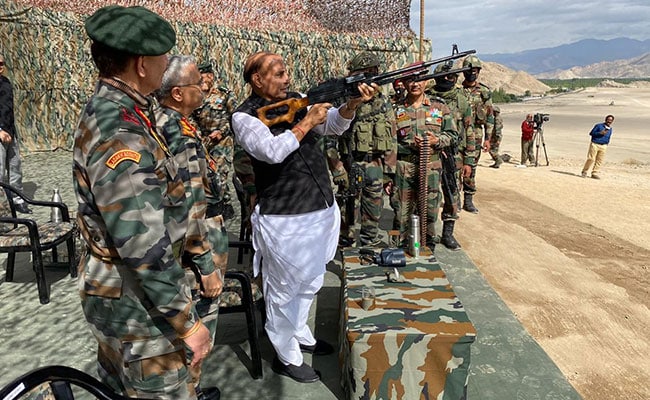
‘Jo ucchit samjho woh karo’ (Do whatever you deem appropriate), this is what Defence Minister Rajnath Singh told the then Army Chief Gen MM Naravane on the night of August 31, 2020 following a tense situation arising out of Chinese PLA moving tanks and troops in Rechin La mountain pass on the Line of Actual Control (LAC) in eastern Ladakh.

In his memoir ‘Four Stars of Destiny’, Naravane recounts Singh’s direction as well as a flurry of phone calls between the defence minister, external affairs minister, the national security advisor and the chief of defence staff that night on the sensitive situation.

ALSO READ | “China’s Xi Jinping Won’t Forget…”: Ex-Army Chief On 2020 Galwan Clash

After Singh’s call, Naravane says a hundred different thoughts “flashed through” his mind. “I conveyed the criticality of the situation to the RM (Raksha Mantri), who said he would get back to me, which he did, by about 2230 hours,” writes Naravane.

“He said that he had spoken to the PM and that it was purely a military decision. ‘Jo ucchit samjho woh karo’ (Do whatever you deem is appropriate).” “I had been handed a hot potato. With this carte blanche, the onus was now totally on me. I took a deep breath and sat silently for a few minutes. All was quiet save for the ticking of the wall clock,” he says.

“I was in my den at Army House, with the map of J and K and Ladakh on one wall, Eastern Command on another. They were unmarked maps, but as I looked at them, I could visualise the location of each and every unit and formation. We were ready in all respects, but did I really want to start a war?” he writes.

In the memoir, Gen Naravane reflects on his thought process that night.

“The country was in bad shape, reeling under the Covid pandemic. The economy was faltering, global supply chains had broken down. Would we be able to ensure a steady supply of spares, etc., under these conditions, in case of a long-drawn-out action?” “Who were our supporters in the global arena, and what about the collusive threat from China and Pakistan? A hundred different thoughts flashed through my mind,” he writes.

“This was no war game being played in a sand model room of the Army War College, but a life and death situation.” Naravane says after a few moments of quiet reflection, he called up Northern Army Commander Lt Gen YK Joshi.

“‘We cannot be the first ones to fire,’ I told him, as it would provide the Chinese with an excuse, a casus belli, to escalate and paint us as the aggressors “Even at Mukhpari (on the Kailash Range) the previous day, it had been the PLA who had fired first (being only two rounds by the PLA and three rounds by us, it had escaped the attention of the media),” he writes.

Naravane says he felt that the Army should maintain this stance.

“Instead, I told him to move a troop of our tanks right to the forward slopes of the Pass and depress their guns so that the PLA would be staring down the barrels of our guns,” he writes.

“This was done forthwith and the PLA tanks, which had by then reached within a few hundred metres of the top, stopped in their tracks,” he says.

“Their light tanks would have been no match for our medium tanks. It was a game of bluff and the PLA blinked first.” Naravane writes the PLA moved troops from Moldo to the area of Chuti Changla towards the South Bank of the Pangong Tso on the intervening night of August 29-30.

By evening itself, they moved forward some troops in the area of the Kailash Range, he says.

By the evening of the 30th, the Indian Army was in a strong position both on the North and South Bank of Pangong Tso as well as the Kailash Range.

“The PLA reaction was not long in coming. On the 30th evening itself, they moved forward some troops in the area of the Kailash Range, stopping about 500 metres short of our locations and started digging in,” he says.

Naravane says the PLA locations were at lower heights and directly under our observation.

“As such, they were of no threat to us, but if they were to come up in strength and try to outflank or surround our localities, then we would have to take action. The situation was tense and nearing breaking point,” he says.

Naravane says the daylight hours of August 31 saw a lot of movement on the PLA side, even as the Army consolidated its own position.

Towards the afternoon, movement of PLA armour was also observed in the area of their garrison at Moldo. Seeing this, our tanks at Tara Base were also ordered to move up to Rechin La, he says.

Naravane says mobilisation of PLA troops was seen in some other locations as well.

“At 2015 hours on the evening of 31 August, Jo (Joshi) rang me up, quite worried. He reported that four tanks supported by infantry had slowly started moving up the track towards Rechin La,” he says.

“They had fired an illuminating round but this had had no effect. I had clear orders not to open fire, ’till cleared from the very top’. A flurry of calls followed, between the RM, EAM, NSA, CDS and myself over the next half-hour,” he adds.

“To each and every one my question was, ‘What are my orders?’ At 2110 hours, Northern Command again rang up, the tanks had continued moving ahead and were now less than a km from the top.

“I rang up the RM again at 2125 hours, with the latest and once more asked for clear directions. The situation was tense. Telephone lines were buzzing.” Meanwhile, there had been an exchange of Hot Line messages and the PLA Commander, Maj Gen Liu Lin, suggested that both sides should stop any further move and that the two local commanders should meet at the pass at 0930 hours the next morning.

Naravane says he called up Defence Minister Singh and NSA Ajit Doval at 2200 hours to share this news.

“I had hardly put the phone down when Jo (Northern Army Commander Joshi) rang up once again at 2210 hours.

“He said that the tanks had started moving up again and were now only about 500 metres away,” he says.

Naravane says Joshi recommended that the only way to stop the PLA was by opening up with our own medium artillery, which he said was ready and waiting.

“My position was critical…,” he says as he explains how the situation was handled.

(Except for the headline, this story has not been edited by NDTV staff and is published from a syndicated feed.)

Read full article
Link copied!