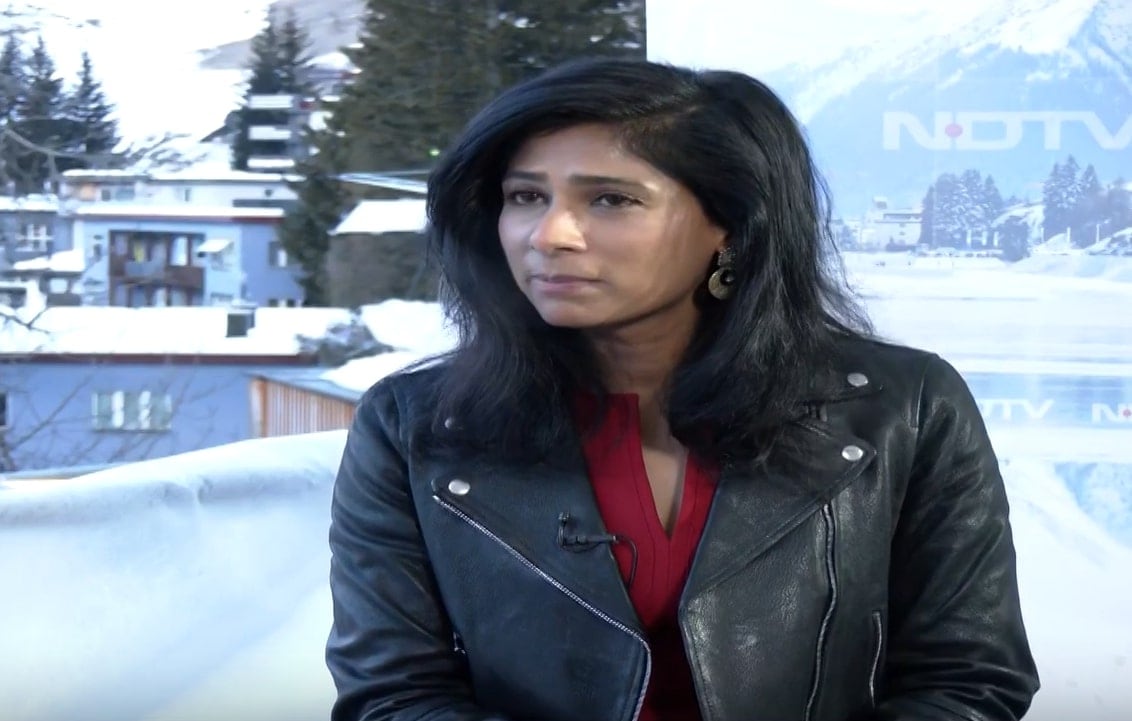
An estimated 26 per cent of India’s workforce, across all industries and sectors, is “exposed” to Artificial Intelligence, or AI, Gita Gopinath, the Deputy Managing Director of the International Monetary Fund, told NDTV Tuesday at the World Economic Forum in Switzerland’s Davos.
It isn’t all doom and gloom, since 14 per cent of those jobs will benefit from the introduction of AI and related technologies. The 12 per cent will battle a “displacement effect”, she said.
“… of course, there is the labour market impact. If you look at India, for example, our estimate is that about 26 per cent (of the workforce) is exposed to AI… but, of this, about 14 per cent will benefit and the remaining 12 per cent will have more of a ‘displacement effect’.”
Her comments seem to agree with what Amitabh Kant, India’s G20 Sherpa, said at the NDTV World Summit in October last year. Mr Kant said that although the advance of is “inevitable”, it will bring in “new kinds of jobs… new scales of jobs”. “And, therefore, we need to create many more skilled people in these areas (referring to data sciences, machine learning, etc.),” he said.
READ | “AI Inevitable, Will Bring New Kinds Of Jobs”: Amitabh Kant To NDTV
AI was a recurring topic at the NDTV Summit, right from the opening remarks by Prime Minister Narendra Modi, who said his government is committed to increase AI use in each sector.
READ | “India Has Double AI Power”: What PM Said At NDTV World Summit
Impact Of AI On Global Economy
Ms Gopinath was also asked about the overall impact (of AI) on global economies, to which she said, “There is a lot of uncertainty… in terms of what AI will do for economies. We have estimates for productivity being raised… which is between 0.1 and 0.8 per cent every year.”
“And given world growth is three (per cent) on average, it is potentially a large impact.”
The actual impact of AI on jobs, whether in India or other countries, Ms Gopinath indicated, will depend on a variety of factors, including rate of development and absorption of the technology, as well as how quickly governments facilitate its integration into jobs and the workspace.
“A lot depends on what gets done… in terms of building digital public infrastructure and skilling the workforce so they can use this new technology, as well as also having the right environment for innovation and starting business,” she told NDTV.
Global Growth Steady At 3.3%
On the larger question of global growth – which the IMF has pegged at three to 3.5 per cent for 2025/26 – Ms Gopinath spoke of divergences and specific challenges faced by some of the world’s more powerful economies, including India, China, and the European Union.
“We see global growth holding steady at three to 3.5 per cent… but this is quite divergent. On the one hand, we see the United States as quite strong and so we have upgraded its forecast, but we see Europe as somewhat weaker and China has its own challenges,” she explained.
“In terms of what countries need to do for balanced growth… this is pretty country-specific. For China, for example, lot more needs to be done on the property sector and the need to bring up domestic demand. In Europe they have to take action to raise productivity to get growth going.”
READ | IMF Expects Global Uncertainty In 2025. On India It Said…
The senior IMF leader also acknowledged the impact of global geopolitical tensions on the world’s growth story, but adopted a realist position on that front, saying, “… when it comes to geopolitical tensions… that’s something governments around the world have to deal with…”
India Slowdown Temporary
She was, however, much more optimistic about the India growth story, pointing out the country remains the fastest growing major economy in the world, even if the projected growth of 6.5 per cent for this fiscal is lower than initially expected.
Ms Gopinath said this was due to a slow start to public investment after the federal election in April-June last year. “We expect India to bounce back… we’re also seeing rural sector consumption strengthening, as expected.”
Growth in the Indian economy had slowed to below 5.5 per cent for the July-September quarter last year as a result of the manufacturing and mining sectors dragging, and poor consumption.
“In terms of getting growth to higher levels (i.e., over the 7.6 per cent threshold needed to meet the ruling BJP’s ‘viksit Bharat’ goal), India will have to invest in public infrastructure and as well as improve ease of doing business. Buying and selling land, for example, should be easier…”
It is also critical, Ms Gopinath said, that India cuts back on some of its “quite high tariffs”.
On Trump’s Tariffs Call
Ms Gopinath refused to be drawn (very much) on the possibility of a tariff war following new US President Donald Trump’s vow to “overhaul our trade system and tax foreign countries”.
READ | Trump Vows To “Tax Foreign Countries” On Return As President
The impact – specifically how it may affect India – will depend, she said, on what kinds of tariffs are imposed, the magnitude of these tariffs, and the reactions of various countries.
READ | No Day 1 Tariffs From Trump, But Full Trade Overhaul Planned
She did, though, note there is already “positive sentiment” in the US after Trump was sworn in for a second term Monday, remarking, “The US is now most popular for foreign investors”.
NDTV is now available on WhatsApp channels. Click on the link to get all the latest updates from NDTV on your chat.