onmynews.com
OnMyNews.com
Live · Global · Independent
Live Feeds

onmynews.com
“My Mission”: Al Jazeera Journalist’s Vow After Family Dies In Israel Strike
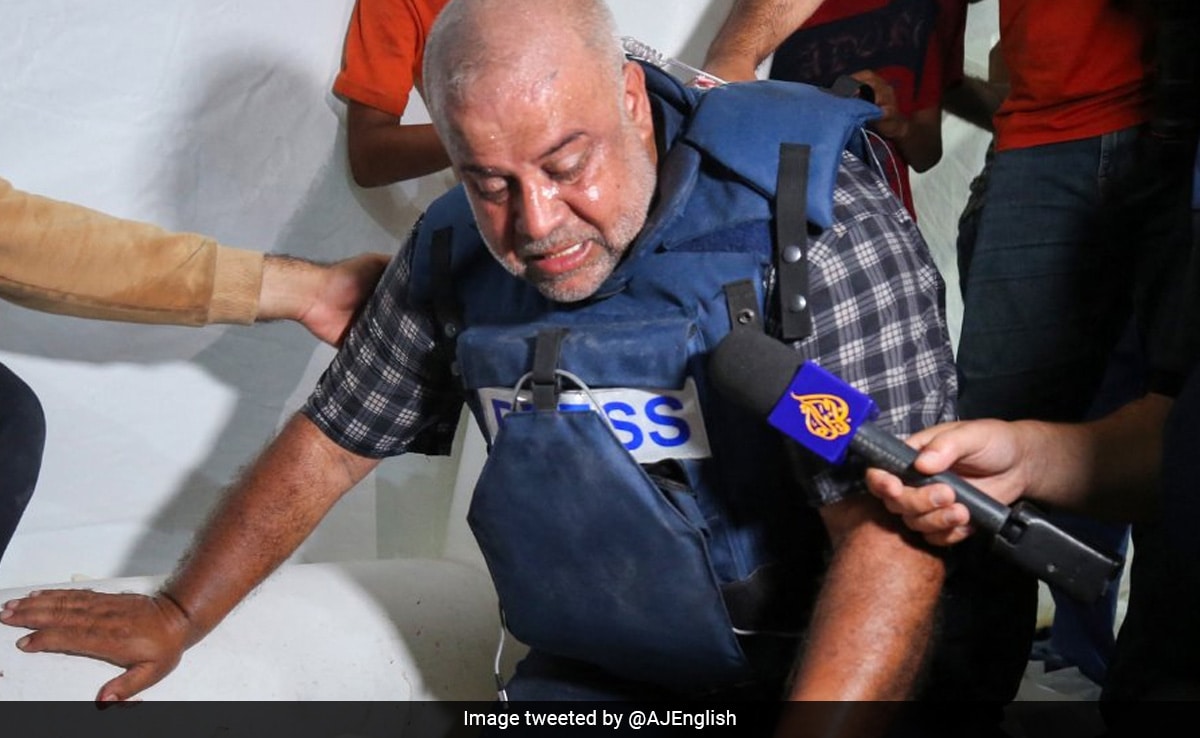
Jazeera journalist Wael Al Dahdouh – who 24 hours ago mourned the death of his wife, son, daughter and nine other family members in an Israeli air strike – has vowed to continue reporting on Tel Aviv’s war on Gaza. Mr Dahdouh told state-run Turkish news agency Anadolu, “This will never silence our voices. Journalism is my noble mission.” “Israel is targeting civilians and committing massacres against families. This is part of what Palestinian families living in Gaza go through every day,” Mr Dahdouh said.
Mr Dahdouh, who is Al Jazeera’s bureau chief in Gaza, was told his wife and children had been killed shortly after a live broadcast from the besieged enclave on Thursday.
Hours later Al Jazeera aired visuals from the morgue in the Al-Aqsa Martyrs Hospital in Palestine’s Deir el-Balah, where a grief-stricken Wael Al Dahdouh cradled the body of his seven-year-old daughter and cried over those of his wife and 15-year-old son.
READ | “In Gaza, No Safe Place”: Girl’s Plea Before Mother Dies In Israeli Strike
Mr Dahdouh’s two older children – Mahmoud and his sister Kholoud – are believed to have survived the attack. Days earlier they had shared a video message to the global community, highlighting the utter devastation in Gaza and pleading for help.
“Help us to stay alive” was their outcry to the world from Gaza.
Mahmoud, Al Jazeera Arabic’s Wael Dahdouh son, joined by his sister Kholoud, sent a message to the world, days before Mahmoud, his mother, and younger sister Sham were killed in an Israeli airstrike in Gaza ⤵️ pic.twitter.com/HWJ8SjIpvx
— Al Jazeera English (@AJEnglish) October 25, 2023
“Whole neighbourhoods have been destroyed,” Kholoud says in a video that shows residential buildings reduced to rubble and entire streets covered in that debris.
“In Gaza there is no safe place…”
READ | Why Israel Is Attacking South Gaza After Telling Civilians To Go There
The Dahdouh family was among a million civilians ordered by Israel to flee from north Gaza ahead of strikes that targeted residential neighbourhoods, as well as schools, mosques and hospitals. Israel also temporarily rolled tanks into north Gaza – the first step in its widely anticipated ground offensive.
READ | Israeli Tanks Enter North Gaza In “Targeted” Overnight Raid, Retreat Later
The family was sheltering in the United Nations-recognised Nuseirat refugee camp in central Gaza, which was called a “safe area” by Israeli forces.
The family of Al Jazeera’s Gaza bureau chief Wael Dahdouh has been killed in an Israeli attack at the Al Nuseirat Camp in central Gaza, where they had forcibly evacuated to shelter from Israeli bombardments ⤵️ pic.twitter.com/ya64Lgunbp
— Al Jazeera English (@AJEnglish) October 25, 2023
Despite the loss – shared by tens of thousands of innocent men, women and children from Gaza, Israel and other nationalities caught up in this bloody war – Mr Dahdough insisted to Anadolu he will continue covering Israel’s strikes on Palestinians.
Tel Aviv’s attacks on Gaza follows the October 7 cross-border attack by Hamas that claimed over 1,400 lives, including civilians and children. Israel has described the Hamas terrorists as “animals” and Prime Minister Benjamin Netanyahu has promised revenge.
Nearly 8,000 people have been killed in the conflict – the bloodiest of the five wars between Israel and Gaza so far. The dead include more than 6,500 Palestinians and 1,400 Israelis, as well as foreign nationalities.
Tel Aviv has allowed small aid convoys to enter Gaza, a heavily blockaded strip of land home to over two million people, but it is only a fraction of basic supplies needed.
NDTV is now available on WhatsApp channels. Click on the link to get all the latest updates from NDTV on your chat.

onmynews.com
Watch: Hasan Minhaj’s Response To Allegations Of Faking Racism And Islamophobia
Comedian Hasan Minhaj was accused in a recent New Yorker magazine story of fabricating or exaggerating the personal stories he tells in his stand-up routine. The article suggested that he was not truthful in his accounts of his life experiences, particularly those related to his experiences as a Muslim American and an Asian American. In response to this article, Hasan Minhaj, The Daily Show alum, released a detailed 21-minute video countering the allegations.
The article in The New Yorker implied that Hasan Minhaj may have stretched the truth when sharing his personal encounters with racism, Islamophobia, and political challenges.
Watch the video here:
In response to The New Yorker’s claims, Hasan Minhaj offers additional details on three stories from his stand-up routine that came under scrutiny. These stories involve his experience of being rejected for a prom date due to racism, encounters with undercover law enforcement monitoring the Muslim community in his hometown, and a personal incident involving an anthrax scare at his residence.
In the beginning of the video, he said he understands if fans are asking, “Is Hasan Minhaj just a con artist who uses fake racism and Islamophobia to advance his career? Because after reading that article, I would also think that.”
“I just want to say to anyone who felt betrayed or hurt by my stand-up, I am sorry. I made artistic choices to express myself and drive home larger issues affecting me and my community, and I feel horrible that I let people down.”
“And the reason I feel horrible is because I’m not a psycho,” he added. “But this New Yorker article definitely made me look like one.” He said the article was “needlessly misleading, not just about my standup but also about me as a person. The truth is, racism, FBI surveillance, and the threats to my family happened.”
“So I’m going to do the most Hasan Minhaj thing ever: I’m going to do a deep dive on my own scandal, with graphics, because there is so much evidence I gave the New Yorker that they ignored that I want to show you,” he continued.
According to The Hollywood Reporter, in Minhaj’s Netflix special Homecoming King, he tells a story of asking a white girl (whom he gives the pseudonym “Bethany Reed”) to prom, only to show up at her house and be told by her mother that Bethany won’t go with him because her family doesn’t want their daughter in pictures with “a brown boy.”
“Bethany’s mom really did say that-it was just a few days before prom,” he said in the video. “I created the doorstep scene to drop the audience into the feeling of that moment, which I told the reporter.”
In the video, Hasan Minhaj plays an audio clip of a portion of his conversation with writer Clare Malone, where they discuss the particular scene in question.
Additionally, the video presents emails and text messages exchanged between Minhaj and Bethany, demonstrating that he provided this evidence to the magazine. These messages show Bethany expressing gratitude to Minhaj for his efforts in protecting her and her family.