A first information report (FIR) has been filed against unknown people a day after oil leaked into a river and streams from a defunct heavy-oil power station in Manipur’s Leimakhong area.
The area has been completely sealed off and more security forces have been posted at the power plant, the Chief Minister’s Office said in a statement today.
A three-member committee to look into the incident has been formed; they will give a report to the Governor in 15 says, the state Home Department said in an order on behalf of the Governor. The report will look into what caused the “leak” and under what circumstances.
The Public Health and Engineering Department (PHED) will collect samples from the streams, Leimakhong river and downstream areas and send the samples to the Indian Institute of Technology (IIT) Guwahati daily, the department secretary N Kheda Varta Singh said in a letter to IIT Guwahati director Parameswar K Iyer. A team from IIT-Guwahati is also coming to Manipur.
Heavy-oil leak in Manipur’s Leimakhong
Residents in Kanto Sabal village, some 4 km from the power plant, found a layer of a viscous, black substance running in Leimakhong river towards Kanto dam on Wednesday night. The alarmed residents scooped up the greasy substance with buckets and found them smelling of oil, which they found also burned easily.
The residents contacted the authorities, after which in an unprecedented level of coordination in recent times the power, water resources, environment and disaster relief departments, along with the police and the district administration rushed to the area, the government said in the statement.
One of the officers who reached the river on Wednesday night was Dr T Braj Kumar Singh, director of Environment and Climate Change. “State government officials in cooperation with residents and state security managed to divert the contaminated river into nearby wastelands and unused lands, and blocked much of the flow from going downstream,” Dr Singh told NDTV on phone from Imphal.
He said most of the viscous layer of oil has been cleared, though in this season the water level is low, and the flow is not strong. “Some residual amount will remain. We will get to know more soon as the results of the samples being tested come,” said Dr Singh, a top expert on environment issues in the northeast, who has experience in the COP climate summit talks. He said he spent most of the night on Wednesday and most part of the day on Thursday near the river, collecting samples, directing teams and working with the residents.
The Manipur government is taking samples from the Leimakhong river and testing them
The Chief Minister’s Office said the course of the stream has been blocked and diverted to a nearby dugout field at Kanto Sabal to contain the spread of contaminants into the public water supply system.
The PHED’s initial reports say there is no damage to the drinking water supply system. The PHED has, however, as a precaution temporarily closed the water supply schemes located near the streams, and will re-open them once the test samples confirm the water is safe to drink. The government said it has arranged drinking water by boring tube wells and sending water tankers to the affected area.
The Chief Minister’s Office said residents who need drinking water may call these helplines – 8794006422, 7085922914.
While the police will run their own investigation separate from the committee formed by the Governor into how the leak happened, publicly available information throws up several questions as to the location of the heavy-fuel power plant and its distance to the river.
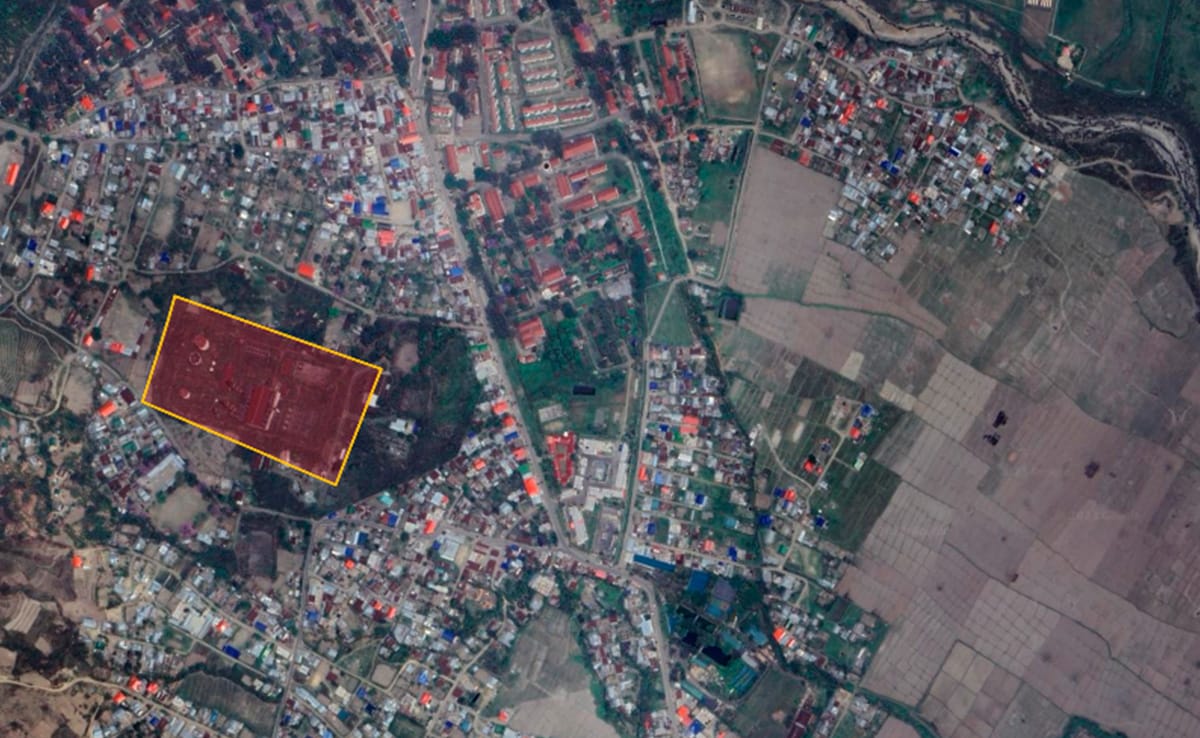
The nearest point from the power station to the river (pic 1) is 450 metres, while the farthest point is 2.5 km within Leimakhong, There are buildings, school, church, market and other structures between the river and the power plant. A surface oil leak would have contaminated the areas between the river and the power plant.
An electrical engineer who has been to this power plant while it was operational said the facility is a self-contained unit, with no fuel connection outside except the electricity outlet.
“I have been specifically told by the electrical engineer and another civil engineer that no piping goes out of the compound, and heavy fuel is stored inside the compound. Oil tankers from Assam and other areas used to bring heavy fuel to fill the tanks in the compound. For example, those storage tanks were like the ones in any fuel station,” the engineer who has over two decades of experience told NDTV, requesting anonymity.
He ruled out underground seepage from the storage unit as the residual heavy oil from the defunct power station was not enough in volume to push through the soil till the river. The tank would also act as a shield against the soil.
For reference, the tree (pic 2) shows the road towards the general direction of Leimakhong.
The image above (pic 3) shows the location of the power station. Notice the tree on the left for distance and direction reference.
The image above (pic 4) shows Kanto Sabal village and Kanto dam, where residents first saw the contaminant. The white arrows show the direction of the river’s flow.
The above image (pic 5) shows the entire area – (left to right) Leimakhong hills visible from the tree on the road, the river, the power plant and its distance from the river, the road to Leimakhong from the tree, Kanto Sabal village and dam, and the tree for reference.
Ethnic tensions between the hill-majority Kuki tribes and the valley-majority Meiteis persist eight months since May 2023, when violence broke out after the Kukis’ protest against the Meiteis’ demand for Scheduled Tribes’ (ST) status.
The “oil leak” amid the Manipur tension makes the matter extremely sensitive, since people from different communities live in the affected area downstream, and the area around the defunct power station.
Manipur Chief Minister N Biren Singh told NDTV in an exclusive interview on January 8 that the violence that began due to tensions between the two communities has now changed into a situation where insurgents are attacking the security forces.
“During these past eight months, unwanted incidents took place on some days, not for the whole eight months. Three-four months were peaceful and silent. The violence during the new year was between the state security forces and militants, not between two communities. Now, the dimension of the conflict has changed to state forces fighting against militants,” Mr Singh told NDTV.