Live · Global · Independent
Live Feeds
PinkVilla
Forbes
NDTV
Hindustan Times
Explained: How Abu Dhabi’s Hindu Temple Represents India-UAE Ties
onmynews.com

Explained: How Abu Dhabi’s Hindu Temple Represents India-UAE Ties

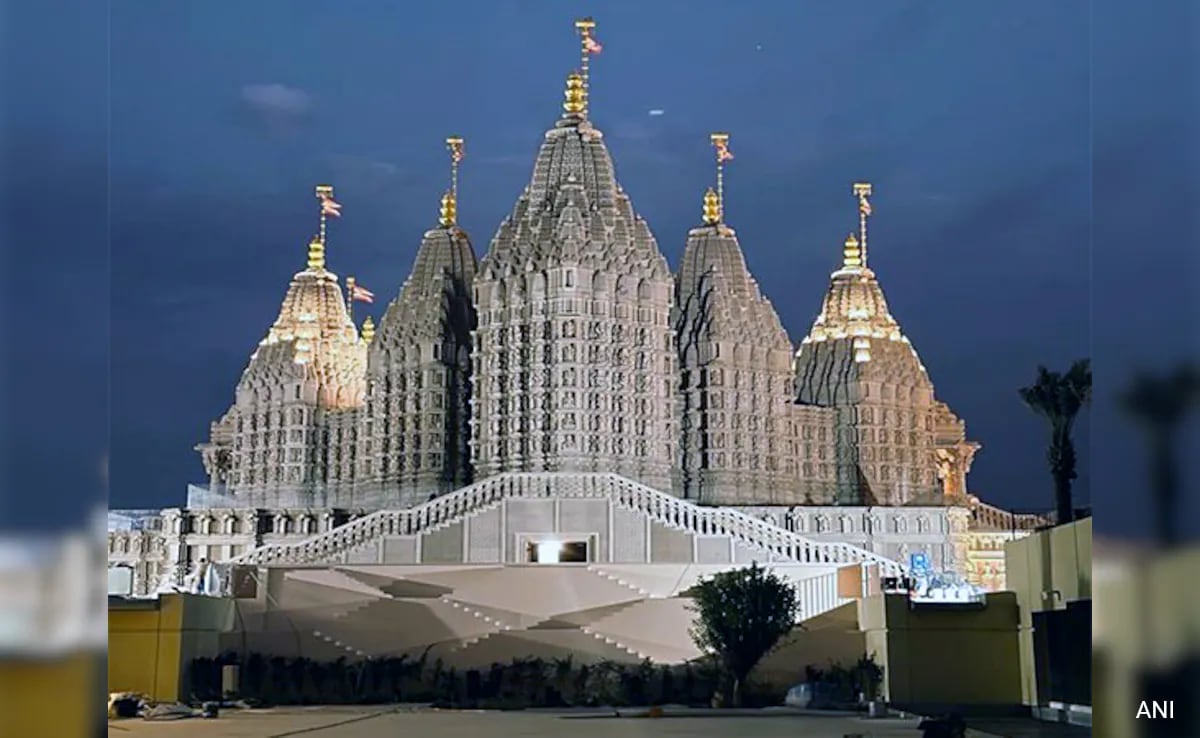
Bochasanwasi Shri Akshar Purushottam Swaminarayan Hindu Mandir or BAPS Hindu Mandir is spread over a 27-acre piece of land.
In 2015, then crown prince and current UAE President, Sheikh Mohamed bin Zayed Al Nahyan, donated 13.5 acres of land for the construction of the first temple in the UAE. In 2019, he gifted an additional 13.5 acres.
The temple represents the idea of coexistence – A Muslim king donated land for a Hindu Mandir, where the lead architect is a Catholic Christian, the Project Manager is a Sikh, and the Foundational designer is a Buddhist. Construction Company is a Parsi group, and the director comes from a Jain tradition.
Prime Minister Narendra Modi during the ‘Ahlan Modi’ event shared an anecdote and said “In 2015, when I presented to him (Sheikh Mohamed bin Zayed) the proposal to build a temple in Abu Dhabi on behalf of all of you, he immediately said yes to it…now the time has come to inaugurate this grand (BAPS) temple.”
Buildings surrounding the mandir are modern, minimalistic and monolithic. Symbolically 7 spires pay respect to the seven emirates of the UAE.
The iconic stone temple is located in Abu Mureikhah, near Al Rahba off the Dubai-Abu Dhabi Sheikh Zayed Highway.
The cost of the construction of the temple is estimated to be around 400 million United Arab Emirates dirhams, as per reports.
Just like all other BAPS mandirs around the world, this mandir is open to everyone and anyone.
The front side panel has lifesize panels of universal values, stories of harmony from different cultures, and representation of Avatars and Hindu Spiritual leaders.
The external facade of the mandir uses pink sandstone from Rajasthan. The mandir interior uses Italian marble with two central domes – ‘The Dome of Harmony’ and ‘The Dome of Peace’.
No iron material is used in the temple. Different types of pillars can be seen in the temple like circular, and hexagonal.
There are idols of historic figures, sages, and acharyas, who have sustained these values, that plinth is known as the plinth of values. Apart from Indian civilization, stories are taken from the Maya, Aztec, Egyptian, Arabic, European, Chinese and African civilizations etc.
Read full article
“Joy In Ayodhya Amplified In Abu Dhabi”: PM Modi Inaugurates Temple In UAE
onmynews.com

“Joy In Ayodhya Amplified In Abu Dhabi”: PM Modi Inaugurates Temple In UAE

Marking a significant milestone for the Indian community in the Middle East, Prime Minister Narendra Modi has inaugurated Abu Dhabi’s first Hindu temple, which is also the largest in the region.

Spread over 27 acres and built at a cost of over Rs 700 crore, the BAPS Hindu temple is also seen as a sign of the deepening relationship between India and the United Arab Emirates.

Speaking after inaugurating the temple PM Modi said in Hindi, “UAE has written a golden chapter in human history today. A grand and holy temple has been inaugurated in Abu Dhabi today. Years of hard work have gone into this temple and a long-cherished dream has come true. Bhagwan Swaminarayan’s blessings are also with this temple.”

Referring to the consecration ceremony of the Ram Temple in Ayodhya on January 22 the PM said, amid cheers, “A centuries-old dream was fulfilled. All of India and every Indian is still cherishing that feeling. My friend Brahmavihari Swamy was saying, ‘Modi ji s the biggest priest’. I don’t know if I have the qualifications of a temple priest but I am proud to be a priest of Maa Bharti (Mother India).”

Stating that every moment of his life and every molecule in his body is dedicated to Ma Bharti, the Prime Minister said, “The joy we felt in Ayodhya has been amplified in Abu Dhabi today. It is my honour that I witnessed the consecration of the temple in Ayodhya last month and this temple in Abu Dhabi today.”

PM Modi – who is in the UAE on a two-day visit and will leave for Qatar later on Wednesday – had praised UAE President Sheikh Mohamed bin Zayed Al Nahyan during an address at a mega diaspora event on Tuesday and said that the then crown prince had agreed to donate land for the temple during the leaders’ meeting in 2015. 

“I consider the construction of BAPS temple here as a reflection of your love for India and your vision for the bright future of UAE. This would not have been possible without your support. During our first meeting, I had made a simple request for you to look into it and you took a prompt decision, telling me ‘put your finger on any piece of land, you will get it’,” the PM had said. 

Mr Al Nahyan donated 13.5 acres of land for the construction of the temple in 2015 and PM Modi had laid the foundation three years later. Construction began in 2019 after an additional 13.5 acres of land was donated earlier that year.

Built by the Bochasanwasi Shri Akshar Purushottam Swaminarayan Sanstha (BAPS), the temple is located in Abu Mreikhah, near Al Rahba. The consecration ceremony of the idols began at the temple on Wednesday morning. 

Temple authorities said seven shikhars (spires) have been built at the temple representing the seven emirates that form the UAE.

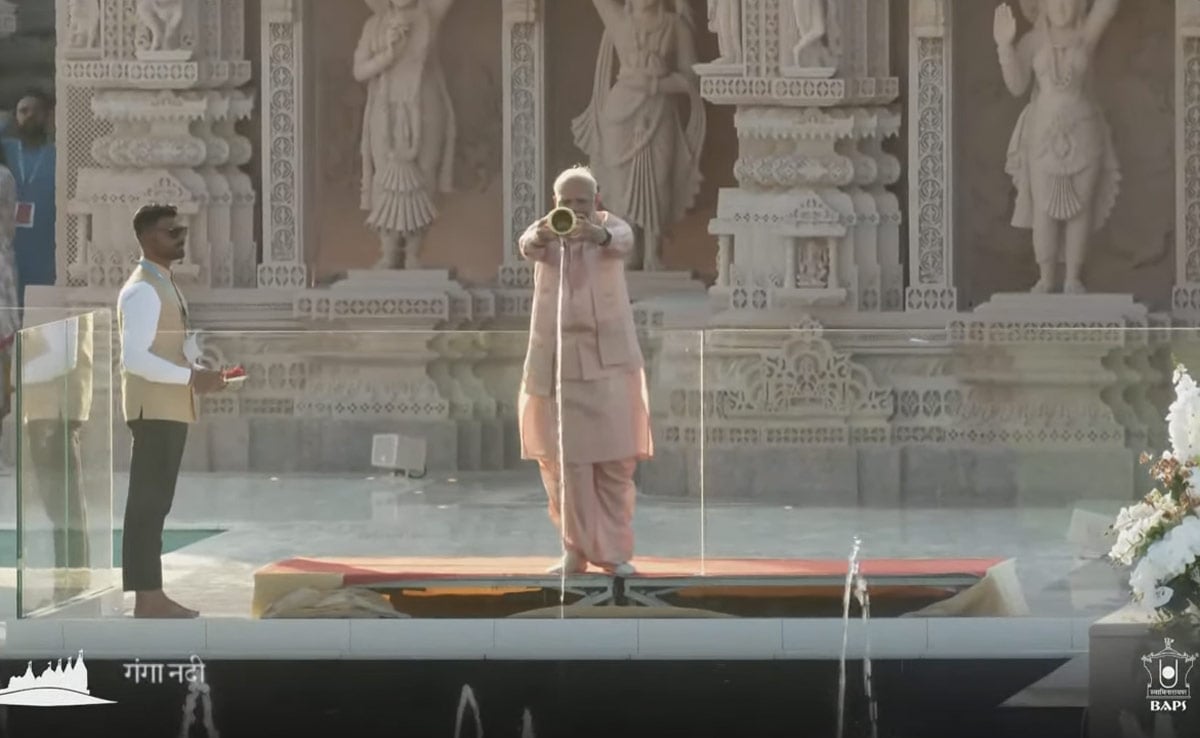
PM Modi also participated in a ‘global aarti (prayer)’, which was performed simultaneously at over 1,200 temples built by BAPS. Before inaugurating the temple, he offered water in the virtual Ganga and Yamuna rivers at the temple and met people from different religions who played a role in its construction. 

“The seven spires have idols of deities, including Lord Ram, Lord Shiv, Lord Jagannath, Lord Krishna, Lord Swaminarayan (considered a reincarnation of Lord Krishna), Tirupati Balaji and Lord Ayappa. The seven shikhars represent the seven emirates of UAE,” Swami Brahmaviharidas, head of international relations for BAPS, told PTI.

“The seven spires also pay homage to seven important deities, underscoring the interconnectedness of cultures and religions. Normally, our temples are either one spire, three, or five but the seven spires express our gratitude to the unity of the seven emirates. But at the same time, the seven spires enshrine seven important deities… The spirals aim to promote unity and harmony in the multicultural landscape,” he said.

PM Modi’s visit to the UAE is his seventh since 2015 and his third in eight months. Addressing the World Government Summit in Dubai earlier on Wednesday, the Prime Minister said Dubai is becoming the epicentre of the global economy and praised UAE President Al Nahyan, describing him as “a leader with vision and resolve”.

After the inauguration, PM Modi will leave for Doha and hold a bilateral meeting with the Qatari leadership. PM Modi’s visit to the country comes on the heels of Qatar releasing eight navy veterans from prison, which was seen as a huge diplomatic victory for India. 

Read full article
Watch: “Dome Of Harmony” Inside Sanctum Sanctorum Of Abu Dhabi Temple
onmynews.com

Watch: “Dome Of Harmony” Inside Sanctum Sanctorum Of Abu Dhabi Temple

Marking a significant milestone for the Indian community in the Middle East, Prime Minister Narendra Modi has inaugurated Abu Dhabi’s first Hindu temple, which is also the largest in the region. 

Spread over 27 acres and built at a cost of over Rs 700 crore, the BAPS Hindu temple is also seen as a sign of the deepening relationship between India and the United Arab Emirates.

PM Modi also participated in a ‘global aarti (prayer)’, which was performed simultaneously at over 1,200 temples built by BAPS. The Bochasanwasi Shri Akshar Purushottam Swaminarayan Hindu Mandir or BAPS Hindu Mandir, is spread over a 27-acre piece of land. The temple is 108 feet high and 180 feet wide and its seven spires represent the seven emirates.

The temple has 402 pillars and iron has not been used in any of them, making it the first Hindu stone temple in UAE. The pillars in the sanctum sanctorum of the temple are made of white Italian marble.

The pillars have intricate carvings of deities and symbols central to the Hindu religion. Seven shrines of different deities including, Lord Ram, Goddess Sita, Lakshmi, and Lord Shiv, are present in the temple. 

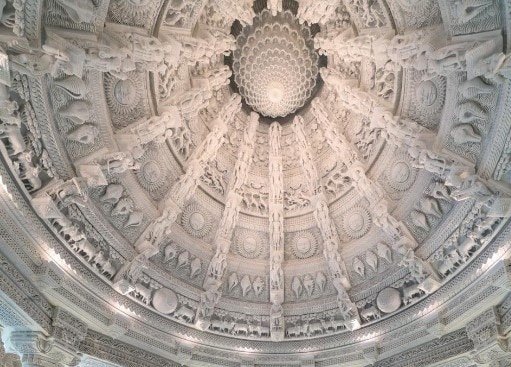
“Dome of Harmony has different levels. These levels represent the fire, earth, air, water and space. The shank represents water, Tej represents the sun and running Deers represent air,” a volunteer told NDTV.

“Every pillar inside the sanctum sanctorum is unique and every pillar has its pillar. There are 1,400 pillars, protected by a transparent shield. They represent differences, but they all make one pillar,” the volunteer added. 

The depiction of different civilizations on pillars makes the temple’s architecture unique. Apart from Indian civilization, stories are taken from the Maya, Aztec, Egyptian, Arabic, European, Chinese and African civilizations etc.

In a shrine of Lord Ram and Goddess Sita, the Ramayan has been carved on the stones and ‘shankh’ (shell) and sun have been sculpted on the dome of the shrine. The Vedic-style temple has two central domes – the ‘Dome of Harmony’ and the ‘Dome of Peace’.

The fine detailing in sculpting the deities and symbols makes the temple an architectural brilliance.

Read full article
Link copied!