Israel carried out air strikes on the south of Lebanon’s capital Beirut that it said targeted Hezbollah’s headquarters, moments after Prime Minister Benjamin Netanyahu vowed to keep fighting the militant group.
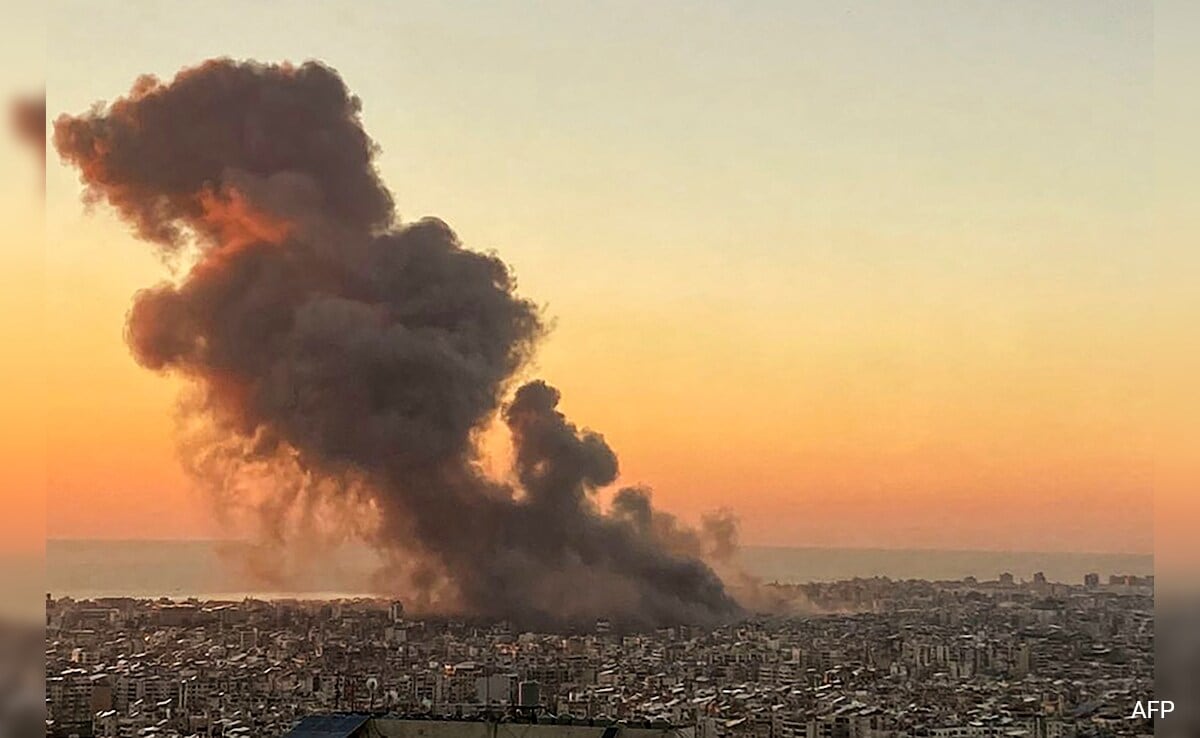
The strikes, heard across the city, sent huge clouds of smoke soaring above the densely populated south of Beirut, the main bastion of Iran-backed Hezbollah.
Israeli military spokesman Daniel Hagari said the strike targeted “the central headquarters” of Hezbollah in the southern suburbs of the city.
The bombing came moments after Netanyahu concluded his address to UN General Assembly delegates in New York, at which he vowed to keep up strikes against Hezbollah and fight “until victory” against Hamas.
Hezbollah and Israel have been locked in a deadly exchange of cross-border fire since the group’s Palestinian ally, Hamas, attacked Israel on October 7.
Israel’s aerial bombardment of Hezbollah strongholds around Lebanon has killed around 700 people this week alone, according to the health ministry, but a US-led bid for a ceasefire has failed to take hold.
“As long as Hezbollah chooses the path of war, Israel has no choice, and Israel has every right to remove this threat and return our citizens to their home safe,” Netanyahu told the UN General Assembly, adding that operations against the Iran-backed militant group will “continue until we meet our objectives.”
Nearly a year into the war with Hamas in Gaza, Israel shifted its focus to its northern front with Lebanon, with its wave of aerial bombardment sparking an exodus of around 118,000 people.
On Friday, Lebanon’s National News Agency said Israeli air strikes had intensified overnight, and that one strike had killed a family of nine in south Lebanon.
Hezbollah fired rockets into the northern Israeli city of Tiberias, saying it was responding to “savage” strikes on Lebanese towns and villages.
‘Deadliest in a generation’
“Everything is collapsing around us,” said Lebanese businessman Anis Rubeiz, 55.
“People are tired mentally… I don’t see (hope) on the horizon… or even a ray of light.”
The UN children’s agency condemned the violence, saying the attacks on Lebanon were killing children “at a frightening rate”.
“We are witnessing the deadliest period in Lebanon in a generation, and many express their fear that this is just the beginning,” the UN humanitarian coordinator in Lebanon, Imran Riza, said.
In Israel, too, many were weary of the violence.
“It is incredibly exhausting to be in this situation. We don’t really know what’s going to happen, there’s talk of a ground offensive or a major operation,” said Lital Shmuelovich, a physiotherapy student.
Netanyahu also addressed the war in Gaza, saying that Israel’s military would continue to fight Hamas until the Islamist movement was crushed.
“If Hamas stays in power, it will regroup… and attack Israel again and again and again… So Hamas has got to go,” Netanyahu said, vowing to fight the group until “total victory”.
Diplomats have said efforts to end the war in Gaza were key to halting the fighting in Lebanon and bringing the region back from the brink of all-out war.
But despite months of mediation efforts, a Gaza ceasefire remains elusive.
Hamas’s October 7 attack resulted in the deaths of 1,205 people, mostly civilians, according to an AFP tally based on Israeli official figures that include hostages killed in captivity.
Of the 251 hostages seized by militants, 97 are still held in Gaza, including 33 the Israeli military says are dead.
Israel’s retaliatory military offensive has killed at least 41,534 people in Gaza, most of them civilians, according to figures provided by the Hamas-run territory’s health ministry. The UN has described the figures as reliable.
After the Hamas attack, the deadliest in Israel’s history, Netanyahu vowed to bring the hostages home and to crush Hamas.
This month, he said securing Israel’s border with Lebanon was also a war objective, to allow residents of northern Israel who have had to flee the area to return to their homes.
Hezbollah commander killed
For the fourth time in a week, Israel carried out a strike on Hezbollah’s south Beirut stronghold, killing Mohammed Srur, the head of Hezbollah’s drone unit.
Hezbollah held a funeral ceremony for Srur on Friday.
The Lebanon violence has raised fears of wider turmoil in the Middle East, with Iran-backed militants across the region vowing to keep up their fight with Israel.
On Thursday, the Israeli military said it intercepted a missile fired from Yemen.
The leader of Yemen’s Huthi rebels, Abdul Malik al-Huthi, said in a televised address Thursday that the Iran-backed group would “not hesitate to support Lebanon and Hezbollah”.
An Israeli air strike on Lebanon’s border with Syria killed five Syrian soldiers, according to state news agency SANA.
Iran is a key ally of Syria, where it has helped prop up President Bashar al-Assad since the start of the civil war in 2011.
Netanyahu also took aim at Iran in his UN General Assembly address, saying: “I have a message for the tyrants of Tehran. If you strike us, we will strike you.”
He added: “There is no place in Iran that the long arm of Israel cannot reach, and that’s true of the entire Middle East.”
Analysts say Iran will try to resist being dragged into the conflict but it is walking a tightrope trying to support Hezbollah without getting dragged into a full-blown war and playing into its enemy’s hands.
(Except for the headline, this story has not been edited by NDTV staff and is published from a syndicated feed.)