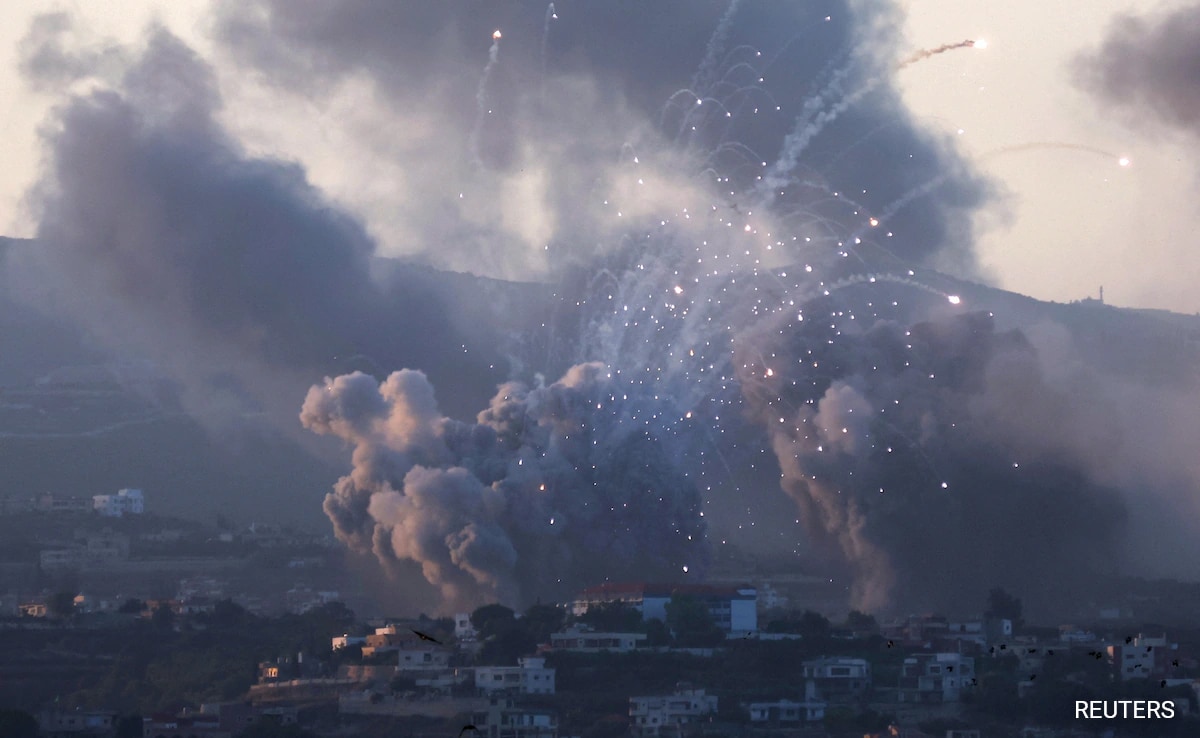
Hezbollah, a Lebanon-based Shia militant group has lost its chief in Israeli air strikes in the capital Beirut. The Israel Defence Forces have moved the conflict north and have vowed to uproot Hezbollah’s political and military arsenal. In the last few weeks intense cross-border shelling and rocket attacks have been witnessed with no sign of a descalation.
Since the pager and walkie-talkie explosions across Lebanon which killed over 30 and injured thousands, the war between Hezbollah and Israel has intensified, with the former calling it a “massacre”. Since Israel invaded Gaza last year to destroy Hamas, Hezbollah has been targeting northern Israel which led to a mass displacement of over 70,000 people due to frequent rocket attacks.
‘Settling Scores’
Israeli Prime Minister Benjamin Netanyahu said they have “settled the score” after killing Hezbollah General Secretary Hassan Nasrallah in an air strike. This came after a week-long aerial bombing campaign carried out by IDF across Lebanon. The heat signature detected by NASA’s Visible Infrared Imaging Radiometer Suite (VIIRS) instrument explains the extent of attacks.
NASA’s Active Fire Map for the last seven days
Pink indicates the urban settlement and the red dots show the region’s active fire data for the last seven days. This is more likely a result of Israeli air strikes and artillery bombing. The data processed by VIIRS shows how Israeli raids were focused more on southern Lebanon, where it believed most of the Hezbollah cadre was stationed.
NASA’s Active Fire Data for the last three days
The bombing campaign over the weekend also included the capital Beirut, where Hassan Nasrallah was killed along with Ali Karaki, the southern front commander of Lebanon and 19 other Hezbollah members. On its east bordering Syria, the campaign was primarily aimed at blocking the supply of weapons from Syria – A state which has an ongoing conflict with Israel and is backed by Iran.
The border between Syria and Lebanon acts as the supply line for weapons and reportedly some manufacturing units are located in southern Lebanon, as claimed by IDF in a post on X after it carried out strikes east of Beqqa valley, south and north Lebanon.
When NASA’s active fire data can be backed by the Institute for the Study of War (ISW) analysis which geolocates the Israeli bombing campaign, suggesting that the heat signatures detected by VIIRS were indeed from the bombing campaign.
This is not an exhaustive list of strikes. Israel has been conducting strikes daily in Lebanon.
“We settled the score with the one responsible for the murder of countless Israelis and many citizens of other countries, including hundreds of Americans and dozens of French,” Netanyahu said after it was confirmed that Nasrallah was dead. Meanwhile, Israeli military spokesman, Daniel Hagari, said “the world would be a safer place with him (Hasrallah).”
According to the IDF, it has eliminated most of the Hezbollah top cadre.
The list has been compiled after claims made by IDF and data analysed by ISW
Over 1,000 people died in Lebanon in the bombardment which began after the pager and walkie-talkie explosions across the country intended to disrupt the communication network of Hezbollah. Most of the deaths came last Monday, the deadliest day in Lebanon’s history since the 1975-90 civil war.
Israel says that it warned the civilian population to evacuate the region before the bombing but almost every attack was directed toward urban settlements. IDF claims that Hezbollah is hiding weapons in populated areas, which act as a shield against attacks.
“For the last 20 years, Hezbollah built its terror network within population centres in Lebanon – primarily throughout southern Lebanon, an area that they turned almost entirely into a launch pad to attack Israel.”
Iran Is Furious
Hezbollah is part of Iran’s “Axis of Resistance” – a group of nations, and proxies – that came into existence after the Iranian revolution in 1979. This includes Syria, Houthi rebels in Yemen, Hamas, the Islamic Resistance in Iraq, Hezbollah and other Palestinian groups.
Hezbollah has participated in the Lebanese Government since 1992. In 2005, a UN Security Council resolution called for disarming militias in Lebanon, but Hezbollah has actively tried to justify the retention of arms by calling itself the defender against Israeli aggression. Since the war between Israel and Hezbollah in 2006, where the latter kidnapped two Israeli soldiers, it has sought to use the conflict to justify its move.
After the death of Nasrallah, Iran has lost an ally in the region that could wage war against Israel. The Hezbollah cadre remains but precision strikes came as a blow, especially after several reports suggest an Iranian spy colluded with Israel and gave coordinates for strikes against Nasrallah.
Iran also vowed to avenge the killing of Revolutionary Guards General Abbas Nilforoushan, who died alongside the Hezbollah leader.
Nasrallah’s death came around two months after Palestinian group Hamas’s political chief Ismail Haniyeh was killed in late July in Tehran where he had attended President Masoud Pezeshkian’s inauguration.
Israel is fighting on two fronts – Gaza and Lebanon – while it has largely succeeded in destabilizing Hamas’s chain of command, the cost of the war was borne by over 40,000 people who have died in a campaign that is in its eleventh month. A similar situation is unfolding in Lebanon.
Houthi rebels fired a rocket to express solidarity over Nasrallah’s death. Late at night, Israel carried out air strikes in Yemen, killing four and injuring 33.
Iran – reeling from the economic impact of international sanctions – has managed to keep afloat its operations through proxies outside its territory but is treading with caution to avoid any major US response.
Tehran-based international relations professor Mehdi Zakerian said the Iran-aligned resistance front “was not only unable to contain Israel, it also suffered serious blows”. “If the government wants to get involved in reconstructing Lebanon or re-equipping Hezbollah, it will aggravate Iran’s economic crisis,” he added.
Ali Vaez of the International Crisis Group says, Iran “has every interest in trying to preserve whatever remains of Hezbollah. Hezbollah is Iran’s shield. I don’t think Iranians would give up on almost 40 years of investment in this project overnight because a dozen people were eliminated.”