onmynews.com
Chennai Metrowater fixes sewage overflow in Washermanpet
Chennai Metrowater fixes sewage overflow in Washermanpet
Chennai Metrowater fixes sewage overflow in Washermanpet
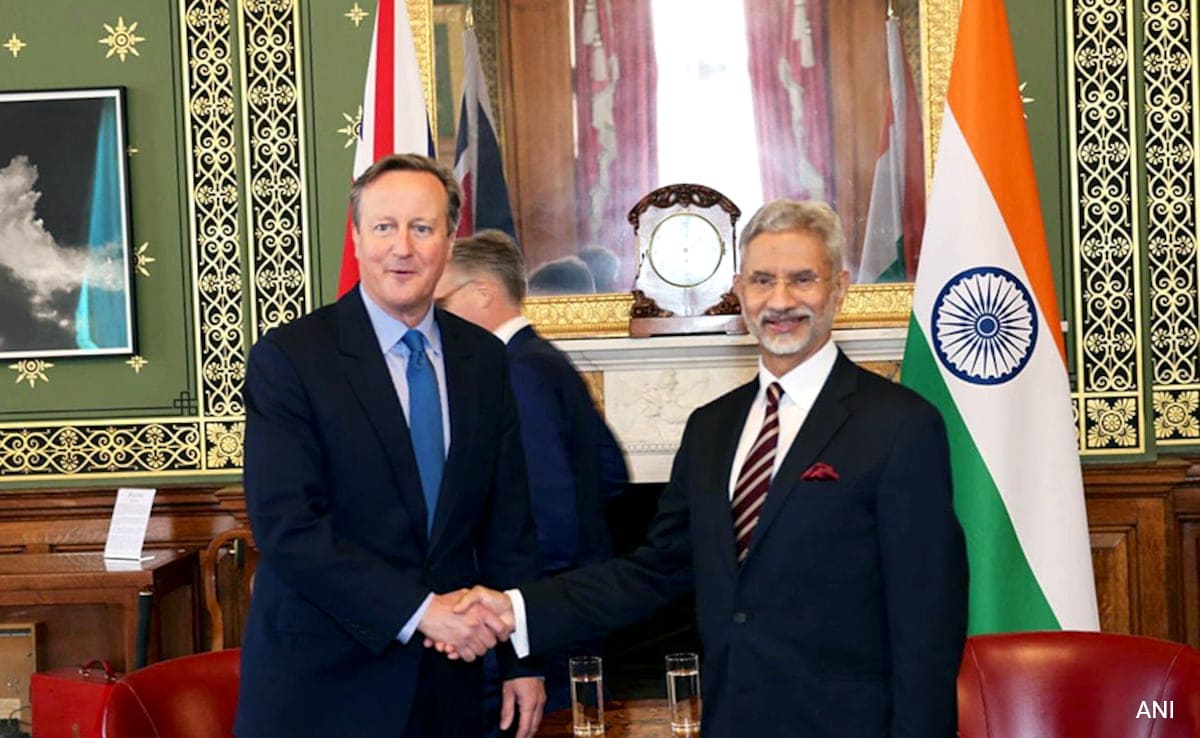
The free trade agreement (FTA) is very much the focus of the India-UK relationship today and India is hopeful of finding a “landing point” in the negotiations that works for both sides, External Affairs Minister S Jaishankar has said.
At a special Diwali reception organised by the High Commission of India at Westminster Central Hall near the Houses of Parliament here on Monday evening, Mr Jaishankar addressed a large diaspora gathering during which he described the bilateral relationship with the UK as a “positive force” for the world.
He also shared insights into the fast pace of technological advances and socio-economic development underway in India, calling on the UK-based Indian diaspora – one of the largest in the world – to spread the story of the new India.
“Today, to realise the Agenda 2030, we are focusing on what is officially called an Enhanced Trade Partnership, in common terms it’s called an FTA – or free trade agreement. And that is today very much the focus of what the Indian and British systems are negotiating, and we hope that we will find a landing point that works for both of us,” said Mr Jaishankar.
“India and the UK have a long history, and a very complex history. What we are trying to do is to make history a positive force with our commonalities, shared practices and institutions… to make history work for us,” he said.
India and the UK have been negotiating a free trade agreement (FTA) since January last year with a target to significantly enhance the estimated 36-billion Pound bilateral trading partnership.
The talks have undergone 13 rounds of negotiations, with officials hopeful of clinching a deal ahead of general elections in both countries scheduled for 2024.
Mr Jaishankar, who arrived in the UK over the weekend for a five-day visit, began his address by thanking British Prime Minister Rishi Sunak for taking the time to host him at 10 Downing Street on a busy Diwali day on Sunday.
Referencing the UK government upheaval on Monday, he spoke of how he “really valued” that the newly appointed Foreign Secretary David Cameron – elevated to the Cabinet in a surprise reshuffle by Mr Sunak just hours before – made time to meet him on day one of his new job even before he “addressed his own ministry”.
“It was extremely satisfying to hear from him about the commitment and support for the relationship. We spent a lot of time talking about cultivating both,” he said.
Mr Jaishankar shared that he also met Mr Cameron’s predecessor and outgoing foreign secretary, new UK Home Secretary James Cleverly, whom he described as a “pillar of strength” for the bilateral relationship.
Mr Jaishankar noted: “There is a global significance for a stronger India-UK relationship. Today, one of the biggest problems the world faces is somehow the manner in which globalisation has unfolded across borders in the last 30-odd years. It has led to a concentration of production in certain limited geographies.
“The India-UK relationship can actually contribute to making India and UK stronger factors in contemporary technology, in greater manufacturing, in science and innovation, and much more relevant ways of modernising… it can also promote pluralism, democracy, respect for diversity in the world because these are values and practices that we hold very dear,” he said.
The External Affairs Minister also flagged the “wonderful” diaspora, which he said acts as a “motivator” to enhance bilateral ties and meet the “enormous promise” of the relationship.
On the domestic front, he highlighted a series of schemes unfolded by Prime Minister Narendra Modi-led government and pointed to the “brand enhancement” of India with the Chandrayaan space mission as a sign of a country that is “dreaming big and executing big”.
“So, I want you to understand that it’s not just change, it is the enormity of the change taking place today… by the end of this decade, India will be a very different society than what it started off as in 2014. And, if there is one particular aspect of this that should really give us all cause for optimism, it is the enthusiasm with which India has embraced technology,” he said, to applause, as he explained how street vendors in the country now use QR codes to conduct their day-to-day sales.
The minister hoped that his current visit would help to set “our relationship not just on a firmer footing” and also “open up new pathways for collaboration.”
Mr Jaishankar, accompanied by wife Kyoko Jaishankar, was joined on stage at the event by UK Foreign Office Minister for South Asia Lord Tariq Ahmad and Indian High Commissioner to the UK Vikram Doraiswami.
The minister is expected at a repatriation ceremony for two ancient temple sculptures from Uttar Pradesh and will join a discussion on the theme of ‘How a billion people see the world’ before he concludes his UK visit on Wednesday.

Gaza’s biggest hospital has buried 179 people, including babies, in a “mass grave” inside its compound, Al Shifa Hospital chief Mohammad Abu Salmiyah said Tuesday, underlining the catastrophic humanitarian crisis developing at medical facilities across the region.
“We were forced to bury them in a mass grave,” the hospital director said. Seven babies and 29 patients from the intensive care unit were buried after the hospital’s fuel supplies ran out.
“There are bodies littered in the hospital complex. There is no more electricity…”
A journalist, who is collaborating with AFP, said the stench of decomposing bodies was everywhere.
A surgeon at the hospital, working with Doctors Without Borders, called the situation “inhuman”.
“We don’t have electricity. There’s no water in the hospital. There’s no food.”
The Al Shifa Hospital is Gaza City’s largest and was cut off from the world for over 72 hours last week after a deadly blockade by Israeli forces that included tanks at the front gates; Tel Aviv insists the hospital sits atop a network of tunnels that form part of the Hamas’ underground headquarters.
Israel has accused the terror group of using hospitals and patients as human shields, an accusation the Hamas and Gaza health officials have denied. In a separate incident, Israel claimed to have discovered a tunnel leading into another hospital from the home of a known Hamas operative.
The United Nations believes thousands, and perhaps more than 10,000 – including patients, staff and displaced civilians – may be inside and unable to escape because of fierce fighting nearby.
Hospitals, and medical personnel, are protected under international humanitarian law and parties in conflict must ensure their protection. They cannot be used to shield military objectives from attack, but any operation around or within must protect patients, staff, and other civilians, the United Nations’ Office for Coordination of Humanitarian Affairs said in its Monday update from Gaza.
Israel had pledged to help evacuate the babies. That has not happened so far.
Earlier today, a heart-breaking image emerged from the same hospital – of seven babies bundled together, some in non-descript, hospital-green fabric and others with tubes sticking out of them.
READ | Gaza Babies Laid In Rows For Warmth; “I Had 39, Now 36 Left”, Says Doctor
“Yesterday I had 39 babies… today 36,” Dr Mohamed Tabasha, the paediatric head, told Reuters Monday. “I cannot say how long they can last. I can lose another two babies today… or in an hour.”