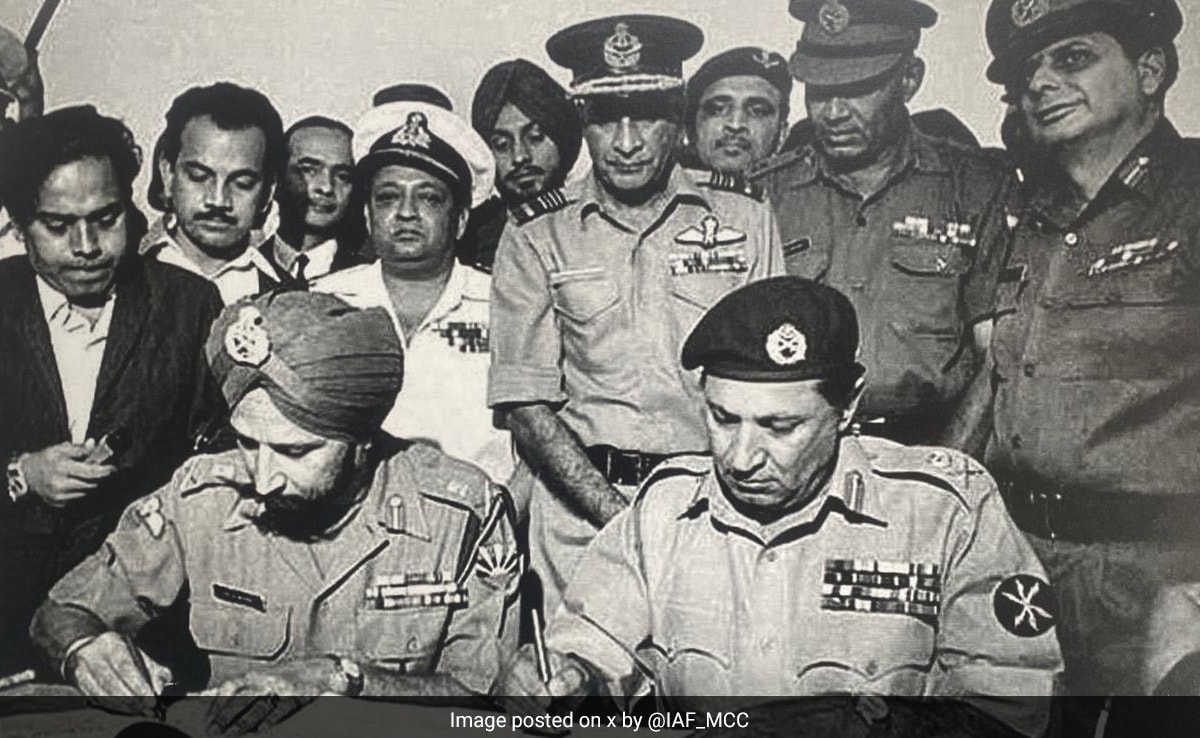
India celebrates Vijay Diwas today to mark the surrender of East Pakistan troops in the 1971 war. Fifty-two years ago the war led to the liberation of East Pakistan and the creation of Bangladesh.
Some important events played in India’s favour that led to the fall of Pak regime in Dhaka and the surrender of over 90,000 troops in East Pakistan in a fortnight of fighting.
Land, Sea and Air Operation
East Pakistan was isolated from its western half following India’s declaration of a no-fly zone for Pakistani aeroplanes. A naval blockade in the west disrupted all routes to supply relief and ammunition.
Within three days of the start of the war, the Indian Air Force established air superiority in East Pakistan, which helped in the swift advance of the army deep inside Bangladesh. INS Vikrant, the navy’s aircraft carrier, and naval aviators blocked reinforcements to the east, cutting off escape routes and Sea Lines of Communication (SLOC).
Meanwhile, the Indian Army’s 4, 33 and 2 Corps marched toward Bangladesh from three directions. The objective was to capture the “fortress cities” built by Pakistani troops and move through the gaps to take on Dhaka. The fall of Sylhet, Chittagong, Tangail, Khulna, Jessore, etc. ensured no escape route was left.
Psychological Warfare
Before the war began, the Pakistani troops in the east led by General AAK Niazi believed that India would take territories along the border in West Bengal. This false impression forced Pakistan to create “fortress cities” around Dhaka, leaving insufficient troops in the capital. The fall of each city made Dhaka look closer and air dropping in Tangail, which was reported as a paradrop of 5,000 troops, was a psychological blow.
Then army chief General Sam Manekshaw (later Field Marshal) broadcast a message for Pakistani troops after the fall of Jessore on December 8, warning Pakistani troops and assuring them “Once you surrender, you shall be treated with dignity as per Geneva Convention”. On December 10, in another message, General Manekshaw said, “Your resistance is gallant but fruitless…Your commanders are giving false hopes.”
US, China Fail To Come To The Rescue
Lt Gen Niazi reportedly told Maj General JFR Jacob after the surrender that he had recognised defeat at least seven days before the troops gave up arms. Pakistan had pinned its hopes on the US and China.
India’s support from the USSR prompted Pakistan to seek help from the US during the Cold War. The Chinese were recovering from the impact of the ‘Cultural Revolution’ and a war deep inside India did not favour them. Massive mobilization of Chinese troops in winter had to be carried out to penetrate deep inside East Pakistan and ensure supply lines were maintained. For China, diverting Indian troops to the northeast meant going for a high-altitude winter war.
Then US President Richard Nixon ordered the deployment of its Seventh Fleet comprising its nuclear-powered aircraft carrier – USS Enterprise. President Nixon believed the presence of a US fleet would take on INS Vikrant, weaken India’s naval blockade and force the navy to step back on the defensive because of the US’ “Gunboat Diplomacy”. The Indo-Soviet treaty came to the rescue. USSR deployed frigates, cruisers, tankers and destroyers armed with atomic missiles.
This deployment brought the two superpowers against each other and hostilities were defused, leaving Pakistan in the east alone.
Surrender
Rapid Indian advance coupled with joint air and naval operations broke the supply of any help to East Pakistan. In the Western theatre, Pakistani troops managed to resist strongly, and the Pakistan Air Force provided air support to its troops, but in the east, the fall of Dhaka was inevitable.
On December 13, Gen Niazi sent a distress signal to Rawalpindi in West Pakistan but was told to continue fighting and hold as much territory as possible. A day later, the Indian Air Force bombed the Governor House in Dhaka when a meeting was ongoing in the building. The air strike had such a demoralizing effect that the East Pakistan government resigned on the spot. This was the last straw on the camel’s back and Niazi chose peace over more fighting.