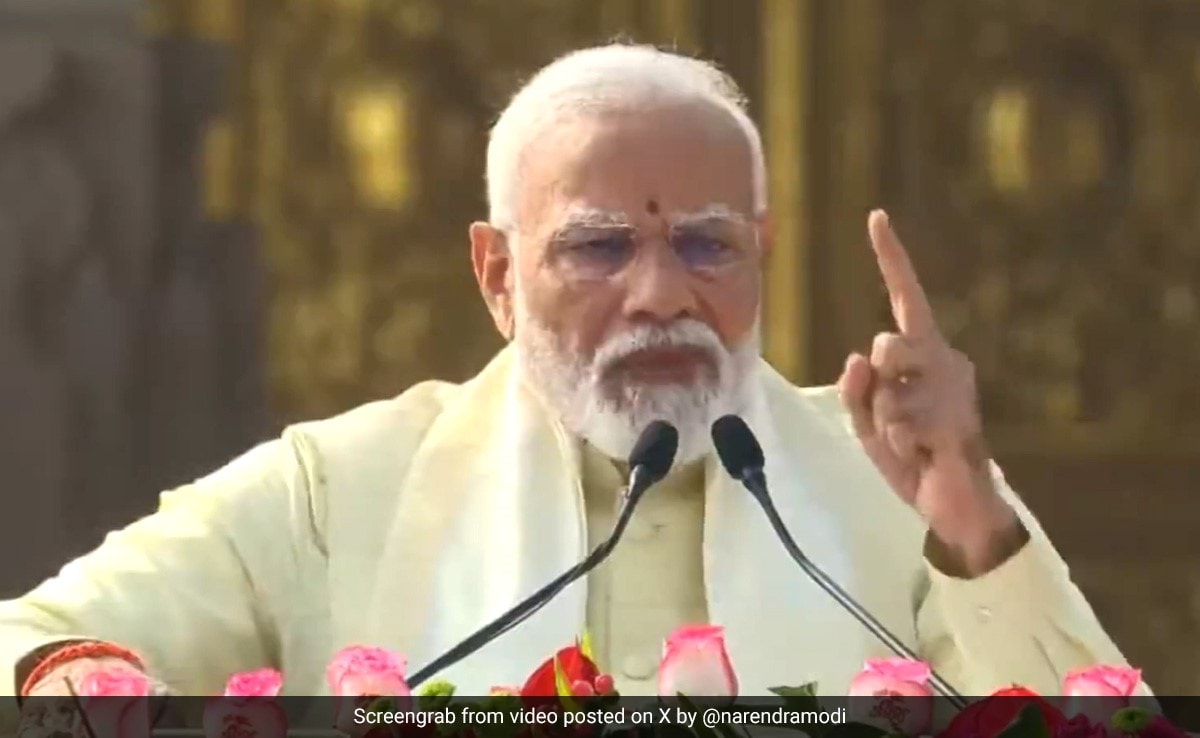
Nearly 400 pillars, 44 doors, and a brand new idol of Lord Ram – the grand temple in Ayodhya was officially inaugurated today by Prime Minister Narendra Modi, with hundreds of religious figures, politicians and Bollywood celebrities in attendance.
As the country witnesses the ceremony in the ancient city, here’s a look back at how a 500-year dispute culminated in the construction of the Ram Temple in Ayodhya.
1528: Babri Masjid’s Origin
The beginning of the Ram Temple movement lies in the construction of the Babri Masjid in 1528 by Mir Baqi, a commander of Mughal emperor Babur. The belief that the mosque was built on the ruins of a Hindu temple set the stage for decades of debate and clashes between two communities.
1751: A Maratha Claim
Writer and former Rajya Sabha MP from the Bharatiya Janata Party (BJP) Balbir Punj, in his book ‘Tryst with Ayodhya: Decolonisation of India’, writes that the Marathas sought control of Ayodhya, Kashi, and Mathura, effectively setting the stage for several contentions.
1858: Nihang Sikhs’ Demand
In 1858, Nihang Sikhs made an attempt to claim Babri Masjid as Lord Ram’s birth place. This incident marked the beginning of the struggle for control over the disputed site, foreshadowing conflicts to come.
The Supreme Court, in its landmark 2019 ruling, mentioned that Nihang Baba Fakir Singh Khalsa, along with 25 Nihang Sikhs, reportedly barged into the Mosque’s premises and made a claim that the site of the mosque was the historic birthplace of Lord Ram.
1885: The First Legal Claim
Raghubar Das, a priest of the Nirmohi Akhara filed the first legal suit in 1885, seeking permission to build a temple on the outer courtyard of the mosque. Though dismissed, it set a legal precedent and kept the dispute alive.
By then, the British administration in the city put a fence around the site marking separate areas of worship for Hindus and Muslims, and it stood that way for nearly 90 years.
1949: ‘Ram Lalla’ Idols Inside Babri Masjid
The night of December 22, 1949, saw the placement of ‘Ram Lalla’ idols inside the Babri Masjid, intensifying the religious sentiments around the site and leading to legal battles over its ownership.
The Hindus claimed that the idols “appeared” inside the mosque. The property dispute went to court for the first time this year.
1950-1959: Legal Suits Multiply
The following decade witnessed a surge in legal suits, with Nirmohi Akhara seeking rights to worship the idols and the Sunni Central Waqf Board seeking possession of the site.
The legal quagmire deepened.
1986-1989: Babri Masjid Locks Opened
In a controversial move, in 1986, during the Rajiv Gandhi-led Congress government at the Centre, the locks of the Babri Masjid were opened, allowing Hindus to worship inside. This decision further fueled tensions and became a pivotal moment in the Ram Janmabhoomi narrative.
The Vishwa Hindu Parishad (VHP) set a deadline for the construction of the Ram Mandir in 1990, escalating the demands for a temple. This period also saw the beginning of a Rath Yatra by BJP veteran LK Advani.
A seismic shift as political leaders, particularly from the VHP and the BJP, mobilised support for the ‘liberation’ of Ram Janmabhoomi.
1990: Rath Yatra and Failed Demolition Attempt
Amidst the Mandal Commission’s implementation and rising political tensions, L.K. Advani’s Rath Yatra in 1990 aimed to mobilize support for the temple. Despite a failed attempt to demolish the mosque, it marked a significant turning point in the movement.
1992: The Infamous Demolition
The year 1992 witnessed a climax – the demolition of the Babri Masjid. Despite assurances to the Supreme Court, the mosque was razed by Hindu activists. The cataclysmic event and the riots that followed changed Indian politics forever.
1993-1994: Post-Demolition Riots
In the aftermath of the Babri Masjid’s demolition, communal riots erupted across India, resulting in the loss of lives and properties.
The PV Narasimha Rao-led Central government’s acquisition of the disputed area was challenged by Dr Ismail Faruqui, leading to a Supreme Court ruling in 1994. The judgment upheld the acquisition, further entrenching the state’s involvement in the matter.
2002-2003: ASI’s Excavation and Allahabad High Court Hearing
The Allahabad High Court began hearing the title case in 2002, and the Archaeological Survey of India (ASI) conducted excavations, claiming evidence of a Hindu temple beneath the mosque.
The legal battle continued.
2009-10: Liberhan Report Submission
After 399 sittings over 16 years, the Liberhan Commission submitted its report, revealing intricate details of the Babri Masjid demolition and implicating key leaders.
The Liberhan Commission submitted its report on June 2009 – naming LK Advani, Atal Bihari Vajpayee and other BJP leaders – almost 17 years after it began its inquiry.
The Allahabad High Court’s 2010 verdict attempted to settle the dispute by dividing the land among Hindus, Muslims, and the Nirmohi Akhara. However, the decision faced appeals and further legal challenges.
2019: Supreme Court’s Historic Judgment
In a landmark judgment in 2019, the Supreme Court awarded the entire disputed land to Hindus for the construction of the Ram Temple and allocated an alternate site for the construction of a mosque.
2020: Ram Temple Foundation Stone
Prime Minister Narendra Modi laid the foundation stone for a grand Ram Temple on the Babri masjid site on August 5, 2020.
A ‘Bhoomi Pujan’ and the formation of the Shri Ram Janmabhoomi Teerth Kshetra Trust paved the way for the construction of the Ram Temple, bringing a semblance of closure to a protracted legal saga.
2024: PM Modi Inaugurates The Ram Temple
PM Modi led the consecration ceremony of the idol of Ram Lalla in the newly-built temple in Ayodhya on January 22, 2024.