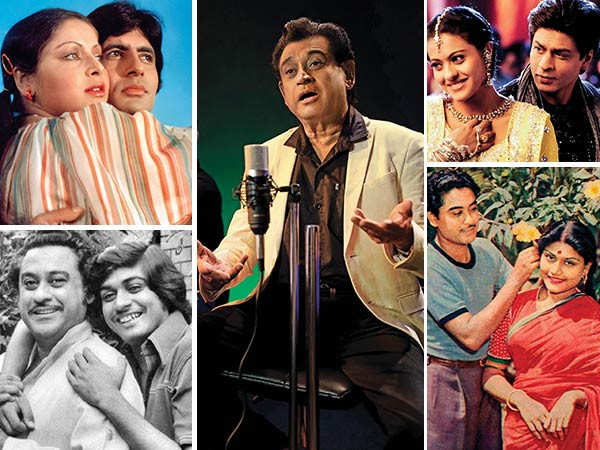
He’s the son of musically gifted parents, Ruma Guha Thakurta and the legendary Kishore Kumar. That perhaps made the endeavour doubly tough and the encore even more rewarding for singer Amit Kumar. Having survived five decades and his songs enjoying tremendous recall value—Bade acche lagte hain being the toast of serials and shows—he’s now enjoying his stint on YouTube. Launched in 2011, the Amit Kumar official channel is making more and more music. “Right now, I have 229,803 subscribers,” he beams as he checks the statistics. “People now want independent music. I am also doing cover versions of my hits like Love Story.” While his individual path has been terrific, the resonance of his legendary father is palpable in his memories and music. “Baba was like a huge banyan tree, a one-man industry. I was going against the wind. I’m fortunate to have been able to carve out my own career. I didn’t suffer from any complex,” says the unstoppable Amit Kumar as he talks about Kishore Kumar, a voice that continues to be heard every second in some part of the world.
In Amit Kumar’s own words:
Classical music was a bouncer
In the early ’70s, I began training in classical music with Ghulam Mustafa Khan Saab. But it all was a ‘bouncer’ for me. I gave up. I started learning light classical from Satyanarayan Mishraji from the Benares gharana in 1987. He made me practise 10 thaat (scale), which I do even now.
Music entered my life around 1969–1970
I first sang at Durga Pooja functions in Kolkata. Then I began doing street shows and singing Baba’s songs. I was paid Rs 500 to Rs 1000 for that. Mom (who founded the Calcutta Youth Choir in 1958) was annoyed. She wanted me to study medicine. She called up Baba, saying, “Your son’s failed twice. The third time, he will be rusticated. He has now begun singing on the streets.” Baba said, “Very good. I like it!” He flew down to Kolkata and watched my performance at Ravindra Sadan, sitting backstage. He then asked Mom to send me to Mumbai. I was around 18. As a father, Baba did whatever he could for me. He made Door Gagan Ki Chhaon Mein (1964), sang Aa chal ke tujhe, main leke chaloon, to an 11-year-old me. Being a comedian, he was advised not to make a serious film. But the film was critically appreciated and celebrated silver jubilee. Aa chal ke tujhe was actually written by Baba, with Shailendraji tweaking it.
I faced the microphone for the first time for Door Ka Raahi (1971) when I was 13
Baba made me sit under the mango tree in this very garden and sing the song Main ek panchhi matwala, written by him. Though he cut it out in the edit, it’s still on record. Baba wrote Khushi do ghadi for the same film in the car while driving from Colaba to Juhu. When he went to Bombay Lab to record it, recordist BL Sharma asked, “Where are the musicians?” Baba replied, “Main hoon aur rabab hai.”
Soon, I began accompanying Baba to stage shows. I played the tabla and dholak and sang duets with him during shows in Holland, Canada, England, America and East Africa in the early ’70s. It gave me confidence. In 1974, he introduced me as a singer at Shanmukhananda Hall. The shows were titled Daddy Kishore Sunny Amit and went on for four years. He provided the platform to follow my dreams. But yes, he was critical of me. If I sang well, ‘Hmmm…’ was all he would say. If I went out of tune, he’d catch me. Mom’s advice was, “Remember, you’re alone in front of the microphone. Feel the song and sing it.”
I was in awe of Baba
Mom was a singer and an actress. She trained at Uday Shankar’s Academy of Creative Dance and learned classical music from Ustad Abdul Rehman Khan Sahab. She acted and sang in several films in the ’50s. She was introduced to Baba at Bombay Talkies. They got married in 1951. Mom’s mother, Sati, was the elder sister of Bijoya Ray, wife of Satyajit Ray. The Gangulys and the Rays were closely knit together. As a child, I wasn’t inclined towards music. Though I enjoyed listening to Baba’s records, one was Piya piya mera jiya pukare from Baap Re Baap (1955). I knew Baba was a star. I was in awe of him. My parents separated in 1957. I remember driving all the way from Mumbai to Kolkata in a Mercedes Benz with my mother as I went away to live with her. But my heart remained in our bungalow, Gouri Kunj, in Juhu, Mumbai. Those days, this bungalow had a slope that took you to the ground floor. Baba had a study there, which he’d beautifully designed. There were garages, too. His first car was a Morris Minor, which he bought for Rs 6,000 when he got married to Mom (1951). He was so melodramatic that after they divorced (1958), he buried the car in this bungalow itself. later seen in Shararat (1959), Jhumroo (1961) and Chalti Ka Naam Gaadi (1958). I’d come down from Kolkata every vacation. I’d delay going back and thus miss school. Mom and Baba would have arguments over that. I used to take the 5 a.m. flight from Mumbai to Kolkata. For that, I had to wake up early. When I’d put on the light to get ready, Baba, who’d be sleeping in the same room with me, would say, “Light nahi jalane ka!” He’d be crying, and he didn’t want me to see his tears.
Baba never rehearsed; he was naturally gifted
He was down to earth as a person. Baba was the most misunderstood man. Even by my mother. Though I love them both. He was a good human being. He believed in Jesus Christ. He would collect artefacts and curiosities about Shiva and Christ. Professionally too, he went through turmoil and trauma, highs and lows. He was a top actor in the ’50s, the second highest-paid actor after Dilip Kumar. He gave several jubilees between 1956 and 1959, including Bimal Roy’s Naukri (1954) and Satyen Bose’s Bandi (1957). Actually, as an actor, he was meant for Hollywood. After Aradhana (1969), he remained the No. 1 singer for 19 years.
Baba lived life king-size
People called him Kanjoos, but it’s all nonsense. Baba lived life king size. He’d say, “Duniya mujhko kehti hai paagal, main duniya ko kehta hoon paagal.” He had a unique sense of humour. Once, he didn’t want to attend the premiere of a film. His secretary, Anup Sharma, said, “You’ll have to for your career.” Baba said, “I’ll go on one condition. I’ll wear a towel to the premiere.” He sat in his open Chevrolet car in a towel. The secretary thought he was joking and would turn the car after a point. Seeing that Baba was in no mood to turn back, the secretary pleaded, “Main aapke pair padhta hoon. Let’s go back. Meri beizzati mat karwayee!” Baba retorted, “Next time, don’t force me to do anything.”
I beat Baba by winning the Filmfare Award for Love Story
My first playback number was Sapan Jagmohan’s Hosh mein hum kahan for Darwaza (1978) in the ’70s. But it was Bade achche lagte hai (Balika Badhu,1976) for Sachin, which brought me fame. It’s the cherry on top of my career, my signature song, my bread and butter song. It grew in popularity gradually. Today, it’s a household song. Aati rahengi baharein in Kasme Vaade (1978) was another well-liked song. My voice matched Kumar Gaurav’s. Yaad aa rahi hai (Love Story, 1981) won me my first and last Filmfare Award. Though Panchamda (RD Burman) joked, it sounded like a bhajan. That year, (1982), Baba was also nominated (Humein tumse pyaar kitna for Kudrat (1981) and Choo kar mere mann for Yaarana, 1981). But I beat him and won the award. The year 1981 brought fame and also Baba’s first heart attack.
I was to get married. It was an arranged alliance but it was called off because the lady was already married. Baba got emotionally disturbed. He cried like a child. I was happy to be a bachelor, though. That’s when he suffered an attack.
Through the ’80s, I gave several hits
My hits in the ’80s included Laila o Laila (Qurbani, 1980), Tu rootha (Jawaani, 1984), Dushman na kare (Akhir Kyon?, 1985), Roz roz ankhon tale (Jeeva, 1986)… Baba passed away in 1987. Call it the sympathy wave; all composers, including Panchamda, Laxmikant-Pyarelalji, etc., said, ‘We are with you’. Panchamda would say, “Whenever I compose, I think of Kishore. You come closest to him.” LP advised, “Never imitate your father. Be yourself, Amit Kumar. Retain your individuality.” I sang around 175 songs for Panchamda, but later he went through a bad time. For Anil Kapoor, I sang Kehdo ke tum ho meri varna and Ek do teen (Tezaab, 1988), Oye oye for Naseeruddin Shah (Tridev, 1989), Kaisa lagta hai for Salman Khan (Baaghi, 1990), Deewana dil deewana, and Sachhi yeh kahani hai for Shah Rukh Khan (Kabhi Haan Kabhi Naa, 1993). Bole Chudiyan in Kabhi Khushi Kabhie Gham (2001) was another popular number. I slowed down in the late ’90s. Baba had said, “This is a topsy-turvy line. One day you’re on top, the next day you can be kicked out.” I’ve seen both the rise and the ebb. For five years, between 1987 and 1993, I was at the top. Then many clones came in. I thought I should quit now. Had I been diplomatic, I would have lasted maybe a few more years. But I don’t blame anyone. I was never in the rat race. I have no regrets. In the following years, I released music albums, including MAD, Dam Dama Dam, Jaanam and Baba Mere. I launched the Amit Kumar official channel on YouTube in 2011. Organically, I’ve reached 229,803 subscribers. The analytics reveal my compositions are doing well. I’m so proud of it. It’s connected me to my audience. I enjoy this pastime, which is bringing me rich dividends. People now want independent music. I am doing cover versions of my hits, like Love Story.
We all will perish; Baba will remain
Looking back, my father was a man of many facets, both emotional and funny. My great-grandfather had a Chrysler Champion car. He’d drive down from Khandwa in it. The car is featured in Chalti Ka Naam Gaadi (1958). All generations have travelled in it. Baba was sentimental about it. After Baba’s death, it had turned irreparable. So I had to discard it. Baba was as emotional about his hometown, Khandwa. The government has created a beautiful samadhi there. We want to build a museum there. On his birth anniversary, we have a show in Baba’s honour. Sudesh Bhosle, Bela Shende, all of us sing. I chose to sing Baba’s uncommon songs. Like this ghazal Husn bhi hai udaas udaas from Fareb (1951). I was advised against it. But I received a standing ovation. Even the musicians were surprised. It proves people are craving good poetry and melody. There’s an interesting story behind the Fareb ghazal. During the rehearsal, Rafi saab, Latabai (Mangeshkar), Talat Mehmoodji, Manna Deyji, etc. were all present. When Baba wasn’t getting it right, composer Anil Biswas told him, “Go home; you can’t get the murki. Manna will sing.” Baba felt insulted. He went home, rehearsed it, and got it right the next time. Baba had once said, “I will not be found again. People will remember me forever.” That’s so true. We will all perish. But Baba will remain.