Live · Global · Independent
Live Feeds
PinkVilla
Forbes
NDTV
Hindustan Times
8 Dead, Several Feared Trapped As 155 Earthquakes Hit Japan In A Day
onmynews.com

8 Dead, Several Feared Trapped As 155 Earthquakes Hit Japan In A Day

Japan has been hit since Monday by 155 earthquakes including a 7.6-magnitude jolt and another over 6, the Japan Meteorological Office said.

Most of the quakes had a magnitude greater than 3 and while the strength has gradually moderated, six strong jolts were still felt early Tuesday, the JMA said.

At least eight people died in a major earthquake that struck central Japan on New Year’s Day, triggering tsunami waves over a metre high, damaging homes and sparking a major fire that wreaked destruction overnight, authorities said Tuesday.

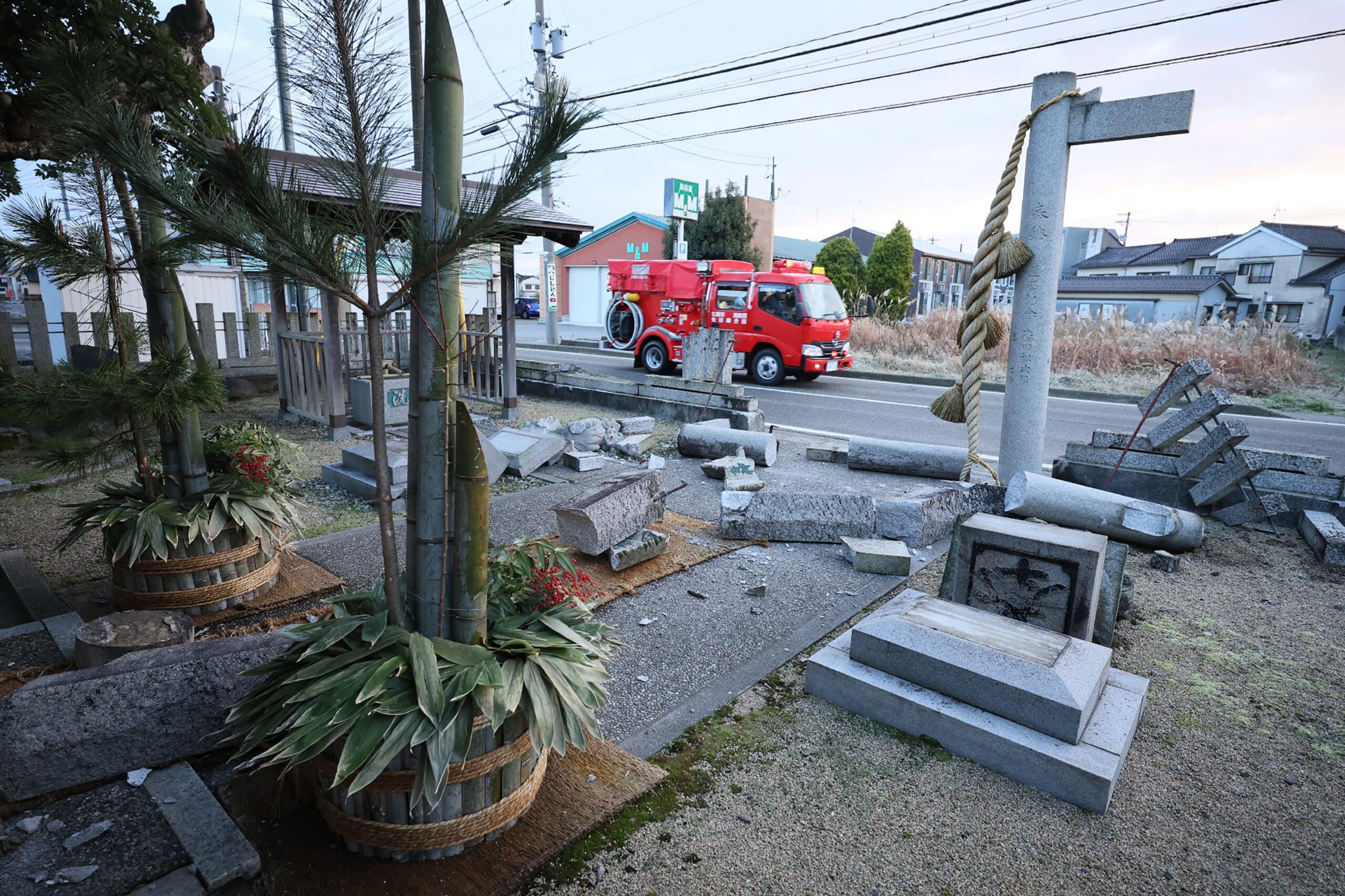
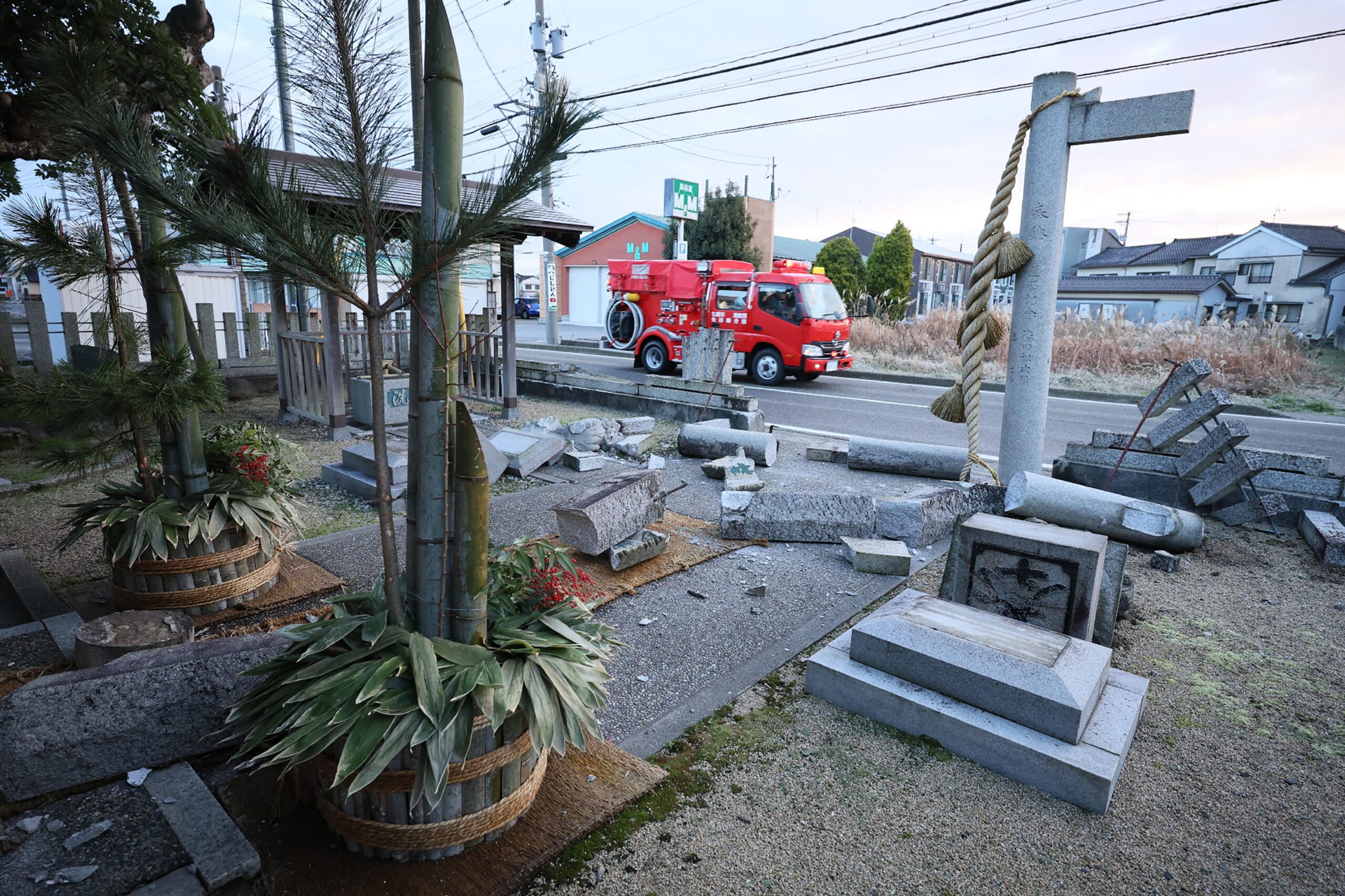
The scale of the damage from Monday’s quake was still emerging, with news footage showing toppled buildings, sunken boats at a port, countless charred homes, and locals without power in freezing overnight temperatures.

The US Geological Survey (USGS) said the quake, which struck Ishikawa prefecture on the main island of Honshu had a magnitude of 7.5.

Japanese authorities put it at 7.6 and said it was one of more than 90 quakes that had rocked the region as of 1:00 am Tuesday (1600 GMT Monday).

Waves at least 1.2 metres (four feet) high hit the port of Wajima on Monday, and a series of smaller tsunamis were reported elsewhere, but warnings of much larger waves proved unfounded.

Aerial news footage showed sunken boats at the fishing port of Suzu, with at least one washed onto shore, and devastation from a major fire in Wajima.

Around 32,700 households in the region remained without power on Tuesday, the local energy provider said.

Tens of thousands of people had been ordered to evacuate, according to the fire and disaster management agency, cited by Kyodo. About 1,000 people were staying at a military base, the defence ministry said.

“I instructed (emergency workers) to reach the area as soon as possible by using whatever means available,” Prime Minister Fumio Kishida said late Monday after a disaster response meeting.

“It is very cold now. I issued an instruction to deliver necessary supplies like water, food, blankets, heating oil, gasoline, fuel oil, by using planes or ships,” Kishida told reporters.

(Except for the headline, this story has not been edited by NDTV staff and is published from a syndicated feed.)
Read full article
Earthquake-Hit Japan Faces “Battle Against Time” To Rescue Survivors
onmynews.com

Earthquake-Hit Japan Faces “Battle Against Time” To Rescue Survivors

At least eight people have died in an earthquake that struck Japan on New Year’s Day as authorities on Tuesday struggled to assess the full extent of a disaster that wrecked buildings and roads and left thousands without power in freezing temperatures.

The quake with a preliminary magnitude of 7.6 struck in the middle of the afternoon on Monday, prompting residents in some coastal areas to flee to higher ground as tsunami waves about 1 metre (3.3 ft) high hit Japan’s western seaboard.

A thousand army personnel have been dispatched to the worst-hit area in the country’s relatively remote Noto peninsula, but rescue operations have been hindered by badly damaged and blocked roads and one of the area’s airports has been forced to close due to runway cracks.

Many rail services and flights into the area have also been suspended.

“The search and rescue of those impacted by the quake is a battle against time,” Prime Minister Fumio Kishida said during an emergency disaster meeting on Tuesday in remarks aired on television.

“We must rescue them as quickly as possible, especially those who are trapped under collapsed structures.”

Public broadcaster NHK said eight deaths had been reported in the hard-hit town of Wajima near the quake’s epicentre, while in nearby Suzu some doctors were unable to reach a hospital that was relying on a backup generator for power. The national police said agency six people had been confirmed dead.

More than 90 tremors have been detected since the quake first hit on Monday, according to the Japan Meteorological Agency. The agency has warned more strong shocks could hit in coming days.

In Toyama city, around 100 km (60 miles) from the worst-hit area, some shelves in convenience stores were empty as the disaster disrupted the delivery of goods across the region.

Four expressways, two high-speed rail services, 34 local train lines and 16 ferry lines were halted, while 38 flights have been cancelled since the quake hit, according to the transport ministry.

President Joe Biden said in a statement the United States was ready to provide any necessary help to Japan after the earthquake.

“As close allies, the United States and Japan share a deep bond of friendship that unites our people. Our thoughts are with the Japanese people during this difficult time,” he said.

The Japanese government said as of Monday night it had ordered more than 97,000 people in nine prefectures on the western coast of main island Honshu to evacuate. They were spending the night in sports halls and school gymnasiums, commonly used as evacuation centres in emergencies.

Almost 33,000 households remained without power in Ishikawa prefecture early on Tuesday morning, according to Hokuriku Electric Power’s website. Most areas in the northern Noto peninsula also have no water supply, NHK reported.

The Imperial Household Agency said it would cancel Emperor Naruhito and Empress Masako’s slated New Year appearance on Tuesday following the disaster.

Nuclear Plants

The quake comes at a sensitive time for Japan’s nuclear industry, which has faced fierce opposition from some locals since the 2011 earthquake and tsunami that triggered nuclear meltdowns in Fukushima. Whole towns were devastated in that disaster.

The Nuclear Regulation Authority said no irregularities were found at nuclear plants along the Sea of Japan, including five active reactors at Kansai Electric Power’s Ohi and Takahama plants in Fukui Prefecture.

Hokuriku Electric’s Shika plant, the closest to the epicentre, had already halted its two reactors before the quake for regular inspections and saw no impact from the quake, the agency said.

(Except for the headline, this story has not been edited by NDTV staff and is published from a syndicated feed.)
Read full article
13 Dead, Several Feared Trapped As 155 Earthquakes Hit Japan In A Day
onmynews.com

13 Dead, Several Feared Trapped As 155 Earthquakes Hit Japan In A Day

Japanese rescuers battled against the clock and powerful aftershocks Tuesday to find survivors of a major earthquake that struck on New Year’s Day, killing at least six people and leaving a trail of destruction.

The 7.5-magnitude quake, which hit Ishikawa prefecture on the main island of Honshu, triggered tsunami waves over a metre high, toppled buildings, caused a major port fire and tore apart roads.

As daylight arrived, the scale of the destruction in Ishikawa emerged with buildings still smouldering, houses flattened and fishing boats sunk or washed ashore.

“Very extensive damage has been confirmed, including numerous casualties, building collapses and fires,” Prime Minister Fumio Kishida said after a disaster response meeting.

“We have to race against time to search for and rescue victims of the disaster.”

Police said six people had been killed although the toll was almost certain to climb. The Kyodo news agency reported that 13 people had died, including seven in the badly hit port of Wajima.

Aerial news footage showed devastation from a major fire at the port, where a seven-storey building collapsed. 

Almost 45,000 households were without power in the region which saw temperatures touch freezing overnight, the local energy provider said. Many cities were without running water.

The US Geological Survey (USGS) said the quake had a magnitude of 7.5. Japan’s meteorological agency measured it at 7.6, and said it was one of more than 150 to shake the region through Tuesday morning.

Several strong jolts were felt early Tuesday, including one measuring 5.6 percent that prompted national broadcaster NHK to switch to a special programme.

“Please take deep breaths,” the presenter said, reminding viewers to check for fires in their kitchens.

Tsunami warning lifted

On Monday waves at least 1.2 metres (four feet) high hit Wajima on Monday, and a series of smaller tsunamis were reported elsewhere.

But warnings of much larger waves proved unfounded and on Tuesday Japan lifted all tsunami warnings.

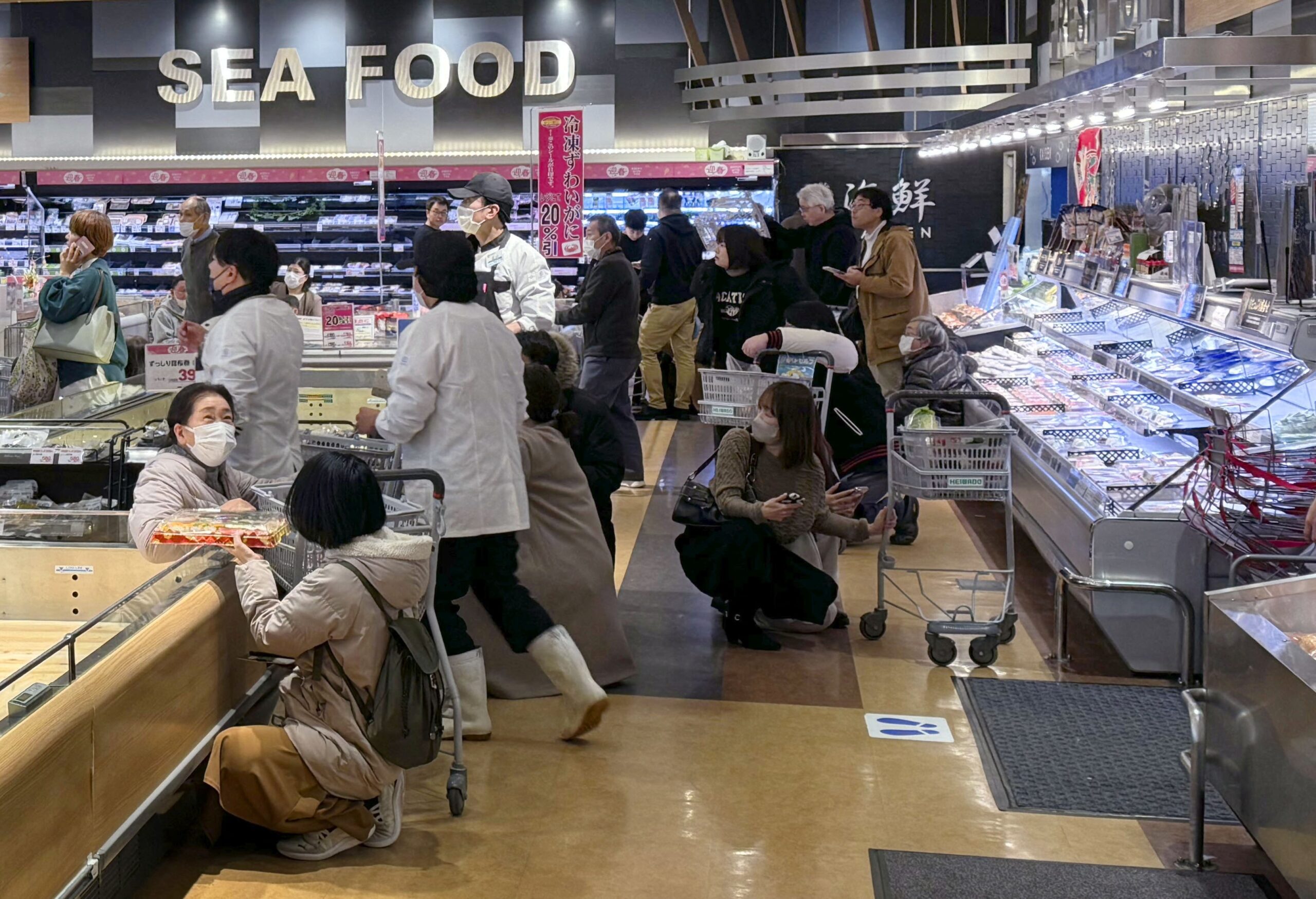
Images on social media showed cars and houses in Ishikawa shaking violently and terrified people cowering in shops and train stations. Houses collapsed and huge cracks appeared in roads. 

A team of firefighters crawled under a collapsed, large commercial building in Wajima, television footage showed.

“Hang in there! Hang in there,” they shouted as they battled through piles of wooden beams with an electric saw.

“There were shaking that I have never experienced before, a local elderly man told NHK.  

“Inside my house, it was so terrible… I am still alive. Maybe I have to  be content with that.”

The fire in Wajima engulfed a row of houses, video footage showed, with people being evacuated in the dark, some with blankets and others carrying babies.

A duty officer at Wajima Fire Department said they still were being overwhelmed Tuesday by rescue requests and reports of damages.

A total of 62,000 people had been ordered to evacuate, according to the fire and disaster management agency.

About 1,000 people were staying at a military base, the defence ministry said.

Bullet trains suspended

Defense Minister Minoru Kihara said 1,000 military personnel were preparing to go to the region, while 8,500 others were on standby. Around 20 military aircraft were dispatched to survey the damage. 

Monday’s quake shook apartments in the capital Tokyo some 300 kilometres away, where a public New Year greeting event that was to be attended by Emperor Naruhito and his family members was cancelled.

Several major highways were closed around the epicentre, Japan’s road operator said, and bullet train services from Tokyo were also suspended.

Japan experiences hundreds of earthquakes every year and the vast majority cause no damage.

The country has strict regulations intended to ensure buildings can withstand strong quakes and routinely holds emergency drills.

But the country is haunted by the memory of a massive 9.0-magnitude undersea quake off northeastern Japan in March 2011, which triggered a tsunami that left around 18,500 people dead or missing.

The 2011 tsunami also sent three reactors into meltdown at the Fukushima nuclear plant, causing Japan’s worst post-war disaster and the most serious nuclear accident since Chernobyl.

Japan’s nuclear authority said there were no abnormalities reported at the Shika atomic power plant in Ishikawa or at other plants after Monday’s quake.

In Washington, US President Joe Biden was briefed on Monday’s quake and offered Japan “any necessary assistance” to cope with the aftermath. 

French President Emmanuel Macron expressed “solidarity” while Italian Prime Minister Giorgia Meloni offered condolences and assistance.

(Except for the headline, this story has not been edited by NDTV staff and is published from a syndicated feed.)

Read full article
Link copied!