Dhananjay Munde’s resignation as Maharashtra minister marks a key milestone in the fallout of a sarpanch’s December murder that revealed the chilling underbelly of rural development in the state and the crime-politics nexus that overshadows this development.
Santosh Deshmukh, the sarpanch of Massajog village in Beed, was tortured and murdered on December 9. The investigation revealed that the 45-year-old had tried to stop an extortion attempt targeting a windmill energy firm operating in the region.
A Rs 2 Crore Extortion Demand
Avaada, a Mumbai-based green energy company, had been working on a project in Beed’s Massajog village. Beed and adjoining districts have seen an economic boost over the past few years due to the wind energy sector. But local criminals have sensed an opportunity in this boost, leading to extortion bids and kidnappings. In May last year, six months before Deshmukh’s murder, Sudarshan Ghule, who runs a crime syndicate in Beed, kidnapped Sunil Shinde, a project officer with Avaada. He later registered a police complaint. According to police, another accused in the murder case, Vishnu Chate, had called Avaada officials on the behest of Mr Munde’s aide and local political strongman Walmik Karad and demanded Rs 2 crore. The officials were threatened that the company would be forced to wind up operations if they did not pay up.
Santosh Deshmukh: A Local Hero
The local sarpanch, Santosh Deshmukh, feared that the threats and extortion calls might force Avaada and other similar firms to stop operations in Massajog and that would impact the livelihood of local residents. Determined to stop this, he took on Ghule. On December 6, three days before the murder, Ghule and others beat up some Avaada employees at its local office. Santosh Deshmukh and others reached the spot and tried to stop this.
According to police, the accused felt Santosh Deshmukh was coming in the way of their plans and decided to eliminate him. Walmik Karad, named the mastermind in the murder case, allegedly asked the other accused to get rid of whoever came in the way of the extortion bid.
Deshmukh was threatened several times. When he did not fall in line, he was abducted and killed on December 9. Police found that Ghule, Karad and Vishnu Chate were in touch with each other before and after Deshmukh’s murder.
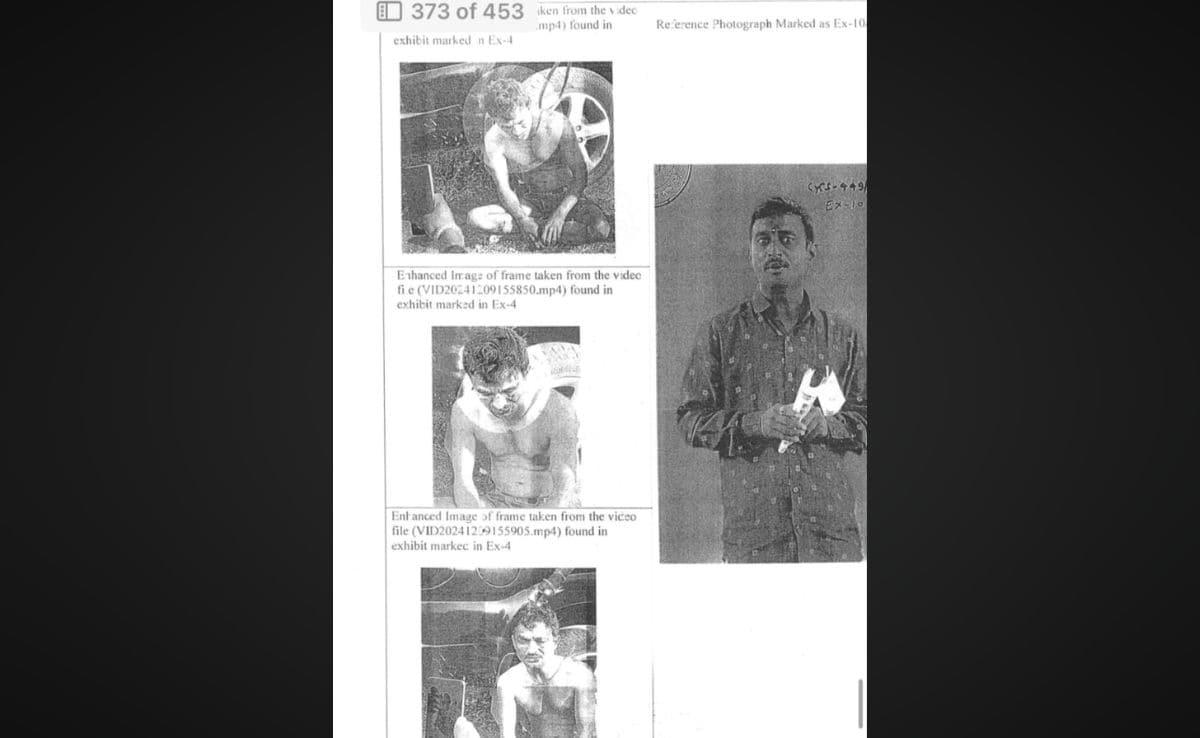
Images of a tortured Santosh Deshmukh in the police chargesheet
Brutal Torture, Shocking Videos
Santosh Deshmukh was abducted by six men in an SUV on December 9 afternoon at Dongaon toll plaza and taken towards Kej taluka. He was found unconscious at Daithna Shivar that evening. He was rushed to a hospital, where he was declared dead.
According to police officials, he was beaten for over two hours with a gas pipe an iron rod, wooden sticks and sharp weapons.
Police have said in the chargesheet that Santosh Deshmukh was tortured before being killed and the assailants recorded 15 videos, clicked eight photos and even made two video calls to document the brutality. In one of the videos mentioned in the chargesheet, five accused are seen thrashing Mr Deshmukh with a white pipe and a wooden stick, and kicking and punching him. The video shows Deshmukh in a half-naked condition. Another video shows one of the accused urinating on him as he bleeds heavily, the chargesheet says.
How Flames Scalded Minister
Walmik Karad, the prime accused in the chilling murder case, is a close aide of NCP leader and then minister Dhananjay Munde. As Karad’s alleged role in the shocking murder emerged during the probe, the Opposition started demanding action. The Crime Investigation Department’s (CID) 1,200-page chargesheet provided more ammo to the Opposition. As chilling visuals documenting the brutality suffered by Deshmukh flashed on social media and TV screens, Chief Minister Devendra Fadnavis took note.
According to sources, Mr Fadnavis met Deputy Chief Minister and NCP chief Ajit Pawar to discuss the political fallout of the chargesheet and what the investigation revealed about Karad’s alleged role. Eventually, he pulled the plug and Mr Deshmukh was asked to resign.
Mr Munde said it has been his firm demand that the accused in the sarpanch’s murder case get the harshest punishment. “Seeing the photos that surfaced yesterday, I was deeply saddened. The investigation into this matter has been completed and the charge sheet has been filed in the court. Also, a judicial inquiry is proposed,” he said. The NCP leader said he had heard his “inner self” to take the decision. He said his health has also not been well and the doctor had advised him to undergo treatment soon.
A Caste Sub-Plot
Santosh Deshmukh’s murder and its fallout also play out against the backdrop of the complex caste politics in the Marathwada region in which Beed falls. This region was the hotbed of the Maratha quota agitation during which the Marathas and OBC Vanjaris clashed in a turf war. This rivalry also played out in the Lok Sabha polls last year when BJP’s Pankaja Munde – a Vanjari — suffered a defeat to NCP (SP)’s Maratha face Bajrang Sonawane. Interestingly, Santosh Deshmukh, a Maratha, had campaigned for Pankaja Munde in the run-up to the election.
In this murder case, all the accused, including Karad, Ghule and Chate, are Vanjaris.
In the aftermath of the murder, several Maratha leaders raised their voices seeking justice for Deshmukh. Among them was BJP’s Maratha leader Suresh Dhasm, who earlier demanded Dhananjay Munde’s resignation.