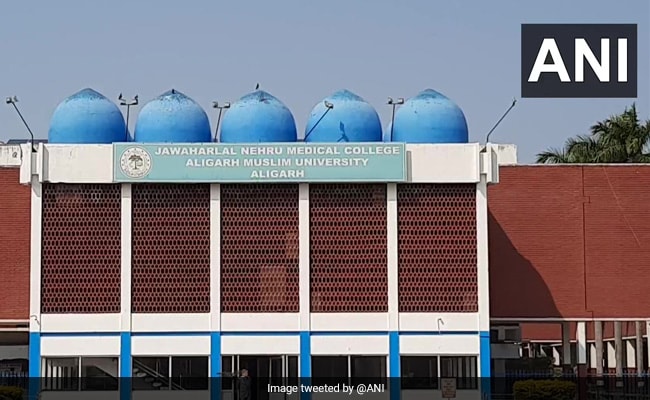
The Supreme Court is scheduled to pronounce its verdict on Friday on a vexed legal question whether the Aligarh Muslim University (AMU) enjoyed a minority status under Article 30 of the Constitution which empowers the religious and linguistic minorities to establish and administer educational institutions.
A seven-judge Constitution bench headed by Chief Justice DY Chandrachud will pronounce the verdict.
The bench also comprising Justices Sanjiv Khanna, Surya Kant, JB Pardiwala, Dipankar Datta, Manoj Misra and Satish Chandra Sharma had reserved its verdict on the question on February 1 after hearing arguments for eight days.
On February 1, grappling with the intractable issue of the AMU’s minority status, the top court said the 1981 amendment to the AMU Act, which effectively accorded it a minority status, only did a “half-hearted job” and did not restore to the institution the position it had prior to 1951.
While the AMU Act, 1920, speaks about incorporating a teaching and residential Muslim university in Aligarh, the 1951 amendment does away with compulsory religious instructions for the Muslim students at the university.
The vexed question has repeatedly tested Parliament’s legislative acumen and judiciary’s prowess in interpreting complex laws involving the institution that was founded in 1875 as Muhammadan Anglo-Oriental College by prominent Muslim community members led by Sir Syed Ahmed Khan. Years later, in 1920, it transformed into a university under the British Raj.
“One thing which is worrying us is that the 1981 amendment does not restore the position as it stood prior to 1951. In other words, the 1981 amendment does a half-hearted job,” Justice Chandrachud had said while proceeding to close the arguments.
“I can understand if the 1981 amendment had said… okay, we are going back to the original 1920 statute, confer complete minority character on this (institution),” the CJI had said.
Earlier, the BJP-led NDA government refused to accept the 1981 amendment to the AMU Act and insisted that the court should go by the five-judge constitution bench verdict in the S Azeez Basha versus Union of India case in 1967. The Constitution bench had then held that since the AMU was a central university, it cannot be considered a minority institution.
The top court had said it needs to see what the 1981 amendment did and whether it restored to the institution the status it enjoyed before 1951.
Those who put forward the view favouring a minority status for the institution, including veteran lawyer Kapil Sibal, contended that the mere fact that only 37 members of the 180-member governing council are Muslim does not detract from its credentials as a Muslim minority institution.
Others like Solicitor General Tushar Mehta contended a university getting enormous funds from the Centre and having been declared an institution of national importance cannot claim to belong to a particular religious denomination.
They had also argued that once the Muhammadan Anglo-Oriental College transformed itself into a university after the 1951 amendment to the AMU Act and began receiving funds from the Central government, the institution surrendered its minority character.
A lawyer disfavouring minority status to the AMU had claimed that it received over Rs 5,000 crore from the Central government between 2019 and 2023, nearly double what the University of Delhi, a central university, got.
Some of them had even contended that prominent people from the Muslim community who had lobbied with the then British government for establishing the institution as a university wedded to the cause of promoting education among the Muslims did not consider themselves as a religious minority in undivided India and advocated a two-nation theory.
Mr Sibal had mounted a spirited counterattack, asserting that Article 30 of the Constitution which deals with the right of religious and linguistic minorities to establish and administer educational institutions was applicable to the AMU.
Notably, the Allahabad High Court had struck down the provision of the 1981 law by which the university was accorded minority status. Appeals were filed in the Supreme Court, including by the AMU, against the high court verdict.
The row over AMU’s minority status has been caught in a legal maze for the last several decades.
The top court had, on February 12, 2019, referred to a seven-judge bench the contentious issue. A similar reference was also made in 1981.
The Congress-led UPA government at the Centre moved an appeal against the 2006 verdict of the Allahabad High Court that quashed the 1981 amendment to the AMU Act. The university also filed a separate petition against it.
The NDA government spearheaded by the BJP told the Supreme Court in 2016 that it would withdraw the appeal filed by the UPA dispensation.
It cited the Supreme Court’s 1967 judgement in the Basha case to claim that AMU was not a minority institution since it was a central university funded by the government.
(Except for the headline, this story has not been edited by NDTV staff and is published from a syndicated feed.)