Israel Revises Down October 7 Hamas Attack Death Count To 1,200
Israel on Friday revised down the death toll of last month’s Hamas attacks to about 1,200 as it continued its assault on Gaza, forcing thousands of Palestinians to flee south to escape the destruction in the city.
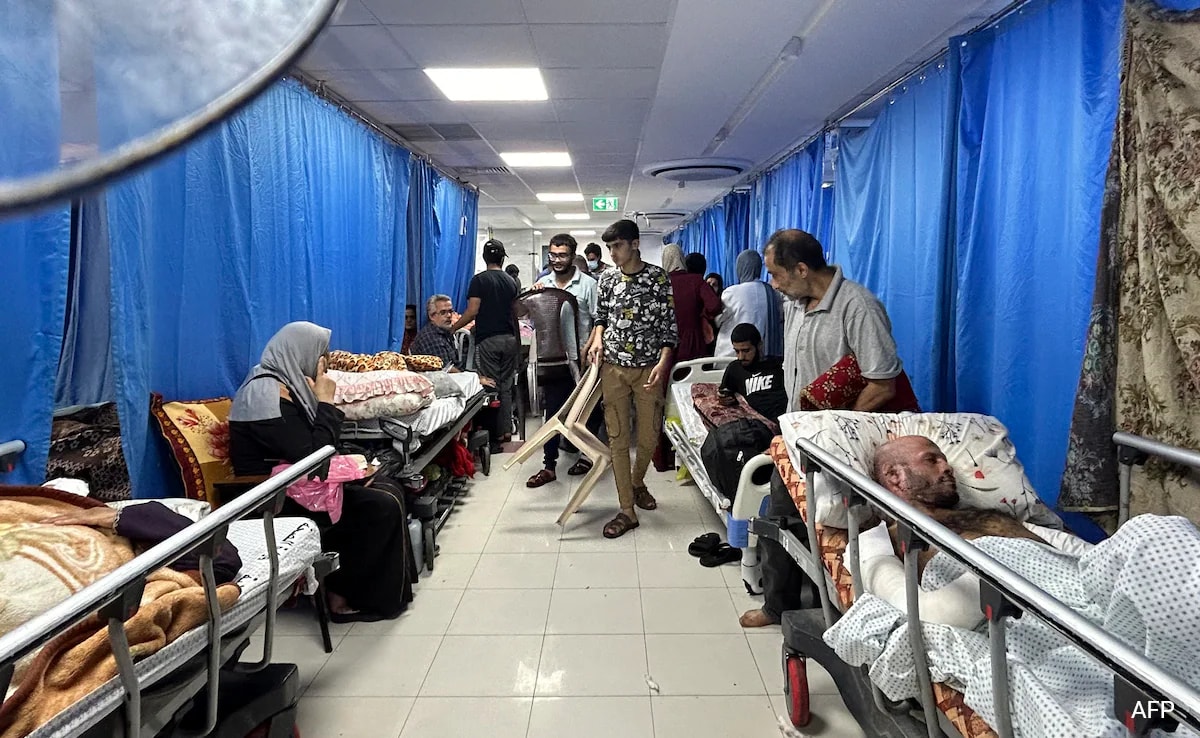
Palestinians reported deadly strikes on Al-Shifa hospital and Al-Buraq school in Gaza City, as well as sniper fire at Al-Quds hospital.
The Israeli army has repeatedly accused Palestinian militant group Hamas of using hospitals, particularly Al-Shifa, as command centres and hideouts. Hamas authorities deny the accusations.
“There is no safe place left. The army hit Al-Shifa. I don’t know what to do,” said 32-year-old Abu Mohammad, who was among those seeking refuge at the hospital.
Al-Shifa’s director and Gaza’s Hamas government, which reported a death toll of 13, blamed Israeli forces for a strike on the hospital.
The hospital received the bodies of another 50 people killed in a strike on Gaza City’s Al-Buraq school, the Al-Shifa director said.
The Palestinian Red Crescent Society said Israeli snipers had also shot at Al-Quds hospital, killing at least one person. AFP could not immediately confirm the tolls.
Israeli forces would “kill” Hamas militants if they saw them “firing from hospitals”, military spokesman Richard Hecht said.
– ‘Point of no return’ –
Heavy fighting was raging near Al-Shifa hospital, with Israel saying it had killed dozens of militants and destroyed tunnels that are key to Hamas’s capacity to fight.
Military spokesman Daniel Hagari said they had taken control of some Hamas headquarters and “terrorist centres” in Gaza City.
Israel launched an offensive in Gaza after Hamas fighters poured across the heavily militarised border on October 7, taking 240 hostages and killing about 1,200 people, according to Israeli officials.
Israel on Friday revised the toll down from over 1,400 dead. The new number was an “updated estimate”, foreign ministry spokesman Lior Haiat told AFP.
Vowing to destroy the militants, Israel retaliated with bombardment and a ground campaign that the health ministry in the Hamas-run Gaza Strip says has killed more than 11,000 people, mostly civilians and many of them children.
“Last night, I wasn’t optimistic that any of my children or I would come out unharmed, given the intensity of the bombing and gunfire,” said Jawad Haruda, who was among thousands walking south in an exodus away from Gaza City.
Witnesses told AFP that hundreds of people sheltering at Gaza City’s Al-Rantisi hospital fled on instruction from the Israeli military, which was surrounding it with armoured vehicles.
Amid the fighting, the Gazan health system was “on its knees”, the head of the World Health Organization, Tedros Adhanom Ghebreyesus, told the UN Security Council.
“Overstretched, running on thin supplies and increasingly unsafe, the healthcare system in Gaza has reached a point of no return,” the International Committee of the Red Cross said.
In Israel, medical services reported two women were wounded in rocket attacks in Tel Aviv. Hamas’s military wing said it had targeted the Israeli commercial hub.
– ‘No safe place’ –
The war in the densely populated coastal territory, which is effectively sealed off, has prompted repeated calls for a ceasefire to protect civilian lives and allow in more humanitarian aid.
Tens of thousands of people have fled to the south of the territory in recent days, often on foot and taking only the things they could carry.
Almost 1.6 million people have been internally displaced since October 7, the UN agency for Palestinian refugees (UNRWA) said — nearly two thirds of Gaza’s population.
But the UN estimates hundreds of thousands of civilians remain in the fiercest battle zones in the north.
The United Nations called for an end to the “carnage” in Gaza, saying “razing entire neighbourhoods to the ground is not an answer for the egregious crimes committed by Hamas”.
“To the contrary, it is creating a new generation of aggrieved Palestinians who are likely to continue the cycle of violence. The carnage simply must stop,” UNRWA chief Philippe Lazzarini wrote in an opinion piece.
Lazzarini also said on social media that over 100 UNRWA colleagues were confirmed killed in one month of war.
“Enough destruction, there’s nothing left. We need a truce,” said Mohammed Khader, who was displaced in Rafah.
“Those hospitals are now full of displaced people and not only injured and martyrs.”
Israeli Prime Minister Benjamin Netanyahu has repeatedly rejected halting the fighting, telling Fox News Thursday that a “ceasefire with Hamas means surrender to Hamas, surrender to terror”.
He also said Israel does not “seek to govern Gaza” in the long run.
“We don’t seek to occupy it, but we seek to give it and us a better future,” he told the US broadcaster.
– Hostages –
Complicating Israel’s military push is the fate of the hostages abducted on October 7.
CIA director Bill Burns and David Barnea, head of Israel’s Mossad spy agency, were in Doha for talks on pauses that would include hostage releases and more aid for Gaza, an official told AFP on Thursday.
Four hostages have been freed so far by Hamas and another released in an Israeli operation. The desperate relatives of those still held in Gaza have piled pressure on Israeli and US authorities to secure the release of their loved ones.
The conflict has also stoked regional tensions, with cross-border exchanges between the Israeli army and Lebanon’s Hezbollah, and Yemen’s Iran-backed Huthi rebels saying they launched “ballistic missiles” at southern Israel.
Iran’s Foreign Minister Hossein Amir-Abdollahian said the expansion of the Israel-Hamas war has become “inevitable”.
The Islamic republic, which supports Hamas financially and militarily, has hailed the militant group’s attack on Israel as a “success” but denied any involvement.
Saudi Arabia is hosting Arab leaders and Iran’s president for two summits this weekend in emergency meetings of the Arab League and the Organisation of Islamic Cooperation.
Saudi Arabia’s de facto ruler Crown Prince Mohammed bin Salman denounced the conduct of Israeli forces in Gaza, saying “we stress the necessity of stopping this war and forced displacement”.
US Secretary of State Antony Blinken wrapped up a marathon diplomatic push Friday, saying Israel’s pauses in its Gaza offensive would “save lives” but more was needed.
“Far too many Palestinians have been killed,” Blinken said in New Delhi, his last stop before heading home, where he repeated US support for ally Israel but was firm that more aid had to reach civilians in Gaza.