onmynews.com
‘Blatant Overreach’: BJP Slams Vijayan Govt Over Appointment of ‘Foreign Secretary’ In Kerala
Kerala government gave IAS Vasuki the additional charge of the matters connected with the External Cooperation.
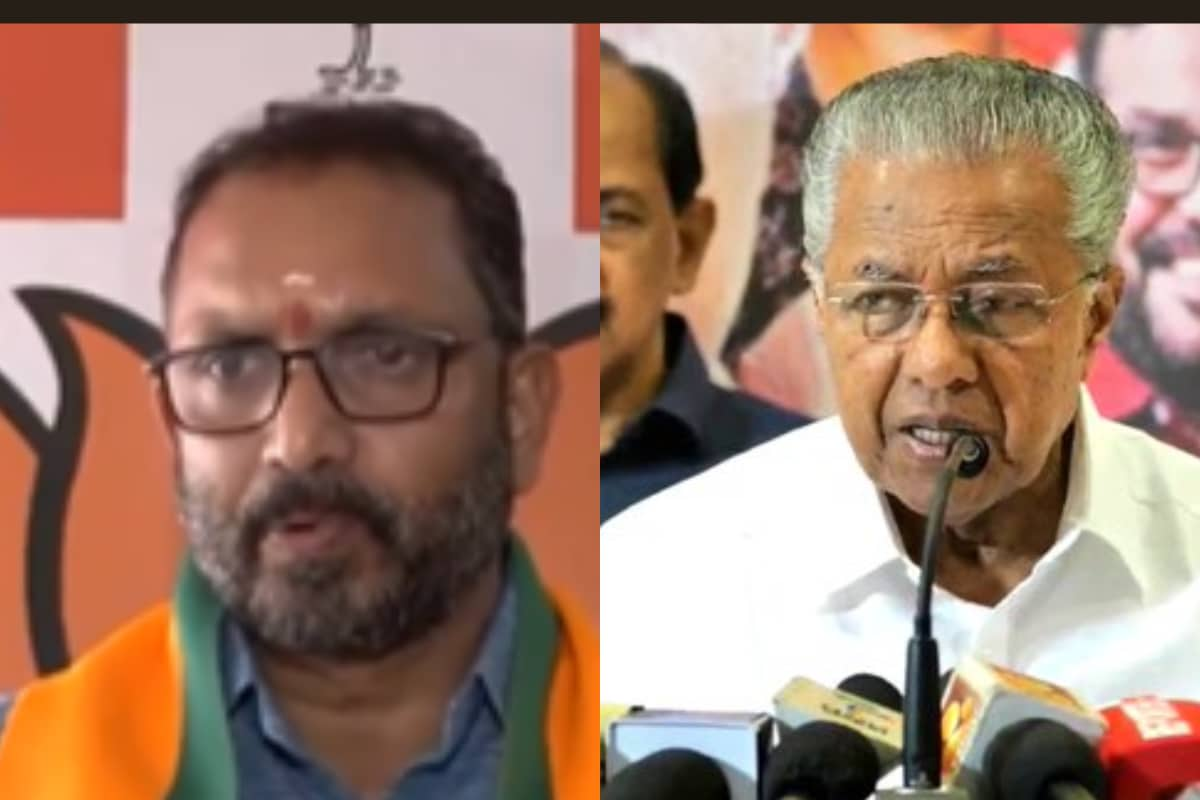
Kerala government gave IAS Vasuki the additional charge of the matters connected with the External Cooperation.

An elderly man and his wife have been arrested in Pune for allegedly assaulting a woman who was travelling on a scooter with two children yesterday, the police said.
In a shocking incident of road rage, Swapnil Kekre – who was allegedly angry because he wasn’t given space to overtake – pulled the woman’s hair and punched her twice with such force that her nose began bleeding extensively.
A case was registered against Swapnil Kekre after Jerlyn D’Silva, a digital content creator, posted a video narrating her ordeal.
Jerlyn D’Silva claimed she was on the Pashan-Baner Link Road on a scooter with her two children and Mr Kekre in his car had been speeding behind them for nearly 2 km.
She said she moved her scooter to the left of the road, not wanting to come in the car’s way, but the man overtook her and stopped in front of her scooter.
“He got out of the car very furiously. He punched me twice and pulled my hair. I had two kids, he didn’t care about them. How safe is this city? Why are people behaving like maniacs? I had two kids with me, kuch bhi ho sakta tha (anything could have happened)… A woman helped me,” Ms D’Silva said in the video, with blood around her nose and mouth.
Speaking to NDTV, Ms D’Silva’s uncle, Vishal, said she called him after the incident and told him that the man assaulted her for “no reason”.
“She told me the man in the car assaulted her for no reason. The scooter didn’t touch his car. He probably did it just to show how powerful he was. The man’s wife was with him but she didn’t try to stop him. The children weren’t hurt physically but they were scared and screaming,” he said.
The incident occurred exactly two months after a 17-year-old allegedly drunk boy rammed his Porsche into two 24-year-old techies in Pune, killing them on the spot. He is out on bail.
Last week, the 25-year-old allegedly drunk son of a politician hit a poultry truck while speeding in his SUV in the city, leaving its two occupants seriously injured. He fled but was caught and a case has been registered against him.
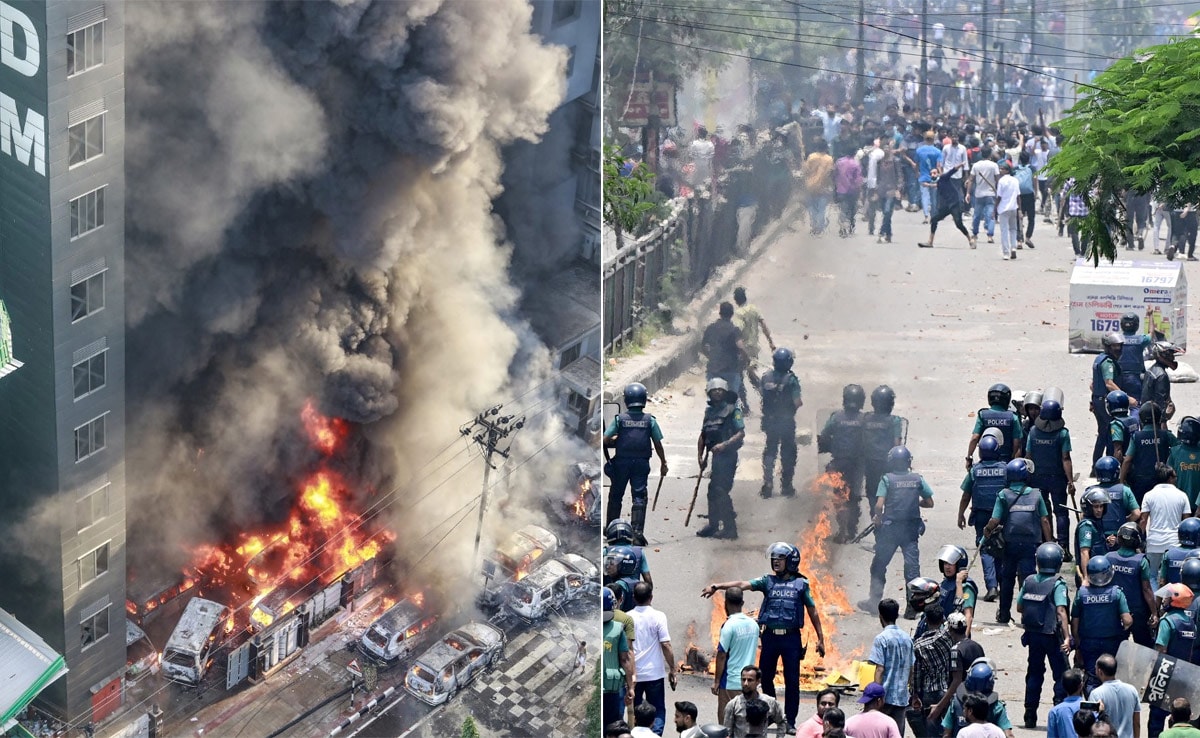
Violence in Bangladesh has left over 130 dead as students demand reforms to a quota system governing the allocation of government jobs in the country. The protests intensified following Prime Minister Sheikh Hasina’s controversial remarks, where she labelled the protestors as “Razakars”. This term, historically loaded and carrying a negative connotation, harks back to the East Pakistani volunteer force that opposed the creation of Bangladesh as a sovereign nation during its 1971 War of Independence.
The protests, which began late last month, reached a boiling point earlier this week when student activists at Dhaka University, the largest university in the country, engaged in violent clashes with police and counter-protesters aligned with the ruling Awami League.
The controversial quota system reserves up to 30 per cent of government jobs for family members of veterans who fought in Bangladesh’s 1971 war of independence against Pakistan. Protesters argue that this system is discriminatory and disproportionately benefits supporters of Prime Minister Hasina’s Awami League party. They advocate for a merit-based system to replace the existing quota. Prime Minister Hasina’s fiery remarks at a public gathering ignited further protests.
“If not the grandchildren of the freedom fighters, then who will get quota benefits? The grandchildren of the ‘Razakars’?” the Bangladeshi PM asked. “This is my question. I want to ask the people of the nation. If the protesters don’t comply, I can do nothing. They can continue their protest. If protesters damage properties or attack cops, the law will take its course. We can’t help.”
PM Hasina’s intent was to highlight the importance of preserving benefits for the descendants of those who fought for Bangladesh’s independence. However, the term “Razakar” struck a raw nerve. It is a term that conjures up memories of widespread violence from the 1971 War of Independence, during which the “Razakars” collaborated with the Pakistani army against the Bengali nationalist movement.
The “Razakars” were a paramilitary force recruited by the Pakistani army during the 1971 Bangladesh Liberation War. Comprised primarily of pro-Pakistani Bengalis and Urdu-speaking Biharis, the “Razakars” were involved in numerous atrocities, including mass killings, rapes, and torture. The 1971 war saw immense suffering, with estimates of civilian deaths ranging from 300,000 to 3 million. The scars of these events are still evident in the national psyche.
In 2010, Prime Minister Hasina’s government established the International Crimes Tribunal to prosecute those accused of war crimes during the 1971 conflict. This move was part of her strategy to address historical injustices and was widely seen as a fulfilment of her party’s electoral promises. The tribunal has since convicted several individuals, predominantly from the now-banned Jamaat-e-Islami party.
In December 2019, the government published a list of 10,789 individuals identified as “Razakars”, marking the first official recognition of these collaborators. This list included prominent figures and was intended to ensure that future generations understand the historical context of their actions.
The current protests are rooted in the quota system for government jobs, which allocates significant portions to descendants of freedom fighters. This system, established in 1972 and abolished briefly in 2018 before being reinstated, has been a source of contention. Critics argue that it disproportionately benefits Awami League supporters and limits opportunities for other qualified candidates.
“They are protesting against the repressive nature of the state,” said Mubashar Hasan, a Bangladesh expert at the University of Oslo in Norway, as quoted by news agency AFP. “Protesters are questioning Hasina’s leadership, accusing her of clinging onto power by force. The students are in fact calling her a dictator.”
Student protests against the quota system have a history in Bangladesh. The latest wave began after the decision to reinstate the system, which was followed by the Supreme Court suspending the order pending a government appeal. This legal limbo has left many students frustrated, feeling that their demands for a merit-based system are being ignored.
The students’ grievances extend beyond the quota system. High youth unemployment and a stagnant economy have all contributed to a sense of frustration and despair. Public sector jobs, with their regular wages and benefits, are highly coveted in a country where economic opportunities are limited.