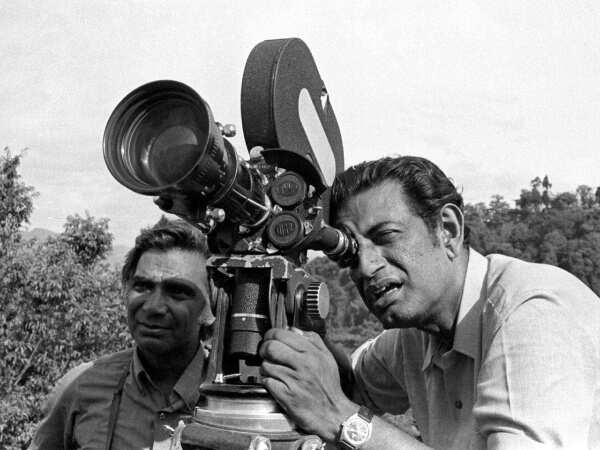
 Thirty-four years ago, on March 30, 1992, Satyajit Ray received an Honorary Academy Award, marking a historic moment for Indian cinema. Hospitalised in Kolkata weeks before the ceremony, the 70-year-old filmmaker accepted the honour from his hospital bed. It was the first time an Indian filmmaker was conferred with an Honorary Oscar.
Unable to travel, the Academy sent a camera crew and the Oscar trophy to Kolkata, recording his acceptance speech for broadcast at the Academy Awards.
The award was presented by the iconic Audrey Hepburn, who paid tribute to Ray’s legacy. She said, “To Satyajit Ray, in recognition of his rare mastery of the art of motion pictures, and of his profound humanitarian outlook, which has had an indelible influence on filmmakers and audiences throughout the world…It begins when Ray began with his very first film, Pather Panchali, the masterpiece that established his international reputation….Ray is not well. He cannot be with us tonight, but he is able to speak with us from his hospital in Calcutta.”
Even in that moment, Ray’s speech carried wit. He recalled writing letters as a young cinephile to Hollywood stars like Deanna Durbin and Ginger Rogers, and later to Billy Wilder after watching Double Indemnity, only to never hear back.
The auteur said, “Well, it’s an extraordinary experience for me to be here tonight to receive this magnificent award; certainly the best achievement of my movie-making career. When I was a small, small school boy, I was terribly interested in the cinema. Became a film fan, wrote to Deanna Durbin. Got a reply, was delighted. Wrote to Ginger Rogers, didn’t get a reply. Then, of course, I got interested in the cinema as an art form, and I wrote a twelve-page letter to Billy Wilder after seeing Double Indemnity. He didn’t reply either. Well, there you are.”
He continued, “I have learned everything I’ve learned about the craft of cinema from the making of American films. I’ve been watching American films very carefully over the years, and I loved them for what they entertain, and then later loved them for what they taught. So, I express my gratitude to the American cinema, to the motion picture association who have given me this award and has made me feel so proud. Thank you very, very much.”
If Ray looked towards the West for inspiration, the West also looked back at him as a master.
Filmmakers across generations have spoken about his influence. Martin Scorsese once said, “Ray’s magic, the simple poetry of his images and their emotional impact, will always stay with me,” adding that Pather Panchali opened up entirely new worlds for him. It was also Scorsese who played a key role in advocating for Ray’s Honorary Oscar.

Legendary Japanese filmmaker Akira Kurosawa once said, “Not to have seen the cinema of Ray means existing in the world without seeing the sun or the moon.”
Christopher Nolan has spoken about watching Pather Panchali and called it an extraordinary work, while Wes Anderson has drawn from Ray’s cinema in more visible ways. Anderson’s The Darjeeling Limited features music composed by Ray and carries echoes of his storytelling, even nodding to his film Nayak in parts.

Actors, too, have found inspiration in his work. Daniel Day-Lewis has cited Ray as one of the filmmakers he admires deeply, while Keanu Reeves stated that his only understanding of India in his younger days was through Ray’s films.
Satyajit Ray passed away on April 23, 1992, just weeks after receiving the Oscar, leaving behind a body of work that is still being studied today.
Also Read: Aranyer Din Ratri: A Deep Dive Into Its Multiple Layers
