
“Woh manzil kya jo aasani se tay ho,
Woh rahi kya jo thak kar baith jaye.”
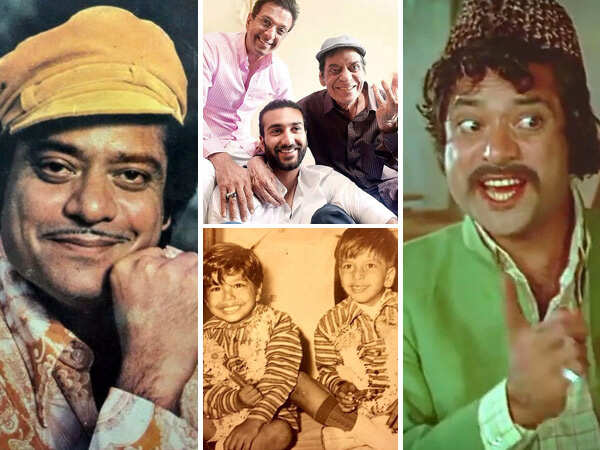
Young Jagdeep often heard his mother, Kaniz Fatema, utter this Urdu couplet. They goaded her on in her fight to exist. Years later, it became the footnote of his life. His reference point, his mantra in hostile times. From an affluent family in Datia, Madhya Pradesh, life flung eight year-old Syed Ishtiaq Ahmed Jafri (actor Jagdeep’s original name) and mother Kaniz on the streets of Bhendi Bazaar in Mumbai. Selling combs and soaps to survive, even as children his age devoured comics and chocolates, destiny handpicked young Jagdeep for the movies. “When reality slaps you hard on the face, you grow up fast,” says son/actor/anchor Jaaved Jaaferi about his late father, who became a breadwinner at nine.
Beginning as a child actor, then hero, Jagdeep later veered towards the comic, given his talent to sell laughter at the box-office. Yet, his ‘core’ remained ‘tragic’, resonating with the personal narratives of most comedians, including Charlie Chaplin, who used comedy to distract their inner demons. “Comedy arises from tragedy. If you only dwell on tragedy, then you’ll die with depression,” maintains Javed who empathised with his emotional father.
Being denied even the smallest joys of childhood, Jagdeep made sure to give sons, Jaaved and Naved Jafri, a sound one. Something Jaaved and Naved respected him for. That’s why perhaps, Jagdeep’s aberrations with alcohol, his stint with smoking, his second marriage… nothing could dent their bond and belief in their father. While the world fondly remembers him as the iconic Soorma Bhopali in Sholay, son Jaaved shares unknown facets of the human being his legendary father was. In his own words:

PARTITION AND FOOTPATH
Being her youngest, Dad’s mother, Kaniz Fatema, brought him along when she came to Bombay from Lahore after the Partition (1947). My grandfather (late Syed Yawar Husain Jafri) was an attorney, and had passed way in Madhya Pradesh. For some reason, grandma’s older sons refused to look after her. So, from a well-placed cultured family, they suddenly found themselves on the streets of Bhendi Bazaar. While grandma cooked in an orphanage, Dad, who was around eight, sold everything from soaps, kites to combs to survive. He also worked with a maalishwala. He’d walk behind him with a canister of oil shouting, “Tel maalish!”
Spotted by a stranger affiliated to films, he was offered the chance to act as an extra in B. R. Chopra’s Afsana (1951). He was around nine then and was delighted to be paid three rupees for the job. He went on to do more films as a child artiste in the ’50s including K. A. Abbas’s Munna, Guru Dutt’s Aar Paar, Bimal Roy’s Do Bigha Zamin and AVM’s Hum Panchhi Ek Daal Ke.

Being a National Award winning film, the child actors of Hum Panchhi Ek Daal Ke including Master Rumi, Daisy Irani and Mohan Choti got the opportunity to meet Pandit Jawaharlal Nehru. He presented them with gifts. When it was Dad’s turn, there was no gift left. So Panditji blessed him and gave him his staff instead. It was Dad’s cherished possession.
Dad was in his early teens when he was cast with Dilip Kumar saab in Footpath (1953). For the mahurat shot, he cried without using glycerin. Dilip saab was impressed. Later, the same day, Dilip saab offered to drop him on his way home. They stopped at the petrol pump, where people gathered asking for Dilip saab’s autograph. Dilip saab, graciously pointing towards Dad said, “Take his autograph he’s kal ka Dilip Kumar.” That was the day Dad gave his first autograph.
Dad was launched as a leading man by AVM Bhabhi (1957), Barkha (1959) and Bindya (1960). He featured in several hit songs like Paas baitho tabiyat bahal jayegi from Punar Milan (1964), Chal ud jaa re panchhi and Chali chali re patang from Bhabhi opposite Nanda. He turned towards comedy with Brahmachari (1968). In the 70s his notable films included Dulhan Wahi Jo Piya Man Bhaaye, Aaina, Do Anjaane, Khan Dost, Nagin, Roti and Bidaai. He also attempted the horror genre appearing in Ramsay Brothers’ Purana Mandir (1984) and 3D Saamri (1985).

CHILDHOOD TALES
By the time I was born in the early ’60s, Dad was an already established actor. We (referring to brother/host Naved Jafri) were closer to our mother Sugra as Dad would be busy shooting. But while Mom would spank us, dad never raised his hand. We respected him and maintained a distance. Dad gave us a comfortable childhood but didn’t let us lose touch with reality. He was a star but we lived in a one-bedroom apartment at Turner Road in Bandra. Our small home would be filled with cousins. I enjoyed cycling around in the quaint lanes of Bandra. We studied at St Teresa High School, the best part of which was that a boy from a slum and that from a skyscraper shared the same bench. That kind of mingling was the greatest gift of my childhood. When I was in class 10, we shifted to a three-bedroom house at Carter Road, near Otters Club.
During our holidays, we’d accompany Dad on his outdoor shoots. One such trip was to Kashmir for the shooting of Anokhi Pehchan (1972) with actors Sanjay Khan saab, Simiji and Nirupa Royji. We lived in a houseboat. I also recollect the time when we were in Kashmir and Rakesh Roshanji had come along with his newlywed wife Pinkyji (Roshan). Another memory that stands out is of the premiere of Anmol Moti (1969 film featuring Jeetendra and Babita). The premiere of the film was held at Naaz cinema. Dad played a pearl diver, who’s killed by an octopus. It was traumatic for me to watch my father being devoured by the creature.
MEMORIES & MORE
Between the ’60s-’70s, Dad as a comedian was on top of his game. Mehmoodji had become older, Johny Walkerji had semi retired. That’s when the iconic role of Soorma Bhopali in Sholay (1975) came along. The character was brilliantly written (Salim-Javed). Dad betrayed an authentic Bhopali diction with the dialogue, ‘Mera naam bhi Soorma Bhopali aise hi nahin hai’ turning iconic. So bang on were his nuances that Dharamendraji and Amitabh Bachchanji kept cracking in the scene where they ask Soorma Bhopali for money on stepping out of jail. Later, Dad even directed a film titled Soorma Bhopali (1988).
Dad’s character in Feroz Khan’s Qurbani (1980) was called Mohammed Ali (a spoofy character based on the famed American boxer and activist). Those days Mohammed Ali visited the Middle East to raise money for his charities. Dad was also part of the contingent visiting the country. Mohammed Ali and Dad were put in the ring for a mock fight. And as Dad did his antics, Mohammed Ali laughed away.

SERIOUSLY FUNNY
Dad was child-like in his love for chocolates. When we visited New York for the first time in the ’80s, he bought a lot of chocolates, even stuffing them in his jacket pockets. He said, ‘I never got these as a child.’ Later, I’d get him Tobblers, Lindt… He also enjoyed petha and gajak, sweets associated with memories of his hometown MP.
Though he was known to be a funny man, basically he was a serious guy. Zindagi ke thapede (slaps) kaafi padhe the! Like comedians Charlie Chaplin and Groucho Marx… who made people laugh but their core was tragedy. The effort was to make it funny and live through it!” Dad was interested in poetry and history. He self educated him in English. He interacted with creative people, writers, filmmakers… like K Asif, Guru Dutt, Mehboob Khan. In jest, I’d say, “Your name is Jug-deep – you’re a deep ‘jug’!” referring to his philosophical outlook towards life.
Towards the later years, Dad was not getting the work he deserved. He felt a bit frustrated. He’d seen great days, where people would rush to open the car doors for him. He turned quieter. He was religious but turned even more spiritual. He rooted for goodness and humanity. He loved India and its people. He’d say, “I’m not acting for that scribe or critic, who sits in a multi-storey building and writes reviews. My audience is that India, which they don’t know about. I perform for my audience – the farmer, the rickshaw puller, the common man. Not for award functions.” He was a man of the masses.

NO GRUDGES
The saddest moment in Dad’s life was when his mother passed away in 1991. My grandma lived with us. In fact, even after I became an actor, I shared my room with her. Dad was shattered. He sobbed like a child as I lowered her in the grave. Something cracked within him at that point. Sometime later, he got married again (to Najma). They had a daughter Muskaan (Jafri). There was a big turmoil at home. But at that point, I understood certain things. I didn’t hold it against him. Whatever grudges my mother may have had against him, as a father he’d done his best for us. Fair enough, there were certain things I didn’t agree with. That doesn’t take away the fact that I respected him, loved him and cared for him.
I didn’t like the alcohol bit because it makes you a different person. Gambling was not something he did in extreme. It’s not that he lost a fortune. He used to smoke too. I got put off by these things so I never took to smoking, alcohol or gambling. We have cordial relations with my stepmother. My sister Muskaan (Jafri) is a fantastic actor. She’s multi-talented. Dad encouraged her. As he was not working while she was growing up, he had more time with her.

LAST DAYS
Dad had developed a prostrate problem in his last few years. That fateful day, my stepmom called me as his oxygen levels had dropped. Dad was breathing heavily and looked intently at me as I placed him on a chair. Then he let out a long breath and it was over. The whole family was around him when he passed away on 8 July 2020. He was 81. In retrospect, I regard him with admiration. He was someone, who took life’s punches on the face. He didn’t allow stardom to affect him. He stood his ground yet remained grounded.
Also Read: Jaaved Jaaferi shares an emotional note about his father and great comedian the late Jagdeep
