Aditi Rao Hydari speaks aboutGandhi Talkswith the bright-eyed excitement of someone deeply, almost instinctively in love with cinema and with life itself. Drawn to the film’s near-silent, emotion-led storytelling, she reflects on the rare joy of communicating without words, of trusting stillness, glances and breath to carry meaning.
For Aditi, the experience reaffirmed her belief that some of the most powerful stories are felt rather than heard. She also opens up about the beauty of collaboration, the quiet alchemy that unfolds when artistes listen to one another, stay present and allow a shared vision to take shape organically. There is a palpable thrill, she says, in surrendering to a collective creative space, where ego dissolves and discovery takes over. At the heart of it all lies her enduring, fiercely protected childlike curiosity, a sense of wonder nurtured by family and mentors, and now lovingly safeguarded by her husband Siddharth.
With an affectionate smile, she calls him her “pixie soulmate”, someone who understands her silences as intuitively as her words. In this warm, candid and engaging conversation, Aditi opens up about art and partnership, about faith in the process, and about the gentle, deliberate act of finding light and joy amid the noise.
Excerpts:
What drew you toGandhi Talks?And what did the experience of working in a silent film demand from you as an actor?
Many things drew me to it but the first was the novelty. The film felt new and exciting. Cinema began with silent films and to return to that space, to be part of something rooted in such a beautiful intention, was very special. I had always wanted to tell a story likeGandhi Talks.The most compelling aspect was the silence itself. You don’t have words to convince people; you have to reach them through actions and emotions. You need to deeply understand your character, who these people are, where they come from. Nothing else matters. What matters are their dreams, hopes, love and struggles. That’s what the audience sees: their choices, how they act, how they live. You realise that the film is ultimately about humanity and connection. True connections come from the heart, from feelings and actions. I found that deeply fascinating.
Not having any dialogue might have been challenging…
I’ve done a Malayalam film calledSufiyum Sujatayum,where I played a mute girl, so the absence of dialogue wasn’t entirely new to me. However, the difference here was that everyone was silent. We were communicating purely through situations and actions,not through sign language, but through what was unfolding around us. We communicated through our eyes and our presence. That was very different, especially while shooting the songs. We would ask the director to play music, because otherwise there would be complete silence on set. Sometimes, you have to feel the rhythm in your own head.
You and Vijay Sethupathi bring very different energies to the screen. Did that ever challenge or push you while performing together?
I don’t like being self-conscious about my energy or acting style. I prefer knowing less,overthinking can become a burden. I like to remain free of those concerns, including ego. Vijay Sethupathi is a phenomenal actor, and I’ve long admired his work. We had almost collaborated on three films earlier, but for various reasons they never materialised. I’m glad this one did. I came in without any preconceived notions. I listened, absorbed, flowed and reacted. That space between ‘action’ and ‘cut’ is magical. I assume my co-actor loves cinema as much as I do, and reacting to someone like him was exciting. There’s a confrontation scene between our characters that was particularly thrilling to film,charged, intense and nuanced for both of us.
How do you do your job as an actor when you don’t spoon-feed the audience with dialogue?
Every film is a challenge because you’re stepping into another world, another life. You take on their heart, thoughts, clothes, habits, their way of being, responding, laughing, eating. Everything is unfamiliar, and you have to make it your own. I love dialogue-driven films and relish saying beautiful lines. But when that is taken away in a silent film, the real challenge is accepting the absence of words,being okay with not verbalising emotion. I love punchy lines, humour and lyrical dialogue, but I also love letting my eyes speak. It was challenging, but it never weighed me down. It was an exciting challenge,a good kind of fear.
How do you view collaboration while performing a scene?
It’s about presence, listening to the director, listening to your co-actor, and responding honestly. It’s also about team spirit. We often hear stories of actors trying to steal each other’s spotlight, but I don’t understand that. A film only works when everyone is doing their best. When I want the person in front of me to shine, and they want the same for me, we elevate each other. That’s when a film truly comes alive,when the story finds its rhythm.
What does preparation really mean to you as an actor?
For me, preparation is about listening, being present, staying curious, absorbing and then flowing with emotion. It’s about reacting and emoting. I approach every film this way. I’m very much a director’s baby, and I love my co-actors. Making a film feels like being on a playground, playing with a companion on set. It’s about giving and taking, acting and reacting, and creating the story together through the director’s vision.
Do you remember any survival skills you had to teach yourself when you first started out?
I’m grateful that I didn’t have to. I started in 2011, doing a few things while studying and figuring life out. I dreamed of becoming a Mani Ratnam, Sanjay Leela Bhansali or Rituparno Ghosh heroine but I couldn’t yet call myself an actor. I stumbled, fell and scraped my knees, but that’s the joy of being a child. You get up, dust yourself off and move forward. You’re optimistic, curious, open to adventure, filled with belief and dreams. That mindset has always kept me grounded.
When the noise gets too loud, what helps you find your way back to yourself?
My family and close friends are my anchors. They support me unconditionally and keep the five-year-old in me alive. Not being self-conscious has also helped me shed negativity,to find music in chaos and light in darkness. My grandmother, Shanta Rameshwar Rao, and my mother, Vidya Rao, have always protected my childlike innocence. And now Siddharth, who is very similar to me in that way, is also a strong support system
If 2016 Aditi could see you in 2026, what would surprise or reassure her the most?
I hope she would see evolution,in my work and in myself. I love that my core remains intact, that the five-year-old inside me is still very much alive. In 2016, I never imagined I would find my pixie soulmate. He protects that part of me, just as I protect it in him. Back then, I had a list of directors I wanted to work with, and by 2026 I’d collaborated with most of them. I remember watching Manisha Koirala in Mani Ratnam’sBombay and wanting to act like her. That dream came true when I received a call from Mani Ratnam himself. I thought it was a prank call and almost hung up. That year changed my life.
Has Siddharth watchedGandhi Talks?
He watched the first edit and gave me feedback. I always find his perspective interesting. He thought the film was compelling, though he hasn’t seen the final version yet as he’s currently shooting. He values cinema deeply, and I value his thoughts immensely.
Do you often exchange notes about cinema?
All the time. Siddharth is a cinema baby, excited about storytelling in all its forms. He’s immensely talented: he writes, composes music, understands the camera, sound design and has a sound studio. He’s always experimenting. He has many interests beyond cinema as well, which makes being around him inspiring. He’s full of ideas.
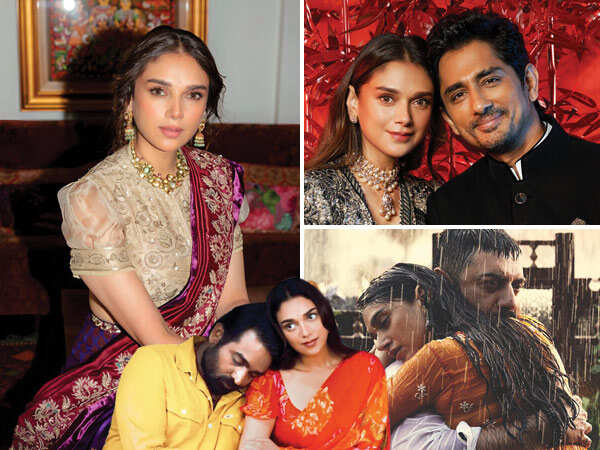
Are we likely to see the two of you together on screen?
I hope so. We’re drawn to similar things, adventurous narratives, distinctive directors, fresh storytelling. If the right filmmaker comes to us with something we both believe in, I’d love that. Ideally, it should feel like being back on a playground together.


 Are we likely to see the two of you together on screen?