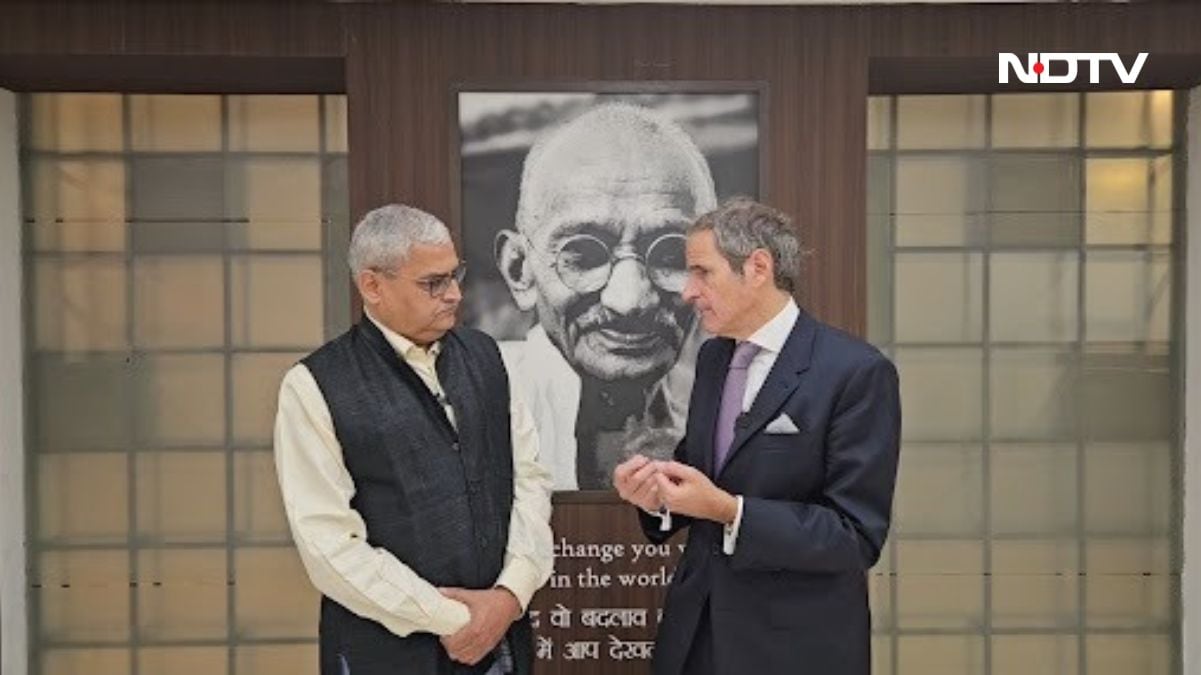
Standing in front of a portrait of Mahatma Gandhi, the chief of the International Atomic Energy Agency (IAEA), Rafael Mariano Grossi, praised India’s nuclear programme as safe and well-managed. India’s nuclear energy ambitions are entering a transformative phase, with the country aiming for 100 gigawatts (GW) of installed nuclear capacity by 2047.
“Gandhi’s legacy reminds us that technology should serve humanity, and nuclear applications can do precisely that,” Mr Grossi told NDTV in an exclusive interview.
The planned expansion marks a big leap from its current nuclear power output and aligns with India’s commitment to clean energy and economic growth.
“India is one of the emerging global powers, and its economy is among the largest in the world, requiring ever-growing amounts of energy to sustain this growth. Nuclear energy, due to its reliability, dispatchability, and flexibility provides India with a very appropriate element in the equation,” Mr Grossi told NDTV.
The expansion plan is ambitious, given that nuclear energy currently contributes a small fraction of India’s total electricity generation. However, Mr Grossi expressed confidence in India’s capabilities. “If any country can do it, it is India. India has the technological base, the industrial base, and the manpower. I don’t see any major obstacles preventing this incremental growth,” he said.
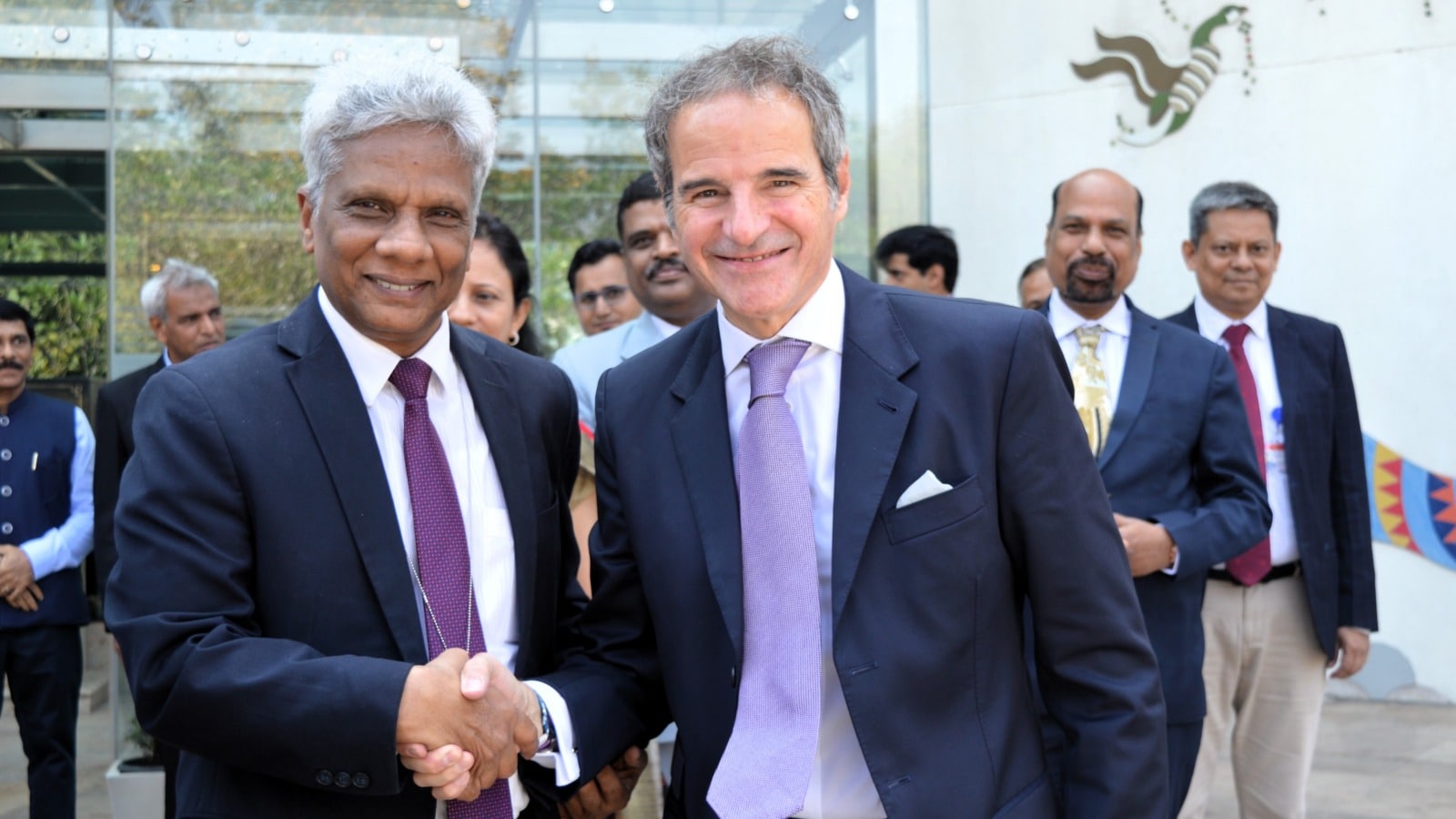
Mr Grossi meeting India’s nuclear energy officials at the Kakrapar Nuclear Reactor
One of the key factors in this growth is Small Modular Reactors (SMRs), which have garnered global attention. India’s decision to explore SMRs, including the indigenous Bharat Small Reactor (BSR) initiative, is part of the effort to decarbonise energy-intensive industries.
“SMRs are popular because they offer several attractive characteristics. First, as their name suggests, they are smaller. This means they can be deployed faster and more easily. They may also be more accessible – not just for major global powers like India, but also for medium-sized and developing countries. I’m very pleased to see that India is exploring this as well,’ Mr Grossi told NDTV.
India’s Need For Independent Nuclear Regulator
Despite India’s strong nuclear track record, one critical issue remains unresolved: regulatory independence. Mr Grossi batted for India’s nuclear regulator to be independent of the Department of Atomic Energy (DAE).
“This is clearly the best practice. I see it worldwide. An independent regulator is extremely important because you need a technical body that speaks truth to power. It must be able to indicate when adjustments are needed. This is how we cultivate a strong safety and security culture. With an independent regulator, you can be sure that the system remains objective,” Mr Grossi told NDTV.
India’s nuclear regulation is overseen by the Atomic Energy Regulatory Board (AERB), which reports to the DAE. Critics argue that this structure creates a conflict of interest, as the same entity responsible for promoting nuclear power also regulates its safety.
The Crumbling Of ‘Atoms for Peace’
Looking beyond India, Mr Grossi provided a sobering assessment of the state of global nuclear governance. The original vision of the IAEA – often summarised as ‘Atoms for Peace’ – was to prevent nuclear weapons proliferation while promoting peaceful nuclear energy. However, Mr Grossi acknowledged the growing concerns that the agency has struggled to fully achieve either objective.
“The number of nuclear-armed nations has grown. However, I would argue that this growth has been relatively contained. Without the Non-Proliferation of Nuclear Weapons (NPT), the IAEA, and the safeguard system, we would likely see dozens more nuclear-armed states, leading to greater international instability,” Mr Grossi said.
Rafael Grossi with India’s nuclear chief Dr AK Mohanty.
“Additionally, the IAEA plays a crucial role in facilitating the safe introduction of nuclear energy. Through our safety standards and security initiatives, we ensure that nuclear technology is used responsibly – not just for power generation but also in areas such as cancer treatment, food security, and environmental protection. While I acknowledge the challenges, I wouldn’t be as harsh in my assessment. Every day, we work toward progress. That is why I am here in India,” he added.
With shifting geopolitical dynamics, particularly the United States’ increasingly thorny equation with NATO under President Donald Trump, fears of nuclear proliferation in Europe have intensified. These developments raise concerns about a new arms race. While the IAEA continues to advocate for non-proliferation, the challenge remains whether it can enforce nuclear restraint in an increasingly fragmented global order.
India’s Nuclear Capabilities
India’s nuclear programme is unique in its end-to-end capabilities. Unlike many other nations, India mines its own uranium, designs and builds its own reactors, reprocesses spent nuclear fuel and has an extensive research and development infrastructure. This self-sufficiency has allowed India to maintain energy security while avoiding reliance on external suppliers.
Agni Missile is capable of carrying nuclear warheads.
Mr Grossi acknowledged this strength, stating, “During my tenure, I worked closely with India and other aspiring nations because they had demonstrated their role as responsible global nuclear players, even outside the NPT framework. My view is that major nuclear stakeholders – like India – should be part of these discussions.”
India has sought full membership in the Nuclear Suppliers Group (NSG), a consortium that controls nuclear trade. Mr Grossi, who previously presided over the NSG, expressed support for India’s inclusion.
The Liability Debate
One major hurdle for international nuclear collaboration in India has been its Civil Nuclear Liability Act. The global nuclear liability regime is seen as industry-friendly, while India’s Liability Act is viewed as people-friendly.
“This issue is complex, and I don’t see it as a simple industry-versus-people debate. A strong liability framework is essential, providing adequate compensation in the unlikely event of an accident. Both sides should engage in dialogue to find a solution,” Mr Grossi said.
This has been a contentious issue in past negotiations with US and French nuclear suppliers, slowing down international nuclear projects in India.
Thorium: India’s Long-Term Bet
India has long championed thorium-based nuclear energy, given its abundant thorium reserves. Unlike uranium, thorium-based reactors generate less long-lived radioactive waste and reduce proliferation risks. Mr Grossi acknowledged India’s leadership in this area but noted that global nuclear infrastructure remains centred around uranium.
“While the global nuclear fuel cycle has traditionally relied on uranium, I believe thorium could play a role in the future. We do not advocate nuclear dominance but rather an intelligent energy mix,’ Mr Grossi told NDTV.