Live · Global · Independent
Live Feeds
PinkVilla
Forbes
NDTV
Hindustan Times
Farmers To March On Delhi Again, After Snubbing Centre’s Offer: 10 Points
onmynews.com

Farmers To March On Delhi Again, After Snubbing Centre’s Offer: 10 Points

On Monday evening farmer leaders snubbed the government’s offer to buy maize, cotton, and three types of pulses – toor, urad, and masoor – at the old MSP. They said it did not make sense as it applied to only a few crops, and ignored those growing the other 18.
The farmers said the price – based on the A2+FL+50 per cent formula (MSP at 1.5 times direct costs, such as seeds and fertilisers, and unpaid family labour), and not the Swaminathan Commission’s C2+50 per cent formula (which includes rent for farm land, or the rental value of owned land) – would be “subsistence” payments and not “income”.
They were also unhappy with a clause that said MSP would only be for those opting for crop diversification, meaning they must plant crops cleared by the government to be eligible for the support price. “We have, thus, decided to reject the proposal…
The offer followed four rounds of talks in Chandigarh between farmer leaders and the government, which was represented by three union ministers, including Agriculture Minister Arjun Munda, who has said “unruly elements are trying to hijack talks”.
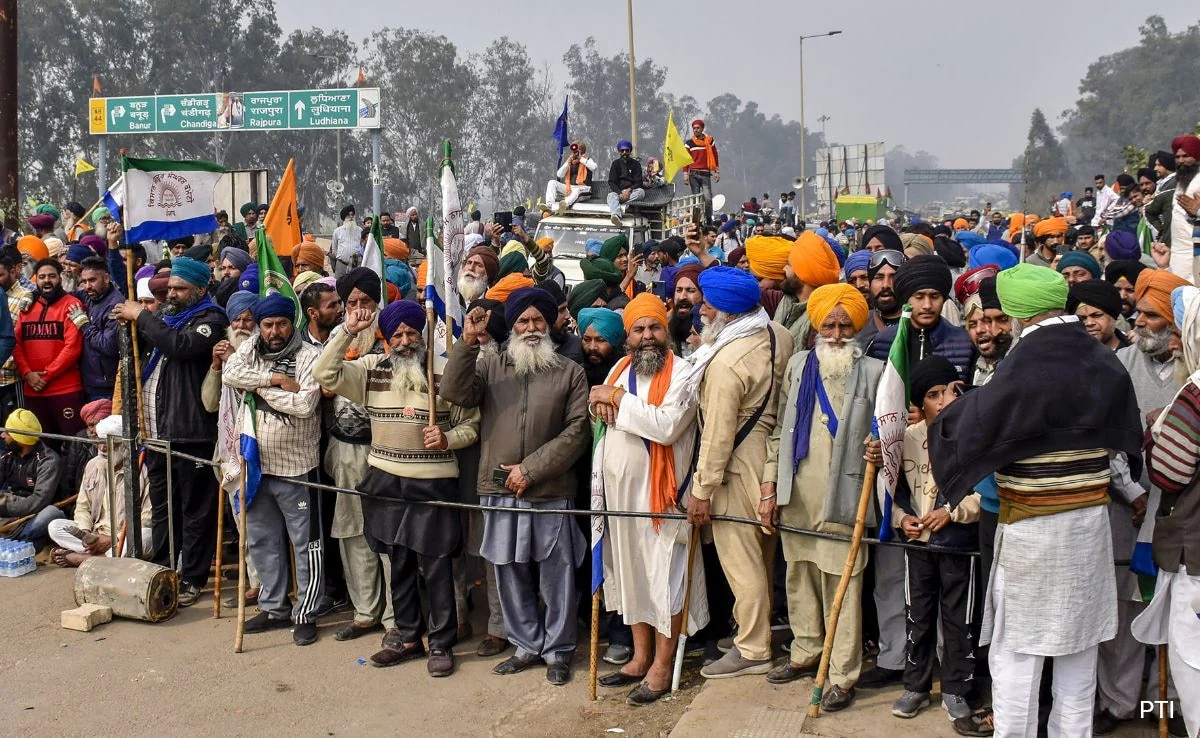
The farmers – who number around a lakh – are at Shambhu on the Punjab-Haryana border and have held station there since last week, while all sides try to negotiate a deal and avoid a repeat of the violent protests in 2020/21. That now seems unlikely.
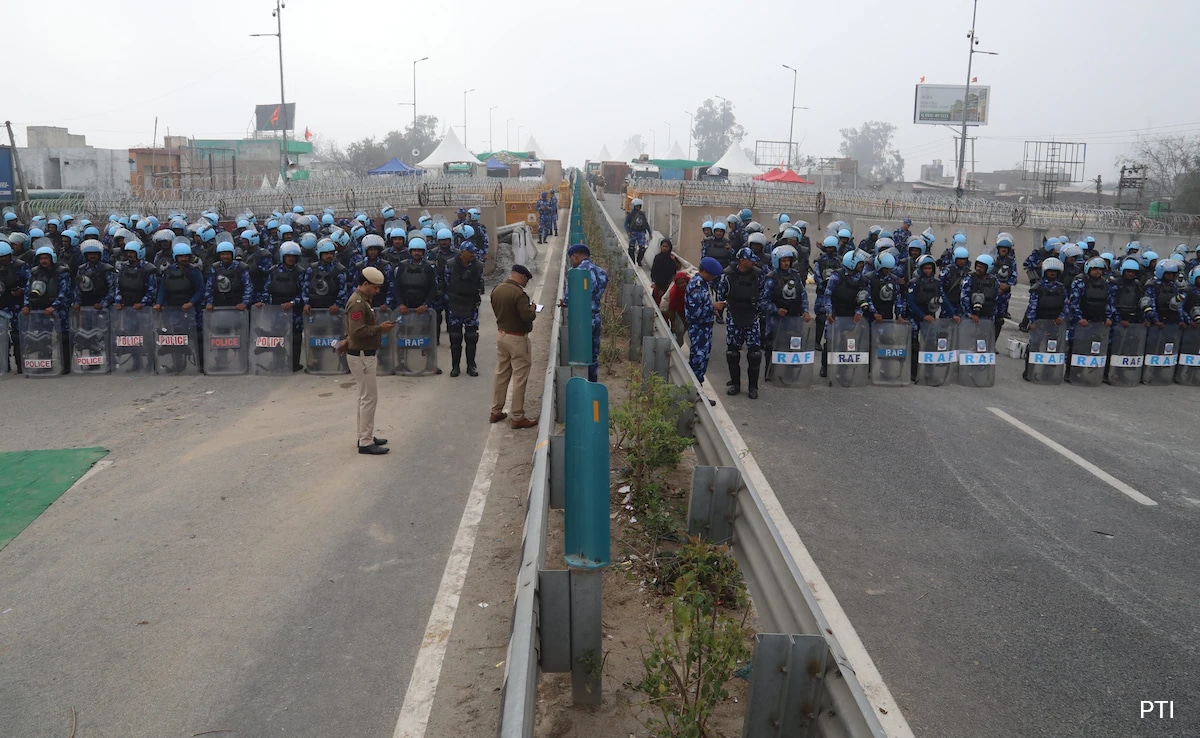
Between them and Delhi lie around 200 km of fortified highways, including concrete barriers, barbed wire fences, and even nail strips to stop tractors from pushing past. Drone footage presents a startling picture – akin to prepping for an ‘invasion’ of the city.
Security around Delhi has been heightened, with key border crossings, including Ghazipur, Tikri, Noida, and Singhu blocked with rows of metal and cement barriers. Delhi Police have also imposed a month-long ban on public gatherings under Section 144.
The farmers have said their march will be a peaceful one. “We want to appeal to the government to not use force against us,” one farmer told NDTV. They are, however, in this for the long haul and have come with food and provisions for six months.
Apart from recalculating MSPs and ensuring a legal guarantee, the farmers also want farm loan waivers, no hike in electricity tariffs, and withdrawal of 2020/21 police cases.
They also want a public sector crop insurance scheme and a monthly pension of Rs 10,000 to farmers over the age of 60. Finally, they also want junior Home Minister Ajay Mishra Teni to be prosecuted in connection with the Lakhimpur Kheri incident.

NDTV is now available on WhatsApp channels. Click on the link to get all the latest updates from NDTV on your chat.

Read full article
Senior Supreme Court Lawyer Fali S Nariman Dies At 95
onmynews.com

Senior Supreme Court Lawyer Fali S Nariman Dies At 95

Eminent jurist and veteran senior Supreme Court advocate Fali Nariman died today. He was 95.

Fali Nariman died at his Delhi home this morning. 

The noted jurist was awarded Padma Bhushan in 1991 and Padma Vibhusham in 2007. 

Fali Nariman started his practice as lawyer at the Bombay High Court and later moved to Delhi. He was appointed the Solicitor General of India in 1972. Fali Nariman resigned in 1975 to protest then Prime Minister Indira Gandhi’s decision to declare Emergency.

The veteran lawyer was also the President of the Bar Association from 1991 to 2010.

Senior advocate and Congress leader Abhishek Manu Singhvi expressed his anguish over Fali Nariman’s death, calling it “end of an era”.

“End of an era-#falinariman passes away, a living legend who wl forever be in hearts &minds of those in law &public life. Above all his diverse achievements, he stuck to his principles unwaveringly &called a spade a spade, a quality shared by his brilliant son,” Mr Singhvi wrote on X.

End of an era—#falinariman passes away, a living legend who wl forever be in hearts &minds of those in law &public life. Above all his diverse achievements, he stuck to his principles unwaveringly &called a spade a spade, a quality shared by his brilliant son #Rohinton.

— Abhishek Singhvi (@DrAMSinghvi) February 21, 2024

Solicitor General Tushar Mehta said the nation has lost a “towering figure of intellect and wisdom.” The country has lost an epitome of what righteousness stood for. The legal fraternity is intellectually poorer today,” Mr Mehta said.

Read full article
Human Chain, Barbed Wire: Delhi’s Border Areas Fortified On Both Sides
onmynews.com

Human Chain, Barbed Wire: Delhi’s Border Areas Fortified On Both Sides

The Shambhu border, which separates Haryana and Punjab, has become Ground Zero for the ongoing farmers’ protest. Farmer leaders have been strategically positioned in a buffer zone to avoid potential clashes with the police.

In preparation for a march towards Delhi, farmer organisations have formed a human chain at the Shambhu border. On one side, a lineup of excavators and tractors stands in defiance, and the Haryana Police on the other. The Punjab and Haryana Police are on high alert, with concerns over the potential use of heavy machinery by the protesting farmers to break barricades and enter Haryana. 

As the confrontation intensifies, Delhi Police has fortified the national capital with a multi-layered security apparatus. Delhi’s critical border points – Singhu Border, Tikri Border, and Ghazipur Border – are fortified with barricades made of barbed wire, nails, cement, and stone walls, supplemented by water cannons and anti-riot equipment. 

The imposition of security measures includes the deployment of long-range acoustic devices (LRAD), producing unbearable noise, and the cancellation of all leaves for Delhi Police personnel. Historical landmarks like the Red Fort and India Gate have also been placed under heavy security.

The Shambhu and Khanauri border points between Punjab and Haryana have become focal points of the ongoing standoff. Farmers, equipped with excavators, are determined to break through the barricades erected by Haryana security personnel. 

Despite four rounds of talks between farmer leaders and Union ministers, the stalemate continues. The recent rejection of the government’s proposal to buy pulses, maize, and cotton crops at the minimum support price (MSP) for five years has further fueled the resolve of the protesting farmers. 

In response to the escalating tensions, the Haryana government has extended the ban on mobile internet and bulk text-message services in seven districts. Ambala, Kurukshetra, Kaithal, Jind, Hisar, Fatehabad, and Sirsa remain under these restrictions, emphasizing the government’s concerns about maintaining law and order. Despite the confrontational atmosphere, farmer leaders insist on a peaceful march towards Delhi from the Shambhu and Khanauri border points.

The demands put forth by the protesting farmers, including a legal guarantee on the minimum support price (MSP), the implementation of the Swaminathan Commission’s recommendations, and a farm loan waiver, remain at the core of the agitation. 

Read full article
Link copied!