Live · Global · Independent
Live Feeds
PinkVilla
Forbes
NDTV
Hindustan Times
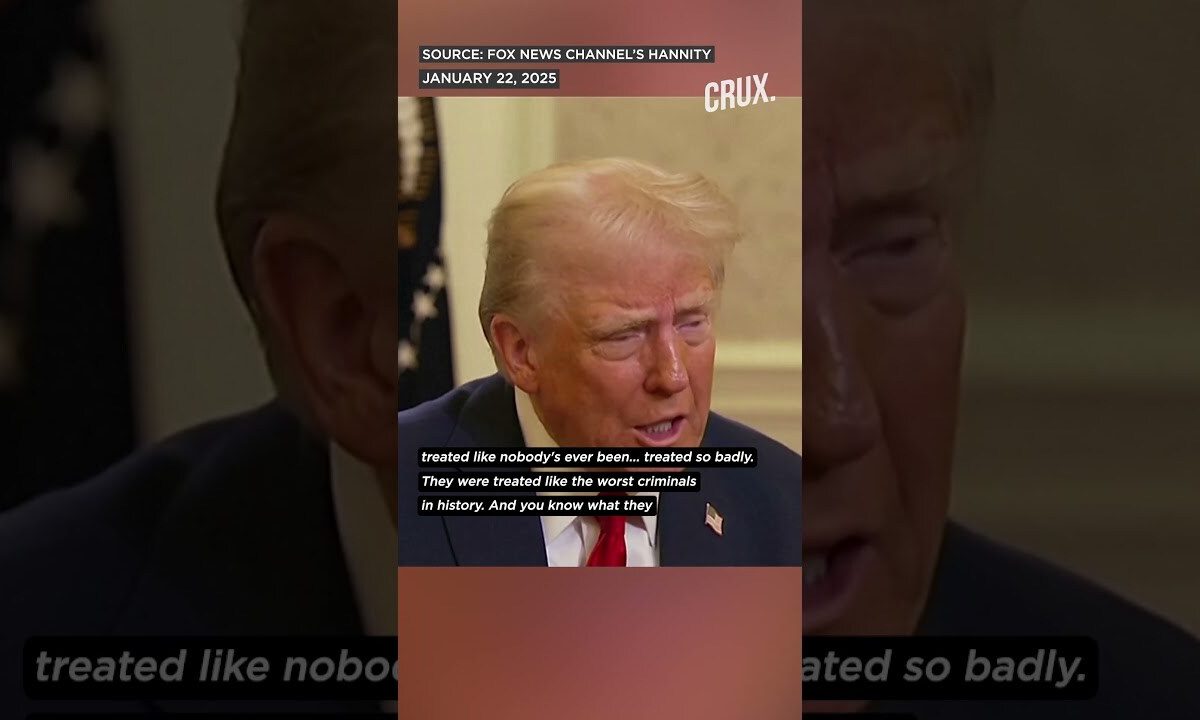
Trump Defends January 6 Pardons ‘They Were Protesting The Vote’
onmynews.com

Trump Defends January 6 Pardons ‘They Were Protesting The Vote’

Former U.S. President Donald Trump defended his decision to pardon individuals involved in the January 6, 2021 Capitol attack during a recent interview. He cited their lengthy imprisonment, often in solitary confinement, and described their treatment as harsh and unjust. Trump argued that they were protesting what they believed to be a rigged election and emphasised that protesting a vote should be permitted. n18oc_world n18oc_crux

Read full article
“Blatantly Unconstitutional”: Judge Blocks Trump Citizenship Order
onmynews.com

“Blatantly Unconstitutional”: Judge Blocks Trump Citizenship Order

A federal judge in Seattle on Thursday blocked President Donald Trump’s administration from implementing an executive order curtailing the right to automatic birthright citizenship in the United States, calling it “blatantly unconstitutional.”

U.S. District Judge John Coughenour at the urging of four Democratic-led states issued a temporary restraining order preventing the administration from enforcing the order, which the Republican president signed on Monday during his first day on office.

“This is blatantly unconstitutional order,” the judge told a lawyer with the U.S. Justice Department defending Trump’s order.

The order has already become the subject of five lawsuits by civil rights groups and Democratic attorneys general from 22 states, who call it a flagrant violation of the U.S. Constitution.

“Under this order, babies being born today don’t count as U.S. citizens,” Washington Assistant Attorney General Lane Polozola told Senior U.S. District Judge John Coughenour at the start of a hearing in Seattle.

Polozola – on behalf of Democratic state attorneys general from Washington state, Arizona, Illinois and Oregon – urged the judge to issue a temporary restraining order to prevent the administration from carrying out this key element of Trump’s immigration crackdown.

The challengers argue that Trump’s action violates the right enshrined in the citizenship clause of the Constitution’s 14th Amendment that provides that anyone born in the United States is a citizen.

Trump in his executive order directed U.S. agencies to refuse to recognize the citizenship of children born in the United States if neither their mother nor father is a U.S. citizen or legal permanent resident.

In a brief filed late on Wednesday, the U.S. Justice Department called the order an “integral part” of the president’s efforts “to address this nation’s broken immigration system and the ongoing crisis at the southern border.”

The lawsuit filed in Seattle has been progressing more quickly than the four other cases brought over the executive order. It has been assigned to Coughenour, an appointee of Republican former President Ronald Reagan.

The judge potentially could rule from the bench after hearing arguments, or he could wait to write a decision ahead of Trump’s order taking effect.

Under the order, any children born after Feb. 19 whose mothers or fathers are not citizens or lawful permanent residents would be subject to deportation and would be prevented from obtaining Social Security numbers, various government benefits and the ability as they get older to work lawfully.

More than 150,000 newborn children would be denied citizenship annually if Trump’s order is allowed to stand, according to the Democratic-led states.

Democratic state attorneys general have said that the understanding of the Constitution’s citizenship clause was cemented 127 years ago when the U.S. Supreme Court held that children born in the United States to non-citizen parents are entitled to American citizenship.

The 14th Amendment was adopted in 1868 following the Civil War and overturned the Supreme Court’s notorious 1857 Dred Scott decision that had declared that the Constitution’s protections did not apply to enslaved Black people.

But the Justice Department in its brief argued that the 14th Amendment had never been interpreted to extend citizenship universally to everyone born in the country, and that the Supreme Court’s 1898 ruling in United States v. Wong Kim Ark concerned only children of permanent residents.

The Justice Department said the case by the four states also “flunks multiple threshold hurdles.” The department said that only individuals, not states, can pursue claims under the citizenship clause, and that the states lack the necessary legal standing to sue over Trump’s order.

Thirty-six of Trump’s Republican allies in the U.S. House of Representatives on Tuesday separately introduced legislation to restrict automatic citizenship to only children born to citizens or lawful permanent residents.

(Except for the headline, this story has not been edited by NDTV staff and is published from a syndicated feed.)

Read full article
Hungry And Thirsty, How Forces Gunned Down 16 Maoists In Chhattisgarh
onmynews.com

Hungry And Thirsty, How Forces Gunned Down 16 Maoists In Chhattisgarh

The forces’ supplies ran low and they were hungry and thirsty, but they didn’t let that affect their morale and went on to kill 16 Maoists, including a senior leader carrying a Rs 1-crore bounty, in Kulhadighat in Chhattisgarh’s Raipur district earlier this week.

Speaking exclusively to NDTV on Thursday, Raipur Inspector General of Police Amresh Mishra shared details of the encounter, revealing that the Maoists used drones to keep an eye on the security forces. He said some of the Maoists killed carried a combined bounty of Rs 5 crore and that the extremists likely lost more men, but may have carried away the bodies. 

Inputs, Operation

On Sunday evening, intelligence inputs revealed that a large group of senior Maoist cadres was assembling in the hills of Kulhadighat. The group, reportedly comprising 25-30 prominent Maoist leaders from Odisha and Chhattisgarh cadres, had convened to discuss fund collection, panchayat elections and establishing a safe corridor from Bastar.

The operation was carried out in three phases: planning, tactical strategy, and monitoring. The security forces, equipped with precise intelligence, embarked on what they had thought would be an operation lasting a day and a half, which eventually stretched on for three days – until Wednesday.

Combined teams of E-30 soldiers (Gariaband district), COBRA 207 and CRPF’s 65 and 211 battalions, along with Odisha’s Special Operations Group (SOG), coordinated the tactical strike.

Challenging Terrain 

The operation unfolded in the rugged hills of Kulhadighat, with heavy firing exchanged between the security forces and the Maoists. Despite limited rations and gruelling conditions, the security personnel demonstrated unwavering resolve and high morale.

Inspector General Mishra said, “The security forces had initially set out for a one-and-a-half to two-day operation, but they ended up fighting the Naxalites for three days, while remaining hungry and thirsty.”

The Maoists he said, had also deployed two drones for surveillance, but the forces outmaneuvered them using local drones for intelligence and monitoring. The extremists were surrounded in a triangle-shaped ambush, with Odisha’s Special Operations Group blocking escape routes to the state, and forces in Chhattisgarh covering the remaining exits. 

Top Leaders Neutralised

Among the 16 Naxals killed, 11 bodies have been identified and the biggest name of them all was Jayaram Reddy aka Chalapati, a Central Committee Member, who was a a key Maoist strategist and had been active since 1991. He was responsible for numerous attacks, including the killing of an MLA in Andhra Pradesh, and played a central role in fund collection and urban Maoist propaganda. The government had announced a Rs 1 crore reward for information leading to his arrest.  

Some of the others are Jayaram alias Guddu, a mobilisation expert with a notorious record of organising Maoist operations and Satyam Gawade, a top commander in Kanker, responsible for coordinating major operations over several years.

“These leaders collectively carried a bounty exceeding Rs 5 crore,” Mr Mishra said.

The officer emphasised that the elimination of these top leaders marks a turning point in the fight against Maoism.

 “The killing of Chalapati, Guddu, and Gawade will cripple their network and strategies. We are on track to eradicate Maoism by March 2026, paving the way for a brighter future for Bastar,” he said.

Strategic Significance 

Kulhadighat, a tribal-dominated region spread across 75 km, comprises seven villages surrounded by forests and hills. The area remains a no-network zone, with a population of about 1,500. Four of the villages are situated on hilltops, making accessibility a challenge.

For decades, this region served as a strategic hub for Naxal leaders overseeing operations across Odisha, Andhra Pradesh, and Chhattisgarh. The rugged terrain and dense vegetation provided a natural shield, turning Kulhadighat into a safe haven for Chalapati and other top cadre leaders.

The villagers in hilltop settlements lead secluded lives, descending only once a week to collect essentials such as rations and water. Supplies are transported back using horses and mules. This exacerbates the challenge of monitoring the area.
Read full article
…
Link copied!