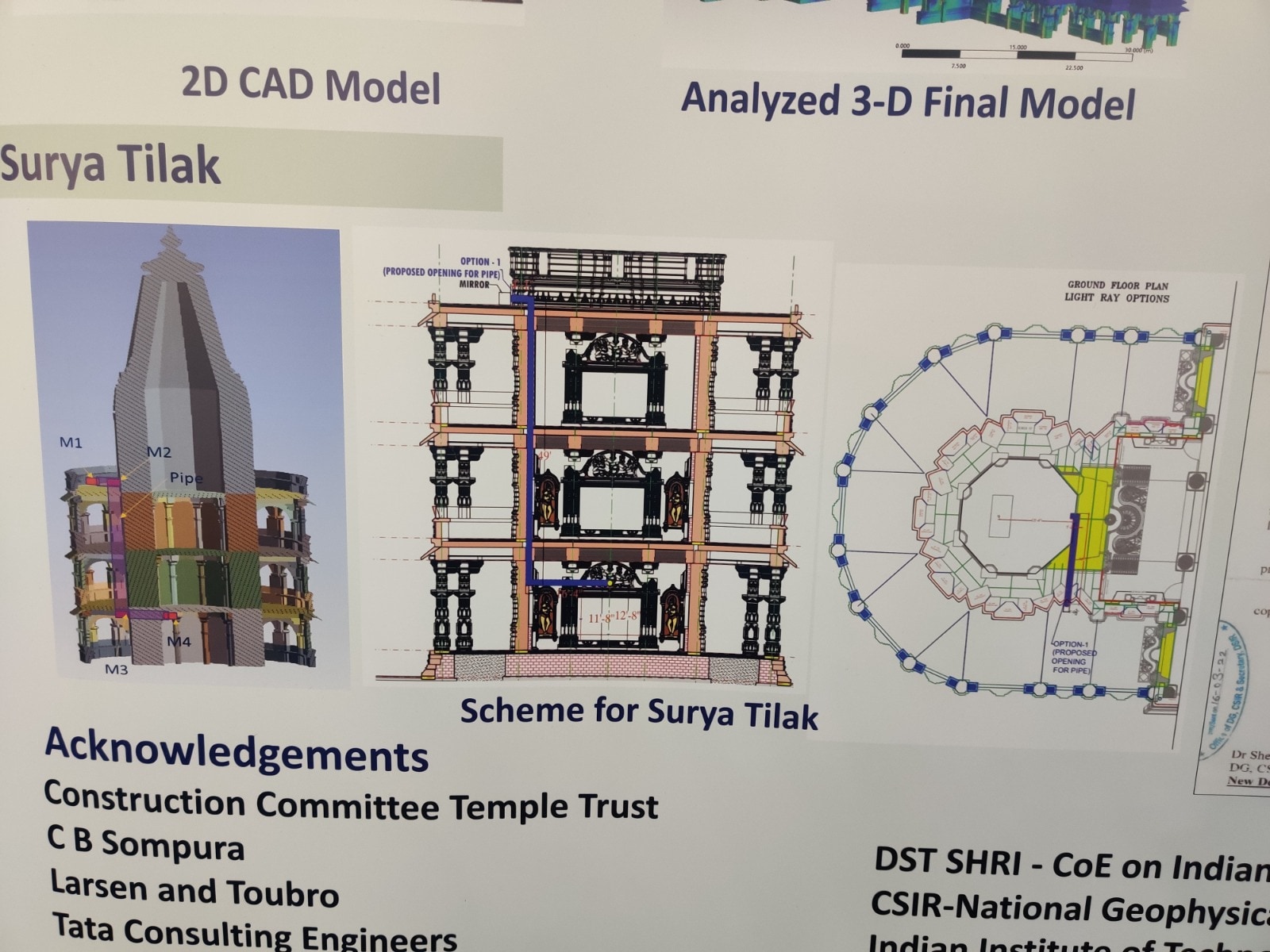
Once a year a special ‘surya tilak’ will adorn the forehead of Ram Lalla. On every Ram Navami, or on the birthday Ram Lalla the incarnate will get a gift of special surya tilak designed by Indian scientists.
Scientists from a top government institution have designed a special mirror- and lens-based apparatus which will ensure that every Ram Navami day at noon, there is a ray of sunlight that falls directly on the forehead of the ‘achal Ram Lalla’ statue.
It is officially called the ‘Surya Tilak mechanism’. It was a scientific and engineering challenge to get it right.
“The Surya Tilak mechanism would be fully operational when the full temple is constructed,” says Dr Pradeep Kumar Ramancharla, Director of the Central Building Research Institute (CBRI), Roorkee.
CBRI is India’s top institution, which is also a part of the Council of Scientific and Industrial Research (CSIR). Currently, only the structure till the first floor has been made, says Dr Ramancharla. “All the equipment that was to be installed in the garba griha and ground floor has been completed.”
The Surya Tilak mechanism is designed by a team of scientists from the CBRI in such a manner that sunrays will fall on the forehead of Lord Ram’s idol at 12 pm on Ram Navami day every year for about six minutes.
A gearbox and reflective mirrors and lenses have been arranged such that sunrays from the third floor near the shikara will be brought to Garbha Griha using well-known principles of tracking the Sun’s path.
The Indian Institute of Astrophysics (IIA), Bengaluru, provided technical support on the Sun’s path and Optica, a Bengaluru-based company, is involved in manufacturing the lenses and brass tubes.
The fabrication and installation of this device will be carried out by Rajendra Kotaria, MD of Optica. The team from CBRI was led by Dr SK Panigrahi, along with Dr RS Bisht, Kanti Lal Solanki, V Chakradhar, Dinesh, and Sameer.
CBRI scientist Dr Pradeep Chauhan, who helped in the design of the Ram temple, says, “100 per cent the Surya Tilak will anoint the forehead of the statue of Ram Lalla.”
Since the date of Ram Navami is fixed using the lunar calendar, special arrangements of 19 gears had to be put in place to make sure that the auspicious anointment takes place as scheduled. “No electricity or battery or iron is used in the gear-based Surya Tilak mechanism,” Dr Chauhan says.
India’s foremost institution on all issues astronomy, the Indian Institute of Astrophysics (IIA) came up with the solution to bridge the seemingly intractable confluence of the lunar and solar (Gregorian) calendars.
“We have the necessary expertise on positional astronomy,” says Dr Annapurni Subramaniam, director of IIA. “This domain knowledge was translated so that the Sun’s rays in the form of a surya tilak could then anoint the idol of Ram Lalla every Ram Navami.”
The IIA also had the expertise with optics as they have designed some of India’s best telescopes. That was extended to make sure this periscope-like device brings sunlight into the enclosed garba griha.
“It was an interesting scientific experiment where the 19-year repeat cycle of the two calendars’ helped solve the problem,” says Dr Subramaniam.
Even as the Sun’s energy will be harvested and directed to the forehead of the statue of the Ram Lalla, another equally ambitious project to make the Ram temple complex green and near net-zero by using solar energy panels to generate electricity could not be implemented.
“The presence of many monkey troops led to the abandoning of the solar energy project,” says Nripendra Misra, chairperson of the temple construction committee of the Shri Ram Janmabhoomi Teerth Kshetra Trust.
“There are so many monkeys, and they are all revered. They would have damaged the exposed solar panels,” he says.
A similar surya tilak mechanism already exists in some Jain temples and at the Sun Temple at Konark, but they are engineered differently.