
Live · Global · Independent
Live Feeds
PinkVilla
Forbes
NDTV
Hindustan Times
Israel Will “Receive Slap In The Face” If Aggression Continues: Hezbollah
onmynews.com

Israel Will “Receive Slap In The Face” If Aggression Continues: Hezbollah

A top official from Lebanon’s Iran-backed militant group on Friday warned Israel would “receive a real slap in the face” if it expanded the conflict along the Lebanon-Israel border.

Since the surprise October 7 attack by Hamas on southern Israel, there have been near daily exchanges of cross-border fire between the Israeli army and militant group Hezbollah, an ally of the Palestinian militants.

Israel has repeatedly bombarded border villages, with the violence killing more than 195 people in Lebanon, including at least 142 Hezbollah fighters, according to an AFP tally.

On the Israeli side, 15 people have been killed, of whom nine were soldiers and six civilians, according to the Israeli army.

“If Israel decides to expand its aggression, it will receive a real slap in the face in response,” Hezbollah’s number two, Naim Qassem, said in a statement.

Any restoration of stability on the border is contingent on “the end of the aggression in Gaza”, he added.

“The enemy must know the party is ready, that we are preparing based on the principle that an endless aggression can happen, just like our will to push back the aggression is infinite.”

His remarks came after Israeli air strikes “completely destroyed” at least three houses in southern Lebanon on Friday, the official Lebanese news agency NNA and the mayor of the affected border community said.

The agency reported four houses were targeted “since this morning by the Israeli air force in Kfar Kila”, a village near the Israel-Lebanon border, while three were “completely destroyed”.

A fifth home was also targeted by artillery fire, NNA said.

The Israeli army said on Friday it had “conducted air strikes and carried out artillery and tank fire against Hezbollah observation posts and terrorist infrastructure” in the Kfar Kila sector.

“There are around 100 residents left in Kfar Kila, but by chance, when the bombings took place, the destroyed homes were empty,” the mayor of the village, Hassan Chite, told AFP.

On Friday afternoon, Hezbollah claimed three attacks, including two against “deployments of soldiers of the Israeli enemy” on the border, including using Burkan missiles, which can carry a large explosive payload.

Israel “is not prepared for a war against what the Islamic resistance in Lebanon has in store for it”, Mohamed Raad, the head of the Islamist militants’ parliamentary bloc, said on Friday, according to the NNA.

On Wednesday, Israeli army chief Herzi Halevi said the probability of a war between Israel and Hezbollah “in the coming months is much higher than it was in the past”.

The same day, UN Secretary General Antonio Guterres said a “total confrontation” between the two would be a “complete disaster”.

(Except for the headline, this story has not been edited by NDTV staff and is published from a syndicated feed.)
Read full article
No Iron And Steel Was Used To Construct Ayodhya Ram Temple. Here’s Why
onmynews.com

No Iron And Steel Was Used To Construct Ayodhya Ram Temple. Here’s Why

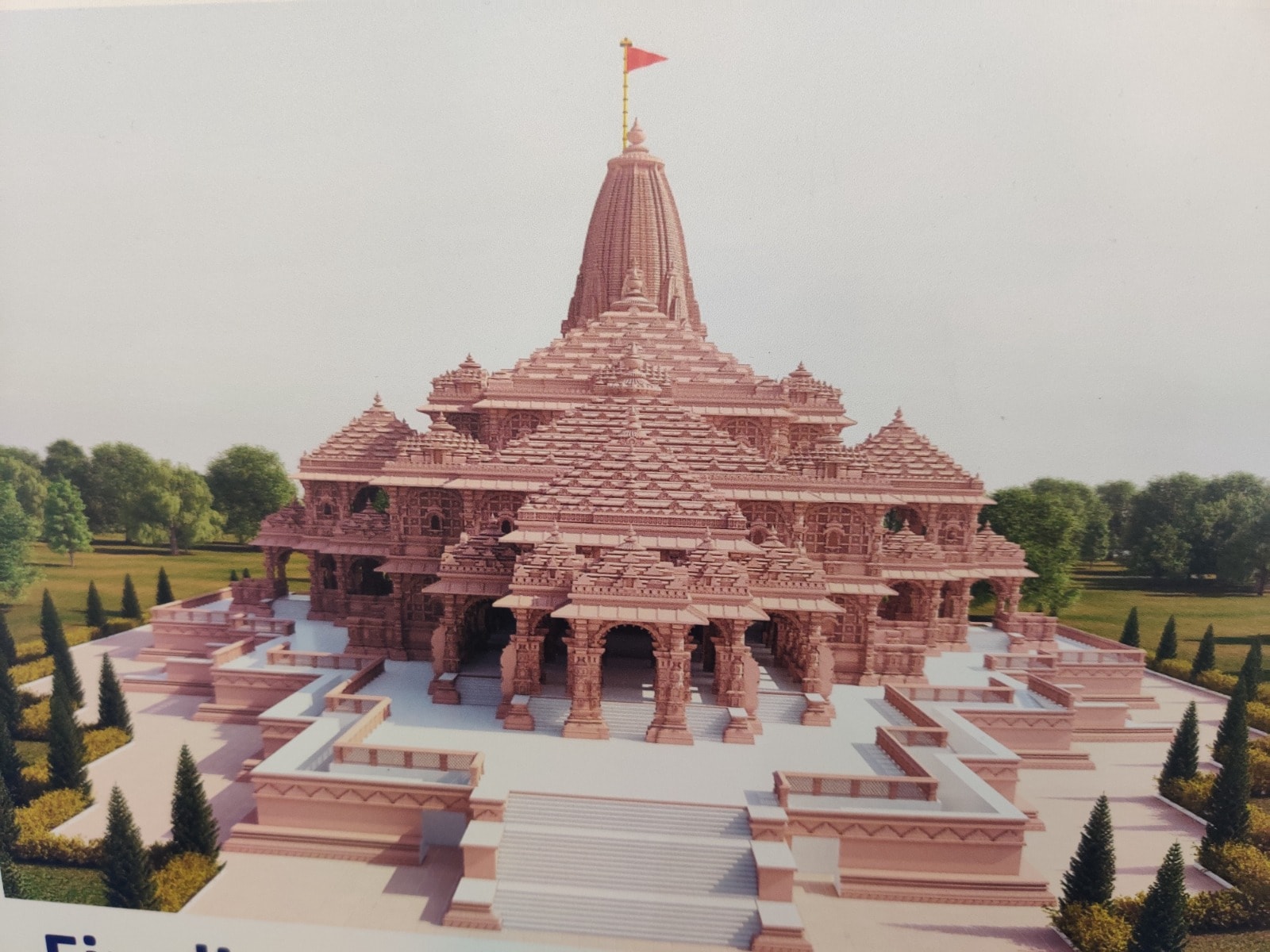
The grand temple at Ayodhya for Ram Lalla or infant Lord Ram is truly an amalgamation of traditional Indian heritage architecture incorporating science for construction so that it can last for centuries.

“The temple has been made to last more than a thousand years,” asserts Shri Nripendra Misra, chairperson of the temple construction committee of the Shri Ram Janmabhoomi Teerth Kshetra Trust, Ayodhya.

He says top Indian scientists have contributed to making it an iconic structure like never before. Even ISRO technologies have been suitably used in the temple.  

The architectural design was made according to the Nagar Shaily or the northern Indian temple designs by Chandrakant Sompura who has been designing heritage temple structures as a family tradition that goes back 15 generations. The family has designed over 100 temples.

Mr Sompura says “In the annals of architecture Shri Ram Temple will be the rarely seen, unique kind of splendid creation ever conceptualized not only in India but at any place on Earth.”

The total temple area is 2.7 acres and the built-up area is about 57,000 square feet it will be a three-floor structure, says Nripendra Misra. He says that no iron or steel has been used in the temple since the life of iron is merely 80-90 years. The height of the temple will be 161 feet or about 70% of the height of the Qutab Minar.

“The very best quality granite, sandstone, and marble has been used and there is no use of cement or lime mortar in the joints, only a lock and key mechanism using groves and ridges has been used in the construction of the entire structure”, says Dr Pradeep Kumar Ramancharla, Director of the Central Building Research Institute, Roorkee who has been actively involved in the construction project. CBRI says the structural design of 3 floored structures has been done to resist an earthquake of the return period of 2,500 years.

Mr Misra says on analysis it was found ground below the temple was sandy and unstable since the Sarayu River flowed near the site at one point, and this posed a special challenge. But the scientists found an ingenious solution to this problem.

First, the soil for the entire temple area was excavated out to a depth of 15 meters. Ramancharla says “An engineered soil was laid in the area to a depth of 12-14 meters, no steel re-bars were used, and the 47 layered bases were compacted to make it solid rock-like.”

On top of this, a 1.5 meter thick M-35 grade metal-free concrete raft was laid as a reinforcement. To further strengthen the foundation a plinth of 6.3 meter thick solid granite stone extracted from southern India was placed.     

The part of the temple that will be visible to visitors is made up of pink sandstone called ‘Bansi Paharpur’ stone extracted from Rajasthan. According to CBRI, the total number of columns on the ground floor is 160, the first floor 132, and the second floor 74, these are all made of sandstone and carved on the outside. The decorated sanctum sanctorum is lined with white makrana marble quarried from Rajasthan. Incidentally, the Taj Mahal was made using marble from the Makrana mines.

“After analyzing around 50 computer models, the chosen model, preserving the Nagara style of architecture, ensures both performance and architectural integrity. Proposed modifications enhance the structure’s architecture while maintaining safety against a 2500-year return period earthquake. Notably, the dry-jointed structure designed for a 1000-year lifespan consists solely of interlocked stone, without steel reinforcement,” CBRI says.

The institute has been involved in the construction of Ram Mandir since early 2020 and has contributed the following in a project mode: structural design of the main temple; design of the ‘Surya Tilak’ mechanism; design vetting of the temple foundation, and structural health monitoring of the main temple.

Dr Sharda Srinivasan, an archaeologist specializing in heritage metals working at the National Institute of Advanced Studies, Bengaluru says “The traditional style of temple architecture in earlier periods was of the dry masonry and remarkably used no mortar nor any iron and steel, (although of course in later periods such as in the 12th century Konarak temple the use of numerous structural iron beams is seen as well as iron dowels in some temples). The Mortis and Tenon method of joining rocks was used traditionally to hold blocks together i.e. with interlocking grooves and pegs, and the use of the trabeate system of lintels spanning columns with horizontal beams was used. The carved columns often monolithic, had a more swollen capital to bear the vertical loads, while the shikara was built by the corbelling technique with lintels and going progressively inwards to form a more pyramidal shape. These aspects are also seen in the colossal feat of the sandstone Ram Temple, while sandstone also has a better tensile strength amongst stones to support the trabeate structure.”

Ramancharla asserts “The temple may have a heritage architecture as its base, but most modern finite element analysis, most sophisticated software tools, and the 21st century building codes are what define the Ram Temple.”

“There can be no doubts that based on the current state of the art knowledge the Ram Mandir will surely survive more than a thousand years,” explains Ramancharla who adds “It was a most enjoyable experience and great learning exercise as such challenges come maybe once in a lifetime.”

Read full article
Watch: Sneak Peek Into Ayodhya’s Ram Temple Ahead Of Grand Opening
onmynews.com

Watch: Sneak Peek Into Ayodhya’s Ram Temple Ahead Of Grand Opening

With just two days to go for the grand consecration of the Ram Temple in Ayodhya, the magnificent abode of Lord Ram Lalla is gearing up for the Pran Pratishtha ceremony that will imbibe the idol with divine consciousness.

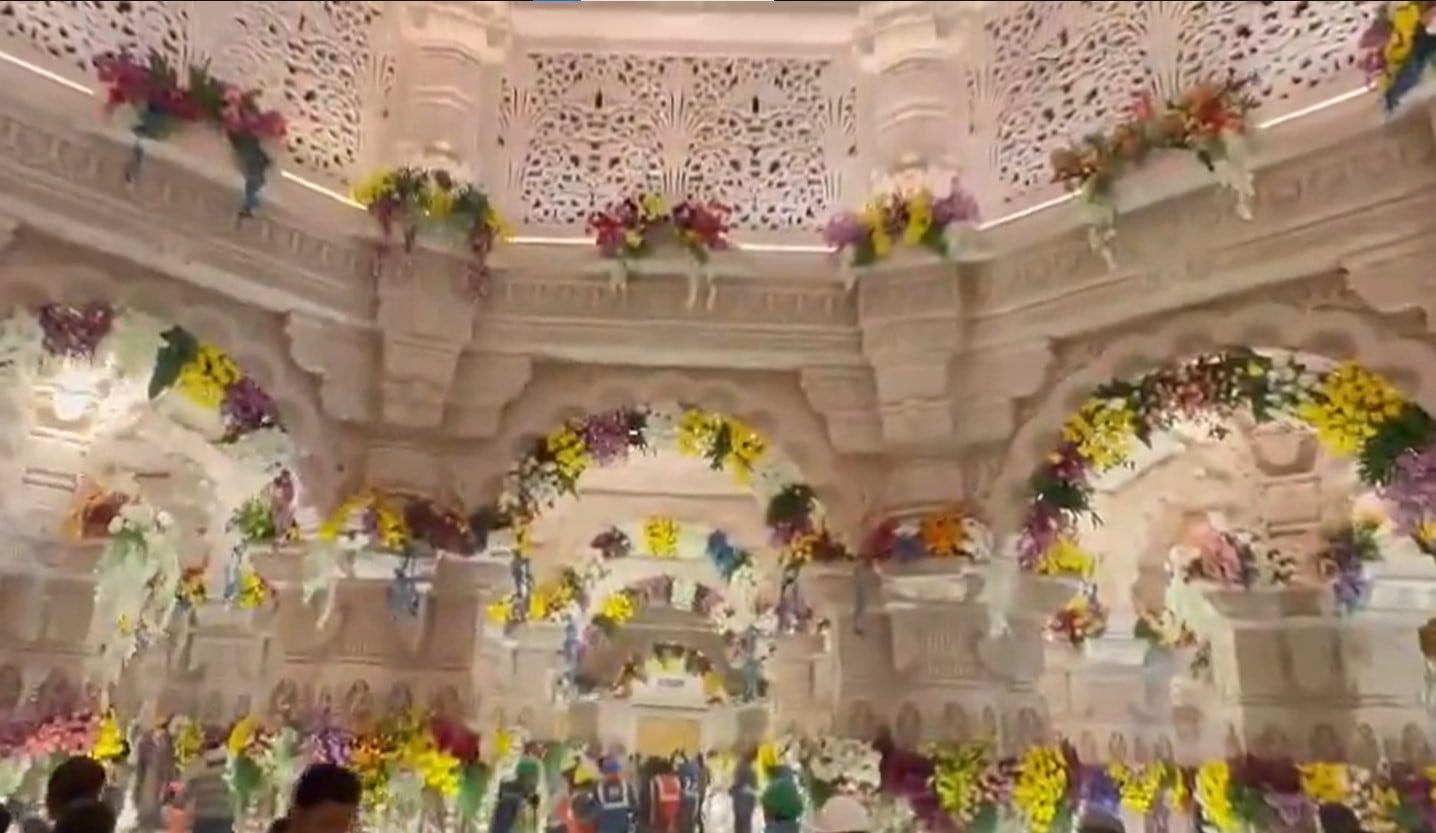
A video posted on X by DD News gives an exclusive look inside the splendid temple. The video shows the footsteps of the grand marble structure awash with light as its pillars and columns are decorated with bouquets of flowers. Inside the temple, workers on ladders are seen hanging multi-coloured flower garlands from the ceiling. 

#DDNews Exclusive sneak peek inside the magnificent Ram Temple!
The craftsmanship is awe-inspiring, a testament to India’s rich cultural heritage. @PMOIndia @ShriRamTeerth @UPGovt @tourismgoi @MinOfCultureGoI @tapasjournalist#Ayodhya #AyodhyaRamTemple #RamTemplepic.twitter.com/FyaMm4FGrv

— DD News (@DDNewslive) January 20, 2024

“Exclusive sneak peek inside the magnificent Ram Temple! The craftsmanship is awe-inspiring, a testament to India’s rich cultural heritage,” the caption read.

The consecration ceremony will begin at 12.30 pm on January 22. The event will be the culmination of a week of rituals performed at the temple to ready it for the Pran Pratishtha. A team of priests led by Lakshmikant Dixit will perform the main rituals of the ceremony.

At the centre of the rituals, placed inside the sanctum sanctorum, is the 51-inch idol of Lord Ram Lalla idol, a depiction of Lord Ram at the age of five years. The idol was carved out of black stone by Mysuru-based sculptor Arun Yogiraj. The complete look of the idol was unveiled on Friday which showed the deity’s face as well as a golden bow and arrow.

The grand event will be attended by Prime Minister Modi and UP chief minister Yogi Aditynath among dozens other dignitaries. Businessman Mukesh Ambani, megastar Amitabh Bachchan and former cricketer Sachin Tendulkar are also among the 8,000 guests invited for the ceremony.

Government offices, boards and corporations in several states have declared a half day or a holiday on January 22.

Read full article
Link copied!