Live · Global · Independent
Live Feeds
PinkVilla
Forbes
NDTV
Hindustan Times
Supreme Court Verdict On Validity Of Ending J&K Special Status Today
onmynews.com

Supreme Court Verdict On Validity Of Ending J&K Special Status Today

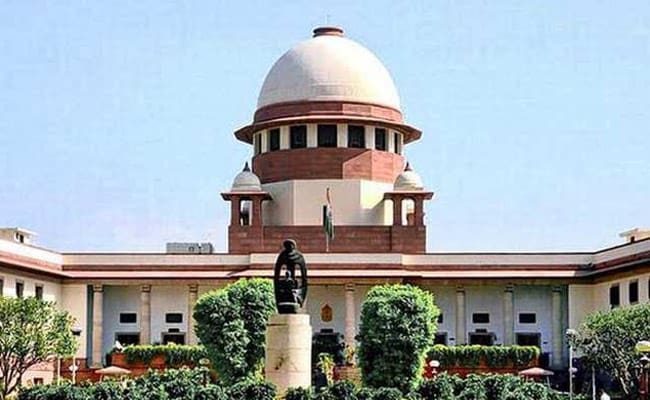
The verdict from a five-judge Constitution bench led by Chief Justice of India DY Chandrachud comes in response to a slew of petitions challenging the Centre’s move four years ago.
The petitioners have argued that Article 370 cannot be scrapped unilaterally by the Centre, since the powers of the Constituent Assembly was vested in the J&K legislature after it was dissolved in 1957.
The top court has questioned who can recommend the revocation of Article 370. Under the rules, a nod is required from the Constituent Assembly to scrap Article 370, which the Constitution held temporary. The court has also asked how the Article became permanent after the Constituent Assembly was dissolved.
The Centre has argued that its decisions were taken within the legal framework. It has also contended that the mainstreaming of Jammu and Kashmir has reduced terrorism and provided a level playing field.
Over the last four years, it has helped move the erstwhile state on the fast-track to development, the government has argued.
Article 370, it also maintained, deprived the people of J&K of many fundamental rights, including the right to education. The Constitutional rights that automatically apply to every Indian could not apply to residents of Jammu and Kashmir unless okayed by the state legislature.
Conversely, Article 35A, which was also scrapped along with Article 370, did not allow people from other parts of the country the right to get jobs, own land and settle in Jammu and Kashmir — which is part of their fundamental rights. These were reserved as special privileges reserved only for the residents of Jammu and Kashmir.
Security has been strengthened in Kashmir Valley ahead of the verdict. The BJP has said the decision of the top court should be respected.
Former Chief Minister and National Conference chief Omar Abdullah said his party will not disturb the peace even in case of an adverse verdict. They will continue their fight in a lawful manner, he said. Mehbooba Mufti’s People’ Democratic Party and the Congress have expressed hope that the court will be on the side of the people.
Article 370 was scrapped and Jammu and Kashmir split in August 2019 – over a year after the PDP-BJP alliance government had collapsed . It took place while the erstwhile state was under President’s Rule.


Read full article
Cash Haul Linked To Congress MP Crosses Rs 351 Crore, Counting Still On
onmynews.com

Cash Haul Linked To Congress MP Crosses Rs 351 Crore, Counting Still On

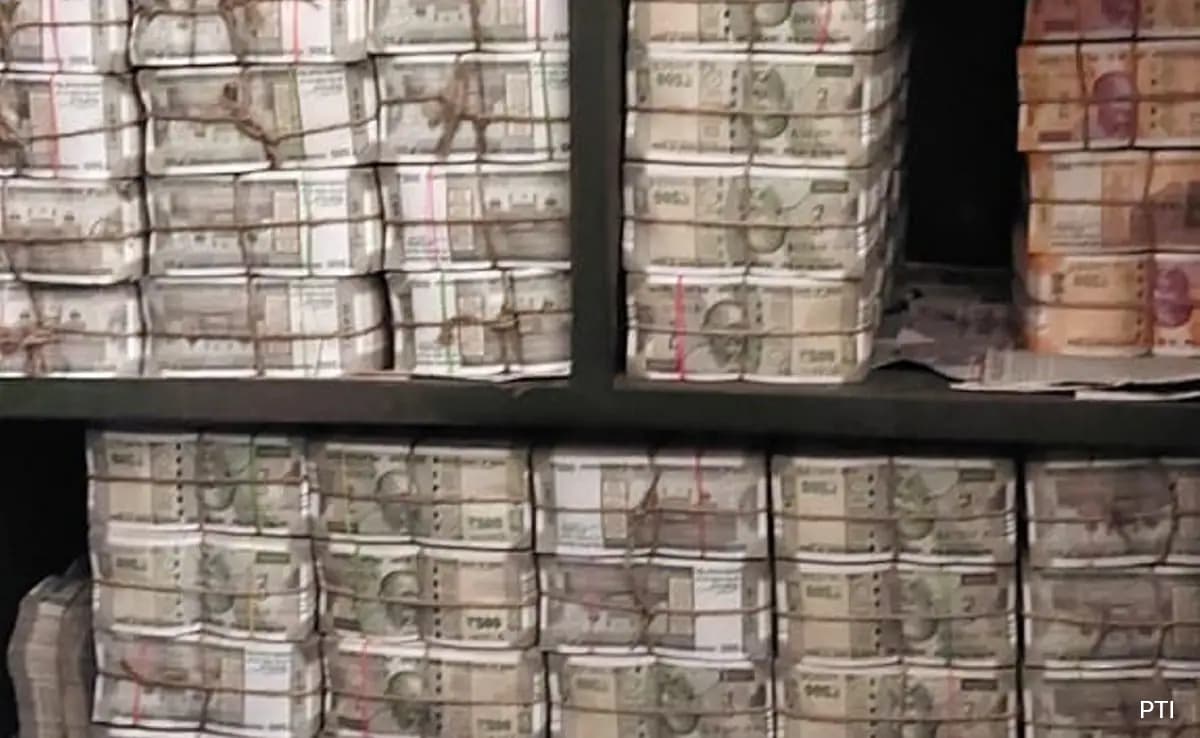
The cash seizure in the income-tax department’s searches against an Odisha-based distillery company, owned by a Congress MP’s family, has been calculated at Rs 351 crore after five days of counting and is the “highest-ever” haul in a single action by any probe agency in the country, official sources said on Sunday.

The premises of the Congress Rajya Sabha MP from Jharkhand, Dhiraj Prasad Sahu, in Ranchi and other places, were also covered during the searches by the department. The company and the member of Parliament did not respond to PTI’s queries regarding the action being carried out against them.

The marathon raids against Boudh Distillery Private Limited, its promoters and others entered the fifth day on Sunday. The raids were launched on December 6 by the taxman on charges of tax evasion and “off-the-book” transactions.

The sources told PTI that Rs 351 crore cash has been counted and the process has ended.

The counting involved nine teams of about 80 people from the tax department and various banks, working in shifts in a 24×7 cycle.

Another team of 200 officials, including security personnel, drivers and other staff, joined in after the taxman found 10 almirahs stuffed with cash apart from some other locations.

As many as 200 bags and trunks were used to transport the cash for depositing it in various bank branches in Odisha, the sources said.

The department believes that the entire cache of currency is “unaccounted” money earned from cash sales of country liquor by the business group, distributors and others.

It is the highest-ever cash seizure made by an agency in the country as part of an action against a single group and entities linked to it, the sources had said.

Some of the high-value seizures in the past include one from 2019 when the GST Intelligence raided a Kanpur-based businessman and seized cash amounting to Rs 257 crore and another instance where cash amounting to Rs 163 crore was unearthed by the I-T department during searches against a road construction firm in Tamil Nadu in July 2018.

The department is also recording the statements of the executives and other staff who were present at the searched locations and will soon issue summonses to the main promoters of the company for recording their statements.

It was not clear what amount of cash and other documents were seized from Mr Sahu’s house.

The maximum cache of currency, largely in Rs 500 denomination, was recovered from the premises of the company in Bolangir district, the sources said.

The BJP on Sunday stepped up its attack on the Congress and other opposition parties, with Union Home Minister Amit Shah saying it is now clear that their “propaganda” about probe agencies being misused was driven by the fear that their corruption will be exposed.

In a statement, the senior BJP leader questioned the “silence” of INDIA bloc leaders, saying he can understand why the Congress is keeping mum but wondered why parties like the TMC, DMK, JD(U) and the RJD were doing the same.

While the Congress has distanced itself from the MP, claiming that the party has nothing to do with his business, Karnataka Chief Minister Siddaramaiah accused the Centre of targeting only the Congress and asked why no searches were carried out against BJP leaders.

Jharkhand Congress in-charge Avinash Pandey said, “Since he is Congress MP, he should make an official statement about how such a big amount of money came to him.” Union Tourism Minister and BJP leader G Kishan Reddy asked why Congress leader Rahul Gandhi was “silent” on the issue.

Prime Minister Narendra Modi had on Friday assured the people that the money looted from the public will be returned and had posted a Hindi newspaper report where the cash recovered by the IT department was shown stacked.

Taking to X, he had said, “The countrymen should look at the pile of these notes and then listen to the honest speeches’ of their leaders …Whatever has been looted from the public, every penny will have to be returned, this is Modi’s guarantee.”

(Except for the headline, this story has not been edited by NDTV staff and is published from a syndicated feed.)

Read full article
Despite Ongoing Talks, China Carves Into North Bhutan With Outposts, Villages
onmynews.com

Despite Ongoing Talks, China Carves Into North Bhutan With Outposts, Villages

Ongoing border talks between Bhutan and China to formally demarcate their boundary have not prevented Beijing from continuing unsanctioned construction activity in North Bhutan’s Jakarlung Valley.

Satellite images of this region, the sharpest to be released so far, suggest that Thimphu may have no option but to accept the fait accompli presented by the Chinese in this area which lies 50 kilometres from Bhutan’s Eastern border with Arunachal Pradesh. 

“This is a case of China making a claim to an area, based on earlier grazing practices by herders, that is very recent and without precedent – and then unilaterally seizing the territory and settling it with villages, military barracks and outposts,” according to Professor Robert Barnett, an expert on Tibetan history at the School of Oriental and African Studies (SOAS) at the University of London.   

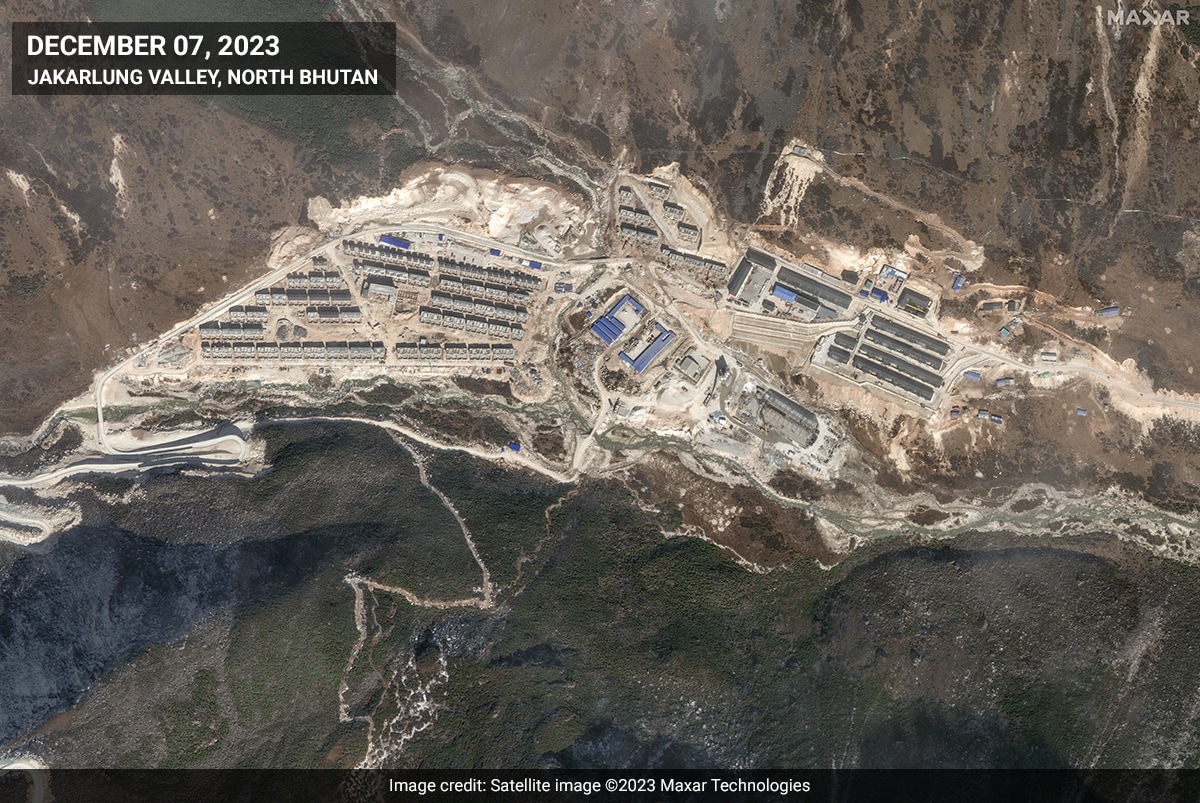
With an expanded highway network, residential and other buildings, China has carried out extensive construction activity in the Jakarlung Valley of North Bhutan between August 2021 and December 2023. (high res: here)

”Jakarlung adjoins the Beyul Khenpajong, which is an important cultural and religious area for the Bhutanese. So this case represents China making a very recent, doubtful claim about an area that is of great cultural significance to a far less powerful neighbour, knowing that neighbour has few if any options as to its response.”

The images in this report from Maxar show how China has scaled up its physical presence in the Jakarlung Valley over two years.  Images from December 7, last week, show ongoing construction of at least 129 buildings which appear to be residential quarters in one settlement and at least 62 buildings in a second enclave a short distance away.  Earlier images from August 2021 of the same area show that none of these buildings had been constructed.    

Before and after images indicate the pace of Chinese construction activity in the Jakarlung Valley of North Bhutan. In August 2021, residential quarters had not been constructed. In December, 2023, there are more than 100. (high res: here)

”The sheer scale of this developmental activity emphasises that these villages are not merely isolated outposts but rather integral components forming a comprehensive ecosystem that supports China’s territorial ambitions, further contributing to the Sinicization of the Bhutanese landscape,” says Damien Symon, who has written extensively about the Chinese intrusions in the East and West of Bhutan.  

Map location of construction activity identified in this story with other areas of disputed Chinese construction activity on Bhutanese territory highlighted. (With inputs from Damien Symon)

The new images come at a time when Bhutan has stepped up ties with China, in an effort to end Chinese incursions into its territory once and for all.  In October this year, Foreign Minister Tandi Dorji travelled to Beijing, a first for Bhutan.  That same month, Prime Minister Lotay Tshering told The Hindu, ”We hope to see a line being drawn- this side Bhutan and that side China. We don’t have that right now.”  

Before and after images of Chinese construction activity in the Jakarlung Valley shows a second enclave having been constructed by December 2023. (high res: here)

Significantly, in his interview to The Hindu, Tshering did not reject the possibility of Beijing and Thimphu agreeing to a land swap – where territory in areas including Jakarlung, described in this report, could be exchanged if China were to give up its claim to the Doklam plateau which lies further to the south. In November, Bhutan’s King Jigme Khesar Nangyel Wangchuk visited India on an official visit.  While details of the ongoing border negotiations were not spelt out in the joint statement which was released, both sides ”held discussions on the entire gamut of bilateral cooperation and regional and global issues of mutual interest.”

In 2017, India and China were involved in a tense two-month-long standoff in Doklam when Indian troops physically prevented the extension of an illegal Chinese road in the area.  Mr. Tshering did, however, confirm that ”it will be to Bhutan’s interest to make sure both the parties [India and China] are happy with the decisions we make” in the border talks.

Irrespective of any outcome, ”India may be concerned by the precedent that Jakarlung sets for China’s willingness to abrogate treaty obligations when it comes to border disputes,” says Robert Barnett. ”China signed a formal agreement with Bhutan in 1998 not to alter the status quo in disputed areas.  In occupying and settling Jakarlung, it violated that agreement.”

India’s immediate concerns over Chinese expansion within Bhutanese territory also extend to the Amu Chu river valley which lies directly adjacent to the Doklam plateau.

Read | In Doklam Standoff, Bhutan PM’s China Comment Raises Concern In India

Following the Doklam standoff, China has constructed at least three villages along the valley.  Any further Chinese extension South would raise alarm bells in New Delhi since that would mean a Chinese presence close to the Siliguri Corridor, the narrow corridor that connects India’s Northeast with the rest of the country.  The Indian Army has, on several occasions, made it clear to the government that China is approaching a red line that it should never be allowed to cross. 

China’s use of what India’s first Chief of Defence Staff, General Bipin Rawat described as “salami-slicing” of territory has been a standard tactic for all of its territorial expansion plans – from converting shoals in the South China Seas to full-fledged military outposts to pushing across multiple points in Eastern Ladakh.   

”In May 2020 in Eastern Ladakh, the People’s Liberation Army (PLA) advanced in five areas, but in that case, India strongly reacted after a few days,” explains Claude Arpi, the renowned Tibetologist. 

”In Bhutan’s case, the Royal Bhutan Army does not have the capacity to react and push the PLA or Border Defence Force back or even stop the construction of the new villages.”

Of greater concern to New Delhi, which in the past was a net guarantor of security for Bhutan, the ongoing talks could result in a profound geo-strategic realignment in the area.  ”Bhutan is slowly shifting towards the strategic orbit of China and there is not much that India can do, except if a new security agreement is signed between Delhi and Thimphu,” says Arpi.  

”It is a difficult situation for Delhi and for the King of Bhutan.”
Read full article
Link copied!