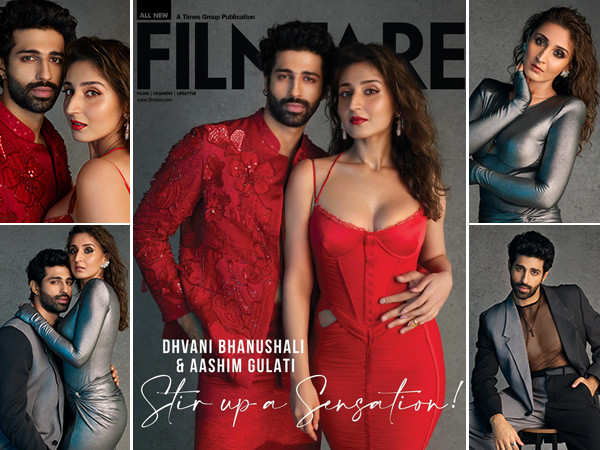
Dhvani Bhanushali and Aashim Gulati are all set to be seen together in Saurabh Dasgupta’s Kahan Shuru Kahan Khatam. The film has been written by National Award winner Laxman Utekar and bankrolled by Vinod Bhanushali’s Bhanushali Studio Limited and Kathputli Creations. The film is all set to hit the theatres on 20th September, 2024. The fresh casting has been grabbing a lot of eyeballs. The audience is stoked to watch Dhvani transitioning from music to films, while Aashim’s ardent followers are eager to watch him take on the big screen again. We caught up with our September Digital Cover Stars Dhvani Bhanushali and Aashim Gulati for a quick chat, scroll through…
How did Kahan Shuru Kahan Khatam come your way?
Aashim: I mean, for me, it was a simple casting process where the casting director reached out and said, Laxman Utekar wants to have a meeting, and this is the film, and then I met Laxman sir and Vinod Bhanushali sir with the casting director, and our director, Saurabh Dasgupta, it’s his first film, and he actually wanted to make this film with me like a few years back, like five, seven years back, and for some reason, I never responded to his message, or I missed his message, and then it all came back, as in like, he got the script again, and then he wrote it a few years back, and now, I mean, it all came back as a full circle, and he narrated the story to me, and I really enjoyed it, I really liked it, and I felt connected with it immediately, and yeah, that was it, and it was Dhwani’s first film, and my first association with Bhanushali Productions and Katputli, and also, the fact that it’s my theatrical release after a long time, so it was very exciting, plus the story made a lot of sense, it was all heart, I related to the character a lot, it’s a sweet, romantic comedy, and I’ve been wanting to do a romantic comedy, like a romantic film for a while, and I think this was the perfect fit.
Dhvani: For me, I think I read it as one of the scripts that had come to the studio, and I really liked it, and I just told dad that he should make a film like this, and then somehow, I think Laxman sir and dad had a meeting, and cosmically thought of it, they just started talking, and I think both of them were like, I’d be good for it, and at that time I was doing this play, that Laxman sir and Saurabh came to see, and they really liked it, and I think from there, I was on board, and when I met Aashim, my first reading with him, I was really scared, I mean I was intimidated, because I’ve been doing music videos, but at the end of the day, when you have to do a proper thing for a film, it just sort of gets to you, and we did a few workshops together. Saurabh and Aashim and Laxman sir really had my back, and it went through really smoothly, I think.
Tell me more about your character in the film, did you have any similarities with your character?
Dhvani: For me, I think Meera again is like, she’s a regular girl with her own set of issues, but personality wise, I think we’re different as people, and you’ll know when you see the film, she’s a little more quiet and speaks a few words, but I’m bubbly all the time, so there are a few differences. But I just feel like I relate to her as she believes in herself. There’s a small messaging towards the end of the film, there’s a small speck of it in the trailer, where she runs away, because she says that it’s a small thing, but girls need to be asked at every level and should not always adjust according to the decisions being made for them by others.
Aashim: So Krish is short for Krishna, and what I connect with my character Krishna is that I was brought up around a lot of women, and Krishna as well. The character’s hometown and home place is Barsana, which is Radha’s birthplace, so I feel like there was a lot in me in terms of when it comes to the sensitivity towards just women, and being brought up around women, and the kind of respect that one naturally has for them, and the kind of needs that women have in today’s day and age, and how they’re seen, and I feel like Krishna is a character that when you watch him on screen, he’s very affable, he’s, I mean he’s every girl’s sort of dream husband or dream boyfriend, or you know, like mothers would want their sons to be like him, so when they say that today, in today’s day and age, raise your sons well, I think that’s a perfect example of what that is, because that’s what I take from him, that’s what I imbibe from my character, and that’s who I really am as a person. I have tried to bring all the qualities of Lord Krishna into my character with a twist of modern times, it’s a very honest, very honest kind of a character, and I just hope that I’ve done justice to him.
How was it working on a film with National Award winner Laxman Utekar? Did it add any kind of pressure on both of you?
Dhvani: This is just my first-hand experience with him, I don’t think he carries that kind of a baggage with him, because when I met him, I just felt like, there’s this honest will to work with new talent, he just wanted us to do well, and had our back throughout, I think he was involved at every level, even during readings. Right before the shoot, because I was obviously very anxious, since it’s my first film, and I remember this one incident, I think, it was the first shot that I was giving, in Krish’s house, and I was just really nervous, and I basically had cold feet, and he just called me, and he said, even for big actors, the first day doesn’t go well, this is your first film, relax, breathe. I was really intimidated, with the whole atmosphere, but he really showed confidence in me and I’m just very grateful for this opportunity, it’s really a big opportunity,
Aashim: Yeah, so, when I met Laxman sir, the abnormal thing about him is that he’s so normal and that really puts you at ease. There is no hierarchy when it came to the way he speaks to you, the way he makes you feel that it’s all happening, for the right reasons, and, and the fact that he’s chosen us to do this, me, I can speak for myself that, the fact that he chose me to play Krish, it’s really a blessing. He’d just given a big blockbuster, with Zara Hatke Zara Bachke, and for him to really show that confidence in me, who hasn’t been on the big screen for a while was huge for me. He told me very clearly, I will make you a star. (Laughs)
What kind of a director is Saurabh Dasgupta? Does he believe in improvising or sticking to the script?
Dhvani: I think first of all, he’s a very sweet, I’ve never seen him yell, not even once, throughout, the whole 40 days, that we shot. He held his calm, and overall, I think the set was very like, still waters. It was not, anything hectic. I feel, I used to rehearse a lot, with him, and he would tell me, certain things, but then he would also, let me flow. But again, since, like I said, Meera spoke less words, so I had to obviously, stick to the script. But, again, it takes a lot of years, and a lot of practice, for you to actually, improvise right. So, I think, I did as much as I could, and, he also, set the boundaries for me, that I couldn’t get out of, which helped me, to stay in character, and deliver the best that I could.
Aashim: Saurabh is a very interesting man. I had to marry his vision, otherwise, it becomes, unnatural. So, with him, it was always like, so collaborative. The film’s like his baby, right. And, you can’t mess, with somebody’s child, right. You only have to be a part of the journey, of bringing the child up. And that’s what, I tried to do. And I hope, I did justice to it. The kind of grit, that he showed, I don’t think he slept, for more than four hours. So, I think, it takes much more, power, will, grit, and I don’t know, what adrenaline, and madness to be on that journey. And, it always comes from, top to down. You know, he really is, the captain of our ship, and I feel like, he really sailed us, all through, with such, finesse, with such grace, with such love. He is very affectionate, and also a fellow Virgo, he’s a massive hugger, then he’ll come and he’ll kiss me on my shoulder, which is a strange thing to do, but, but, he’ll constantly do that, and I’m like, and he’ll just like, leave me thinking, I was like, who does all this? So you know, that’s the kind of man he is, and I really respect him, for his journey, and I really hope, for his sake, that this film really does well.
What pulled you both towards acting?
Aashim: I was in a boarding school, and I hated being in class, and around fellow boys, I was in an all boys school, I used to get like, bullied, and then, I feel like, I used to run away from class, and then, my recluse was the stage, and that’s how I started acting, because it would give me time away from other boys, and when I was on stage, I’d feel really like, even though the lights were on me, the attention was on me, but still I would be able to get lost, in the character, you know, and that I think, the idea of getting lost was so beautiful to me, that I kept getting lost every year, in one of the characters that I played, and I got really good at it, and then later on I felt like, this is something that I want to do, because it just made me feel alive. I realised that I was given excellency in the field of art, in my school, and I realised that this is something that I’m good at, so eventually when I wanted to study abroad and I didn’t have the money, I realised that okay, I’d rather do something that I enjoy doing, and, and that’s, like enjoyable for me, so, that’s how I came to Bombay, and that was back in 2011 and ever since I’ve just been doing what I really like to do.
Dhvani: I don’t actually see it as a transition, either way, I just see it as something parallel, that I’d like to have. I think during COVID, I just really felt this, urge to sort of, get into acting, and learning the craft. But at that time, I didn’t plan to do a film, I thought it’ll help me in my music videos, I think my dad saw, and then he’s like, why don’t you take it up like properly, so, then I started taking coaching and did like a full play, and, a few workshops and then eventually the film happened.
What puts you in a good mood instantly on a set?
Dhvani: Music.
Aashim: Music for sure, but, I think the right energy. Yeah. People, because, especially as an actor, I feel you really catch on to like, energies.
How was the experience of working with each other?
Dhvani: For me, initially I was just a little bit intimidated, because it’s my first film. But, eventually I think it was really fun. He’s a nice guy. And, very easy to work with, and, how do I say, he was really there for me throughout the film. Never really made me feel like I couldn’t do a certain thing, didn’t say anything negative in my ears, if I couldn’t do something, he would sit with me. I’ve never lived without my parents for like 40 days, so him and Aishwarya were really like my family there, and I really appreciate that.
Aashim: Oh, she’s a disaster. (Laughs) No man, Dhvani Bhanushali is just really very innocent. And I think that she’s very clean hearted, like, she’s quite pure like that. And that I really like. I think it’s so important for an actor to somewhere have those qualities, because you can be very honest with the characters that you play then. And I saw that endearing quality, I saw that honesty, I saw the hard work that she was ready to put in, she was a total rockstar.