Key Numbers To Watch Out For In Nirmala Sitharaman’s 7th Straight Budget
Finance Minister Nirmala Sitharaman will on Tuesday present her 7th straight Budget that would lay a roadmap for Viksit Bharat (developed India) by 2047 while giving a glimpse of 10 years’ performance.
All eyes will be on whether Sitharaman provides the much-expected tax relief for the middle class, leaving more money in their hands, as there is tax buoyancy. Besides, the market also expects staying on the fiscal glide path to lower the fiscal deficit to 4.5 per cent of GDP by 2025-26.
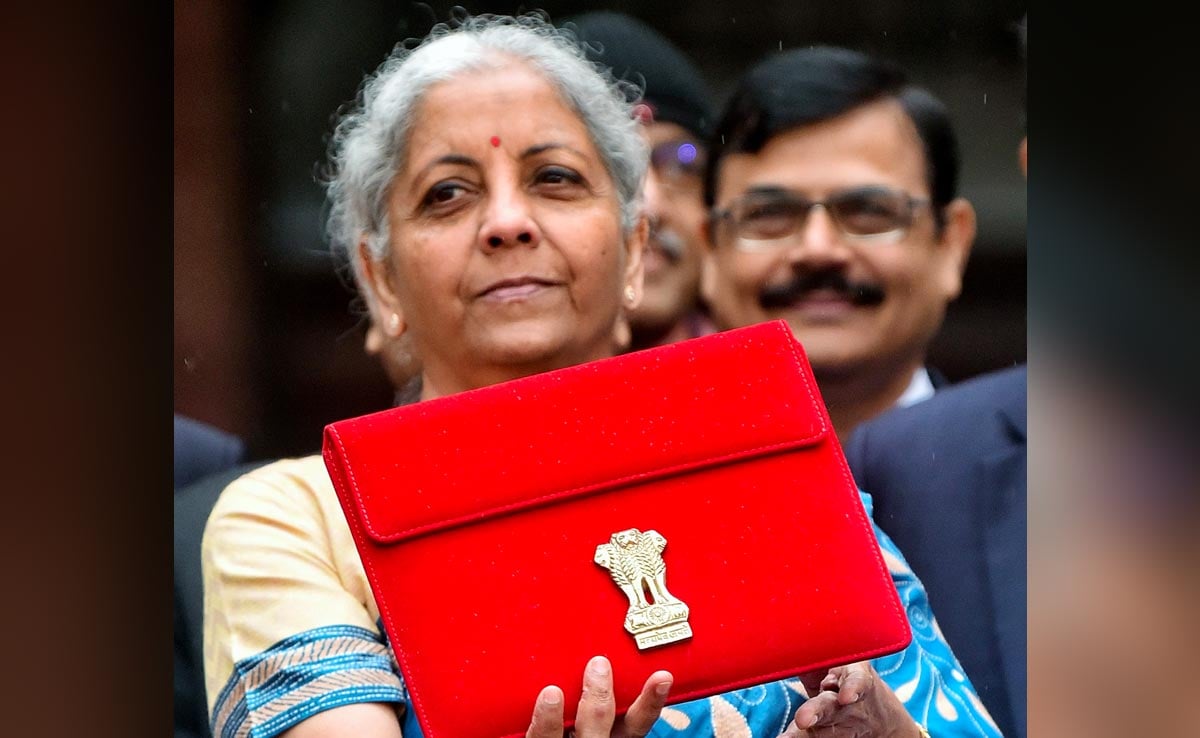
Ms Sitharaman, who would be presenting her seventh straight budget, had in her first Budget in 2019 replaced the leather briefcase — which had been in use for decades for carrying Budget documents — with a traditional ‘bahi-khata’ wrapped in red cloth. This year’s Budget would be in paperless form, as done in the last three years.
Here are the key numbers to watch out for the first full Budget of Modi 3.0:
* Fiscal Deficit: The budgeted fiscal deficit, which is the difference between the government expenditure and income, for the current fiscal is 5.1 per cent as projected in the Interim Budget in February, against 5.8 per cent in the last fiscal year. The full Budget is expected to provide better-than-earlier projections as there has been tax buoyancy.
The government has projected a fiscal deficit of 4.5 per cent of the GDP in FY26.
* Capital Expenditure: The government’s planned capital expenditure for this fiscal year is budgeted at Rs 11.1 lakh crore, higher than Rs 9.5 lakh crore in the last fiscal year. The government has been pushing infrastructure creation and also incentivising states to step up capex.
* Tax Revenue: The Interim Budget had pegged gross tax revenue at Rs 38.31 lakh crore for 2024-25, an 11.46 per cent growth over the last fiscal. This includes Rs 21.99 lakh crore estimated to come from direct taxes (personal income tax + corporate tax), and Rs 16.22 lakh crore from indirect taxes (customs + excise duty + GST).
* GST: Goods and Services Tax (GST) collection in 2024-25 is estimated to rise to Rs 10.68 lakh crore, an increase of 11.6 per cent. The tax revenue figures will have to be watched out for in the final Budget for the 2024-25 fiscal year.
* Borrowing: The government’s gross borrowing Budget was Rs 14.13 lakh crore in the current financial year as per the Interim Budget. The government borrows from the market to fund its fiscal deficit. The borrowing number will be watched by the market, especially on the back of more-than-expected dividends from the RBI and financial institutions.
* Nominal GDP: India’s nominal GDP growth (real GDP plus inflation) in the current fiscal year is estimated to be 10.5 per cent to Rs 327.7 trillion as per the Interim Budget. Given the expected normal monsoon, improvement in revenue collections and pick up in rural consumption, is expected that there could be an upward revision in the growth estimate. Real GDP growth in the current fiscal is projected at 7.2 per cent, as per the RBI.
* Dividend: The interim Budget had projected Rs 1.02 lakh crore from RBI and financial institutions. This will be revised upwards as the RBI has already made a surplus transfer of Rs 2.11 lakh crore earlier in May.
At the same time, Rs 43,000 crore is expected to be garnered from CPSEs.
* Spotlight would also be on spending on key schemes, like NREGA, as well as key sectors like health and education.
(Except for the headline, this story has not been edited by NDTV staff and is published from a syndicated feed.)