Heeramandi Series Review
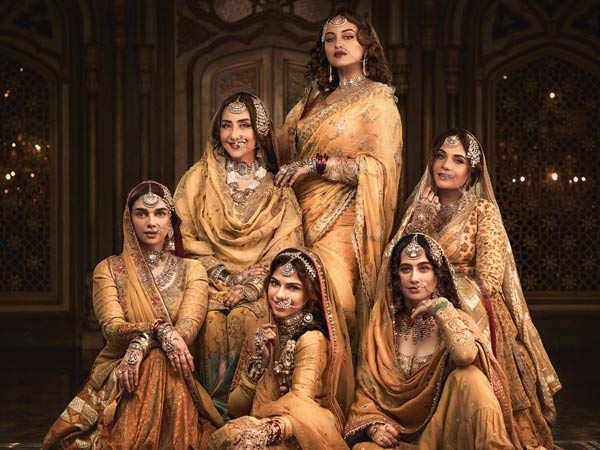
Poetry permeates every frame of Heeramandi, a testament to director Sanjay Leela Bhansali’s reverence for the Sufism and Urdu couplets and ghazals. The song Sakal ban, which heralds the spring in the film, draws from an Amir Khusro poem, while nods to Ghalib, Mir, Zafar, and Niyazi abound. Alamzeb (Sharmin Sehgal), is an aspiring poetess. Conversations unfurl like verses, with Alamzeb playfully declaring to her beloved, “I will serve you couplets for breakfast and poems for lunch.” Alamzeb, is the younger daughter of Mallikajaan (Manisha Koirala), who reigns as the madam of Shahi Mahal, a prestigious brothel nestled within Lahore’s Heera Mandi pleasure district. Mallikajaan’s lineage extends further with Bibbo (Aditi Rao Hydari), a renowned singer, who is a secret revolutionary. Lajjo (Richa Chadha), is an alcoholic courtesan living in denial, while Waheedan (Sanjeeda Sheikh), is the younger sister who is forever being duped of her due. Tajdar Baloch (Taha Shah), is an idealistic London-returned nawab who later becomes a revolutionary. Zulfikar (Shekhar Suman) is a debauched nawab, and so is Wali Mohammed (Fardeen Khan). Adhyayan Suman plays the double role of Zoravar and young Zulfikar. Sonakshi Sinha too essays the double role of mother-daughter Rehana and Fareedan
In Bhansali’s universe, Heeramandi isn’t the infamous Lahore red light area but a complex of geisha palaces where patrons are taught culture, music, manners, the art of love, conversation and more. Any sex which happens is secondary. The nawabs do sleep with the tawaifs, of course, but that’s not the only order of the day, or to be more precise, the night. There’s a decorum, tehzeeb, to be maintained all around by all parties. Everyone knows they’re playing a part and relish in it all the same. The series is set in the 1940s, against the backdrop of the Quit India movement. Lahore’s rich nawabs are shown to be least bothered by the revolutionary wave spreading across the country. They’re busy toadying favour with the British in order to gain wealth and power. Ironically, the tawaifs of Heeramandi leech them of their money and kind of bring a balance to the society.
Two strands run parallel in Heeramandi. One is that of intrigue between the various courtesans and primarily between Mallikajan and Fareedan. The duo use all kinds of underhand techniques to win supremacy over each other and the control of two of the biggest pleasure houses. Then, the revolutionaries are shown to be constantly waging a battle against the British. So one samples intrigue on one hand and nationalism on another. It’s not easy to mix such scenarios but to Bhansali’s credit, he has been able to mix and match with aplomb. We wait and as one emotion-laden scene follows the other, leading to a climax which is akin to the reverse of Padmaavat’s ending. There, hundreds of women jointly committed johar. Here, hundreds of women march with flaming torches towards the enemy and sing the song of freedom, demanding an end to the British Raj. It’s a goosebump inducing moment indeed. There’s also the subplot of a rich boy from a respected family falling in love with a courtesan’s daughter. The love story gleefully employs all the tropes of a ’60s slow-burn romance.
At one level Heeramandi is Bhansali’s ode to such films as Mughal-e-Azam (1960) and Pakeezah (1972). The sheer opulence of the set design, especially of the kothas and the havelis takes your breath away. The costume design matches the production design to a T and the combination makes you feel you’ve indeed landed in another era. Add the old world charm to Urdu dialogue to the lot and the illusion is complete. One must add here that in Lahore, one would have expected more people to speak Punjabi, as it was the language of the majority and still spoken widely today. But apart from the servants and the one or two Sikh characters, none of the other characters speak Punjabi. Sudeep Chatterjee, Mahesh Limaye, Huenstang Mohpatra, Ragul Dharuman have offered some sublime cinematography. The tracking shots, use of trolley and excellent lighting was reminiscent of the Guru Dutt brand of cinema.
The series is primarily a musical and Bhansali has again excelled in that department as well. The standout songs are Tilasamein bahein, Phool gendwa na maaro and Sakal ban. Dance choreography is excellent but doesn’t stand out as it normally does in Bhansali’s films.
Bhansali has the habit of drawing his best from his performers and is in excellent form here as well. Manisha Koirala draws all her experience to give us Mallikajaan, a courtesan whose iron will never bends even once. She’s a woman cloaked by contradictions and yet you find yourself rooting for her at the end. It’s one of the finest performances by the actress. Juxtaposed to her is Fareedan, played flawlessly by Sonakshi Sinha. Fareedan is as ruthless as Mallikajaan and yet possesses a vulnerable heart. Their confrontation scenes make the series come alive. Aditi Rao Hydari plays the most layered character by contrast. Her Bibbo is both a tawaif and a freedom fighter and she does ample justice to both facets. She gets her moment in the sun towards the end, when her martyrdom becomes the rallying point for the courtesans. The roles of the men seem restricted. They come and go in flashes and are missing in action most of the time. Fardeen Khan makes a comeback to showbiz as a dapper nawab Wali Mohammed and performs to the expectations of the role. The same can be said of Adhyayan Suman, another actor who was missing from the scene for quite some time. Shekhar Suman makes most of his role, that of nawab Zulfikar, Mallikajaan’s paramour who has secrets of his own. Taha Shah and Sharmin Sehgal have done a competent job as two individuals who not only are star-crossed lovers but also are people who are idealistic to the extreme and hence misfits to their respective societies.
Watch the series for its grandeur and for the inspired acting displayed by the entire cast.