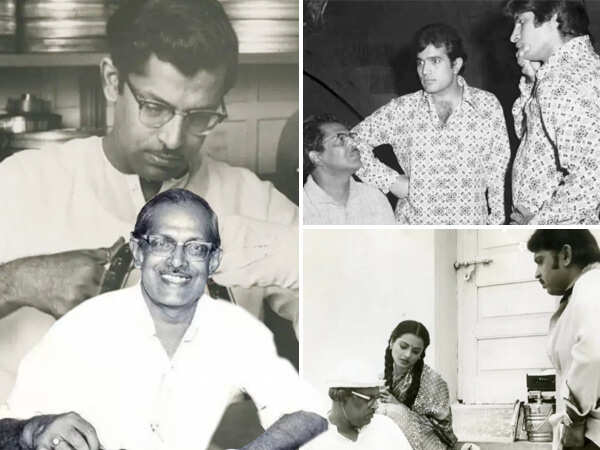
On Hrishikesh Mukherjee’s death anniversary, Filmfare Editor-in-Chief Jitesh Pillaai remembers the legendary filmmaker, reflecting on his extraordinary body of work and the timeless stories that continue to resonate across generations.
From Anand and Gol Maal to the many unforgettable characters and moments he brought to the screen, this is a tribute to a master storyteller whose warmth, simplicity and cinematic legacy remain truly irreplaceable.
In Jitesh Pilaai’s words:
It’s been years since Hrishikesh Mukherjee left us, but the lines still echo: “Zindagi badi honi chahiye, lambi nahi.” Gulzar saab’s one line encapsulates the joy and meaning of Anand (1971). One of my most favourite films and arguably Rajesh Khanna’s best performance alongside Amar Prem (1972), Anand is so beautifully written, directed and acted that it makes space in your heart. Showing us how good he was, Amitabh Bachchan as young doctor Bhaskar is a mix of idealism and realism. He becomes friends with his patient Anand who’s terminally ill.
Anand dies, leaving behind memories of happy times. He shows them all about seizing the moment, about forgetting your pain and living the moment.
To get a sense of how the mighty fall, Hrishida’s films towards the fag end of his career were indifferent to middling. Like Jhoothi (1992), Namumkin (1988), Jhooth Bole Kauwa Kaate (1998).
You wonder if it was the same Hrishikesh Mukherjee who had given us Anari (1959), Anuradha (1960), Anand (1971), Chupke Chupke (1975), Mili (1975), Abhimaan (1973), Khubsoorat (1980), Namak Haraam (1973) and Gol Maal (1979).
While I shall always hold Guru Dutt and Vijay Anand in the highest estimation, Hrishidaa was my absolute favourite. It’s his films, be it Khoobsoorat (1980) or Bemisaal (1982), Abhimaan (1973) or Anand (1971), that I keep revisiting the most. Even his weaker film like Alaap (1977), Jurmaana (1979), Naram Garam (1981) have such a resonance even to date.
As a cinema lover, if you haven’t seen Hrishida’s earlier oeuvre like Musafir (1957), Anupama (1966) and Satyakam (1969), you ain’t seen nothing yet.
Dharamji’s demise made me revisit all of Hrishida’s body of work. Hrishida has his flaws, but through it all, his humanism and outstanding insights into the foibles of human nature come shining through. You can see it in his weaker but utterly delicious films like Biwi Aur Makaan (1966), Mem Didi (1961), and Majhli Didi (1967).
For us 80s kids, we grew up on Khubsoorat (1980), Jurmaana (1979), Bemisaal (1982), Namak Haraam (1973), Abhimaan (1973), Anand (1971), Chupke Chupke (1975) and Mili (1975). Perhaps my endless fascination for Amitji, Jayaji, also coincide with their outstanding work in Hrishida’s films.

I consider it my good fortune to have met Hrishida a few times during my rookie years. Despite failing health, he was an expert raconteur and told me about the halcyon glory days. For that I shall always be grateful. More of Hrishida’s oeuvre in another post soon. I’ve lost count of the times I’ve seen Anand and Mili, and every single viewing I’ve wept. Anand and Mili were perhaps two sides of the same coin.
Both protagonists lit a candle and refused to curse the darkness. There is so much wisdom in both these films; there is experience, and there’s that one quality we are losing out on- goodness. Hrishida showed us the good face of the movies, and for that we are forever indebted.
Also Read: Editor’s Take: Gulzar, The Words That Wounded Us, Healed Us




 The first half of 2026 was unkind to Telugu cinema. After a promising Sankranthi season, film after film stumbled at the box office, leaving the industry in a prolonged period of uncertainty. Whispers grew louder that streaming platforms had quietly become the preferred destination for audiences and that the theatrical experience was losing its charm. Trade circles debated whether Tollywood was experiencing a temporary slump or witnessing a permanent shift in viewing habits.