Can India Abolish Income Tax?
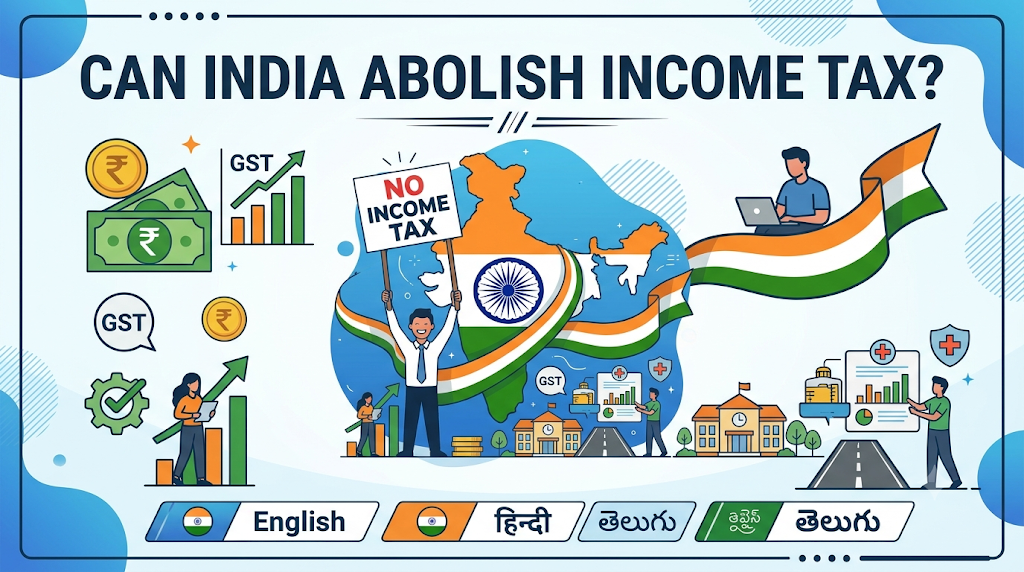
Abolish income tax. Tax the flow instead.
India has built the only payment system on earth that makes this possible. The arithmetic has been ready for years.
Levied on ₹3,215 lakh crore of annual payment flow. Central tax figures are FY26 estimates.
Entry I · The absurdity we defend
India employs an army to collect a tax that two people in a hundred pay, and then hands a sixth of it back.
In FY26 the department collected ₹28.12 lakh crore gross and refunded ₹4.71 lakh crore of it — money taken, processed, contested and returned, producing nothing.
Of the 8.09 crore returns filed in FY24, 4.90 crore reported no taxable income at all.
We run one of the world’s most elaborate tax machines to reach one of the world’s narrowest tax bases.
And because the base is so narrow, the rates on it must be brutal — thirty per cent plus surcharge plus cess, landing on the salaried professional who cannot hide a rupee.
Entry II · The base nobody is using
Indians moved ₹3,215 lakh crore through the banking system last year. Nine times GDP. Almost none of it is taxed.
The RBI’s Payment Systems Report counts 26,819 crore transactions in calendar 2025, compounding at 16.6% a year in value.
| Rail | Value, CY2025 | Share |
|---|---|---|
| RTGS | ₹2,205 L Cr | 68.6% |
| NEFT | ₹479 L Cr | 14.9% |
| UPI | ₹305 L Cr | 9.5% |
| IMPS, NACH, cards, others | ₹152 L Cr | 4.7% |
| Cheques (CTS) | ₹70 L Cr | 2.2% |
| Wallets & prepaid | ₹3 L Cr | 0.1% |
Forty-one paise on every hundred rupees replaces the entire income tax of India.
Seventy-three paise replaces corporate tax as well. And one rupee — a flat 1% — raises ₹32.15 lakh crore.
One per cent funds the Republic. The rest is administration.
Entry III · The dial
What would it actually cost you?
Turn the dial. Every token on the belt is a real payment; every paisa skimmed off it drops into the treasury.
Treasury filled: 12% of ₹13.12 L Cr
| Chai and samosa ₹40 | ₹0.16 |
| Auto ride ₹150 | ₹0.62 |
| Salary credited ₹1,20,000 | ₹489 |
Sixteen paise on a chai. Four hundred and eighty-nine rupees on a salary that currently loses tens of thousands.
Nobody would notice paying it. Everybody notices paying income tax.
Entry IV · Why now, and not in 2005
India built the collection machine by accident
Every previous attempt failed on plumbing. The 2005 Banking Cash Transaction Tax raised almost nothing and was withdrawn in 2009.
Twenty years later, digital payments are 99.7% of transaction volume, UPI alone carries 85.5% of it.
The tax does not need to be enforced. It needs to be switched on.
No return, no assessment, no refund cycle. The bank deducts at the moment of credit and remits.
Entry V · It has been done
Brazil ran this tax for over a decade and it worked exactly as promised.
The CPMF charged 0.38% on bank account movements. In its final year it raised close to $20 billion.
It was not abolished because it failed. It fell four votes short of renewal in a December 2007 Senate vote.
The people who hate a transaction tax most are the people who have the most to hide from it.
India already runs its own working version: STT, on securities trades.
Entry VI · The stress test
Break it if you can
Switch off rails you would rather protect, assume a flight from the banking system, and see what rate you still need.
You have to switch off RTGS, switch off NEFT, and assume a flight from banking India has not seen since before UPI existed.
The headroom is the argument. There is room to exempt the poor and still fund the Union.
Exempt every credit below ₹5,000. Exempt DBT and pension credits.
Entry VII · The cascade objection
Compared to what, exactly?
Critics say the tax cascades: no input credit, so it bites at every handover. Now measure it against the cascade we tolerate today.
A tax that cascades to 3–6% replaces a tax that starts at 18% on a single sale. Prices fall. They do not rise.
We are comparing it to the most complicated indirect tax India has ever run.
Entry VIII · Who really pays
A flat rate on value is not a flat burden on people. Value is where the wealth is.
Income tax today · 2 in 100 carry it
Flow tax · 100 in 100 contribute a sliver
Two-thirds of India’s payment value moves through RTGS — corporates, institutions, treasuries.
The daily wage earner receiving ₹600 contributes ₹2.46. The promoter moving ₹50 crore contributes ₹20.5 lakh and cannot restructure his way out of it.
Income tax is progressive on paper. A flow tax is progressive in cash.
The salaried class currently carries this tax almost alone, because salary is the only income the state can see perfectly.
Entry IX · The dividend
What the country gets back
Take-home pay rises immediately for every taxpayer, and the increase is largest where it is spent fastest.
MSMEs stop financing the government. No TDS reclaimed a year later, no refunds pending.
Compliance costs collapse for eight crore filers.
A tax base growing at 16.6% a year needs no Budget speech to keep up with spending.
Entry X · The proposal
Do it in stages, not in a leap
Nobody serious argues for flipping the switch overnight. The sequence writes itself:
1. Levy 0.25% on all bank credits above ₹5,000 and use it to raise the income tax exemption to ₹25 lakh.
2. Watch the base for two years. If flow holds, step to 0.5% and retire personal income tax entirely.
3. Fold in corporate tax at 0.75%, with a carve-out for interbank settlement.
Every argument against this tax is an argument for testing it, not for refusing to look.
Three genuinely contested claims: Elasticity — nobody knows how much flow leaves the banks at 1%. Incidence — NIPFP concluded a banking transaction tax gives up some equity the present system has. Wholesale — RTGS carries two-thirds of the value; the real rate may be closer to 1.3%.
None of these are fatal. All are reasons to pilot before legislating.
India spent twenty years building the rails. The tax that fits them is sitting there, unclaimed.


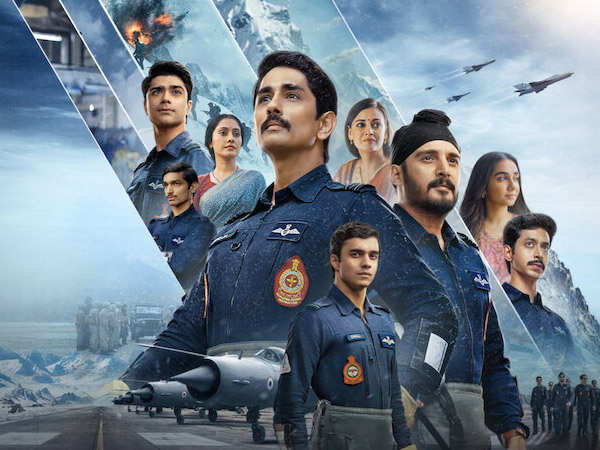
 Set against the backdrop of the 1999 Kargil War, Operation Safed Sagar follows the brave officers of the Indian Air Force as they take part in the historic air campaign that helped turn the tide of the conflict. Squadron Leader Ajay Ahuja (Siddharth) arrives as a flying instructor and mentor to a group of young fighter pilots under the command of his friend, Wing Commander BS Dhanoa (Jimmy Shergill), affectionately known as ‘Tony’. As tensions rise across the border and Pakistan’s military leadership secretly prepares for war despite ongoing peace efforts, the Indian Air Force launches Operation Safed Sagar to counter the enemy’s strategic advantage in the mountains. Alongside the dangerous missions, the series also explores the personal lives of the officers and their families, highlighting the sacrifices made both on and off the battlefield. Among the young pilots are Flying Officer RS Dhaliwal (Abhay Verma), known as ‘Dhali’; Flying Officer CH Bal Reddy (Mihir Ahuja), nicknamed ‘Baldy’; Flight Lieutenant Jitendra Sangwan (Taaruk Raina), called ‘Sangy’; and Flying Officer Amit Gupta (Arnav Bhasin), fondly known as ‘Goofy’.