Pics: Katrina Kaif Shares Rare Glimpses of Vihaan From Her Birthday Celebration With Vicky Kaushal
A 50-year-old programmer, wiped out by someone else’s accounting fraud, sat down in his house and rebuilt the help desk. Twenty-two years later that help desk bills $13.3 billion a year and calls itself the operating system of the enterprise. This is how the ServiceNow record moved from Open to Critical.
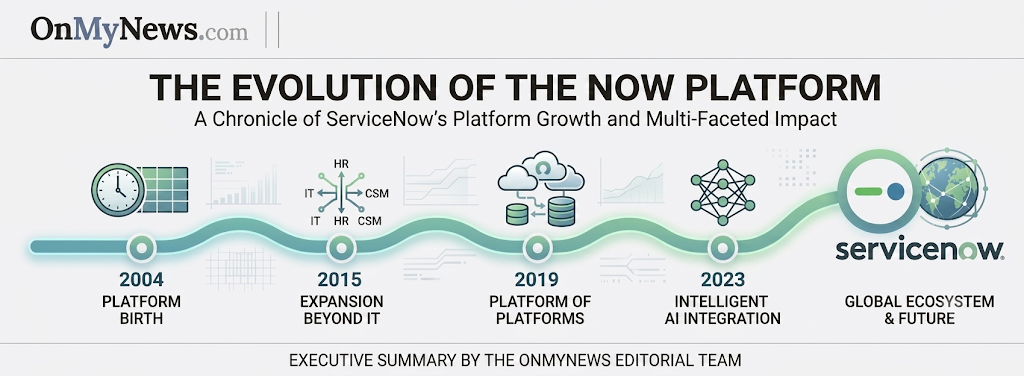
The record history
Fred Luddy starts again at 49, two weeks before his 50th birthday, after losing roughly $35 million to accounting fraud at his previous employer.
The product finds its identity: web-based IT service management, delivered as a subscription.
Profitable before it was fashionable. Growth is funded by customers replacing legacy on-premise suites.
Luddy hands over to scale enterprise sales and stabilise a cloud straining under its own success.
A ~$2.2 billion debut. The capital funds an assault on the incumbents’ installed base.
HR, Customer Service and Security Operations are built on the same engine. The addressable market multiplies.
The platform is now standard infrastructure in large IT organisations worldwide.
Ex-SAP. Re-aims the entire company at the C-suite and sets an explicit path to $10B+.
Pandemic-era digitisation makes workflow automation a board-level line item.
Revenue of $10.98B, up 22.4%. Growth at scale that few enterprise software companies have matched.
Subscription revenue of $12.88B. Q4 alone brings 244 deals worth over $1M in net-new annual contract value, and 603 customers now spend more than $5M a year.
Agentic AI moves from demo to product line — and the stock takes its sharpest drawdown in a decade while investors argue about what AI does to seat-based pricing.
The origin
Fred Luddy had done everything right and lost anyway. His employer’s books turned out to be fiction, and roughly $35 million of paper wealth evaporated with them. Two weeks before his 50th birthday he started over — no office, no sales team, and a deeply unglamorous idea: that the software companies used to log a broken laptop was slow, expensive, and installed on a server nobody wanted to maintain.
He was right about the boring thing, and the boring thing turned out to be enormous. Every large organisation runs on requests — a laptop, a password, a new hire, a security alert, a customer complaint. Each one is a small unit of work that has to be routed, approved, tracked, and closed. Luddy’s bet was that the routing itself was the product.
Fix the plumbing of work, and you inherit every department that has plumbing.The ServiceNow thesis, in one line
Three acts
Built in a house, sold to IT managers who were sick of on-premise software. No hype, no category, no venture theatre.
The listing gave it capital. The product insight gave it a market ten times larger than the one it started in.
The pitch moves out of the IT basement and into the boardroom, then reinvents itself again for AI.
The compounding
The remarkable thing is not any single year. It is that ServiceNow has grown roughly 20%+ every year since listing — at $250 million, at $2 billion, and at $13 billion. Very few software companies have held that line through three orders of magnitude.
Total revenue, US$ billions · 2012–2025
Source: ServiceNow annual reports and SEC filings. FY2025 total revenue $13.28B, of which $12.88B is subscription.
The 2026 argument
Here is the tension no growth chart shows. The business kept compounding through 2025 and into 2026 — and the market repriced it anyway. The question hanging over enterprise software is simple and brutal: if AI agents do the work of the people who hold the seat licences, what happens to a company that sells seat licences?
The business
Revenue growth in Q1 2026, with $27.7 billion in remaining performance obligations — roughly two years of revenue already contracted. Management’s stated ambition is $30 billion in subscription revenue by 2030.
The market
Market capitalisation in mid-July 2026, against roughly $210 billion a year earlier. The 52-week range runs from $81 to $210 a share — one of the widest swings in large-cap software.
ServiceNow’s answer is that AI compounds its revenue rather than compressing it: freed-up seat licences convert into AI agent consumption at a higher value per unit, and customers who renewed with its AI products in 2025 expanded their contracts substantially. That is a claim, not yet a proven law. The next two years decide whether the workflow layer captures the value of agentic AI — or gets disintermediated by it.
The first twenty years were spent proving that work could be routed. The next five will decide who gets paid when the routing is done by machines.The open question
The lesson
ServiceNow was never the exciting company in the room. It sold ticket routing while others sold social, mobile and metaverse. It went cash-flow positive on $13 million of revenue and grew for eight years before anyone outside IT knew its name. Then it discovered that the plumbing of work runs through every department in every large organisation on earth — and it already owned the pipes.
A fraud destroyed one man’s fortune in 2003. The company he built to recover from it now processes the daily work of most of the Fortune 500.
Author: Sumanth
Grace when she smiles.
Fire when she doesn’t.Mandakini… @PriyankaChopra in #Varanasi pic.twitter.com/4lYerYbm4Q
— rajamouli ss (@ssrajamouli) July 18, 2026
Also Read: SS Rajamouli Unveils Priyanka Chopra Jonas As Mandakini in Varanasi on Her Birthday