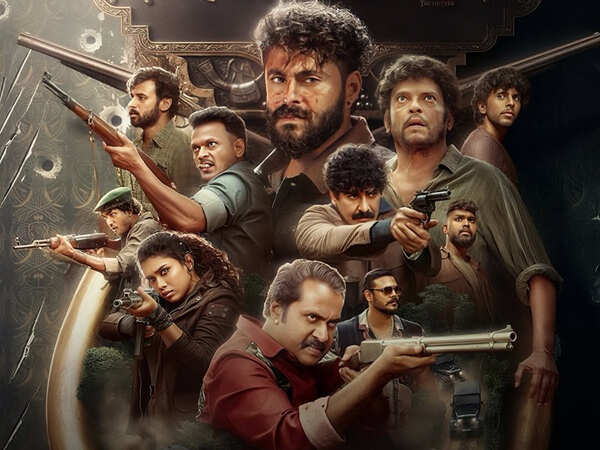
There’s a stretch in Kattalan where Antony Varghese Pepe walks through a forest lit only by fire and vehicle headlights, men collapsing around him while Ravi Basrur’s score practically announces the arrival of a legend. It’s an image the film desperately wants us to absorb. Not merely a man surviving violence, but a man becoming myth through it. Debutant director Paul George approaches Kattalan less like a grounded action thriller and more like folklore narrated through blunt force trauma. Everyone speaks in loaded pauses, every stare carries the weight of prophecy and almost every entry scene arrives wrapped in slow motion and percussion-heavy elevation music. For a while, the film makes that excess work. Or at least convinces you it does.
Set within a world of ivory smuggling, forest routes, and shifting gang loyalties, Kattalan unfolds like a survival drama soaked in sweat, mud, and testosterone. Renadive’s cinematography gives the film much of its personality. The forests here are not passive locations. They feel humid, predatory, and constantly alert. Torches slice through darkness, silhouettes emerge through smoke, and entire stretches unfold with the texture of men disappearing into terrain rather than moving through it. There’s a tactile quality to the filmmaking that keeps pulling the film back whenever the writing starts drifting. And it drifts often.
Antony Varghese Pepe is operating entirely within his comfort zone here, but to the actor’s credit, he understands precisely what this film requires from him. Pepe has always been effective at playing men whose emotional vocabulary begins and ends with suppressed rage. The performance is built almost entirely on physicality. The way he occupies a frame, the heaviness in his walk, and the exhaustion sitting beneath the aggression. Pepe gives the character more weight than the screenplay manages to.
There are moments where the film briefly discovers something genuinely compelling within all its noise. One ambush sequence inside the forest, staged largely through confusion, sound, and fragmented movement, hints at a far more immersive film buried underneath the constant need for elevation. Paul George shows strong visual instincts in these stretches. He understands how geography can shape tension. The action scenes are ugly in a convincing way. Bodies stumble through mud, people attack out of panic rather than style and the violence occasionally feels exhausting in the way violence should.
But Kattalan eventually becomes trapped inside its own idea of intensity. Every scene feels mounted at the same emotional pitch. Men enter frames like WWE superstars. Conversations unfold as though everyone is seconds away from delivering a pre-climax monologue. Silence isn’t used to build tension as much as to signal importance. After a point, the film becomes so busy turning everyone into myth that nobody feels human anymore. Nothing breathes long enough to acquire meaning.
This becomes especially apparent in the second half, where the film starts resembling a collection of hyper-violent episodes stitched together by exposition. Characters appear, threaten each other, disappear and return later carrying grudges the film barely gives us enough time to register. Kattalan keeps hinting at larger underworld politics and universe-building ambitions, but these threads remain frustratingly vague. You can sense the film reaching for scale constantly. It just doesn’t always know what to do with that scale once it gets there.
People die here and the film moves on before grief can fully enter the room. Important emotional turns arrive abruptly. Relationships are spoken about more than they are felt. The film is so committed to momentum that it mistakes exhaustion for escalation. By the time the climax arrives, the violence has stopped feeling shocking and started feeling repetitive.
Dushara Vijayan brings a degree of stillness the film desperately needs, although the screenplay keeps pushing her to the edges whenever it returns to its preferred mode of masculine posturing. Siddique and Jagadish lend authority almost automatically, but even seasoned performers can only do so much when characters are written more as extensions of mood than actual people. Sunil and Kabir Duhan Singh fit comfortably into the film’s world of permanently simmering hostility, though neither role evolves beyond familiarity.
Ravi Basrur’s score functions similarly to the film itself. Effective in bursts, exhausting in excess. There are scenes where the music genuinely amplifies dread. But there are just as many where it feels as though the soundtrack is trying to generate emotional weight the screenplay hasn’t fully earned. Even exhaustion arrives with background music here. Kattalan rarely trusts silence. Or restraint.
The shadow of Marco hangs heavily over the film, not merely in its brutality but in the way it fetishises masculine suffering and retaliation. But where Marco occasionally found disturbing psychological texture within all its carnage, Kattalan mostly remains on the surface, fascinated by violence as aesthetic rather than violence as emotion. The film wants its men to feel mythic, but mythology without interiority eventually starts feeling like posture.
Malayalam cinema’s recent fascination with hyper-masculine action dramas has increasingly blurred the line between character study and hero worship. Kattalan exists squarely within that space. It understands the grammar of intimidation, elevation, and visual spectacle, but struggles to locate the emotional soul beneath all the smoke and blood.
What remains, finally, is an intermittently absorbing action thriller powered by strong technical craft and Antony Varghese Pepe’s committed screen presence, but weighed down by a screenplay that mistakes relentless intensity for depth. The film keeps reaching for myth so relentlessly that it sometimes forgets the people underneath all that blood and smoke.
Also Read: Balakrishna and Koratala Siva Team Up for a Purposeful Mass Film