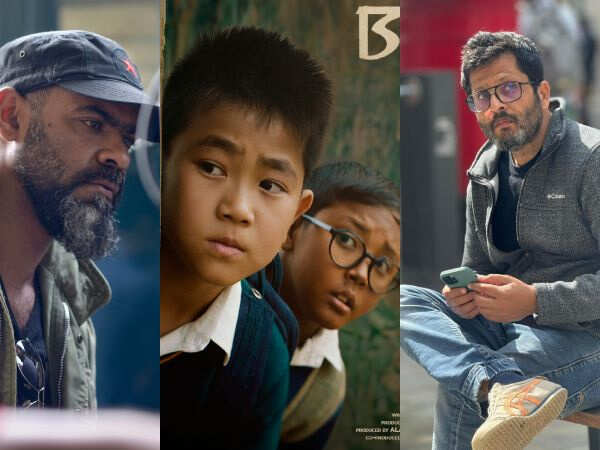
When Boong won the BAFTA for Best Children’s & Family Film this year, it wasn’t just another trophy. It was a landmark moment for voices from India’s Northeast and regional cinema as a whole. Directed by Lakshmipriya Devi and backed by producers Shujaat Saudagar and Vikesh Bhutani alongside Farhan Akhtar and Ritesh Sidhwani of Excel Entertainment, the Manipuri-language drama has become the first Indian film to win in this category. It is a coming-of-age story following a young boy, Boong, who lives with his mother after his father disappears.
Believing that reuniting his family would be the greatest gift, he embarks on a journey from his village to the border town of Moreh and beyond, confronting both hope and hardship along the way. In a conversation with Filmfare, Saudaagar and Bhutani reflect on the surreal nature of the BAFTA win and credit the people of Manipur, from local crews to first-time actors, whose support and belief made the film possible. They discuss Lakshmipriya’s long-standing creative partnership with them, her insistence on casting non-actors for authenticity, and the blend of local talent with technicians from Bombay that helped shape the film.
They also discuss larger questions about the place of culturally specific films in the Indian market, how backing from major production houses can influence risk-taking, and what such recognition might mean for the commercial and creative future of films like Boong.
Excerpts:
How are you celebrating the win?

Shujaat: We are absolutely overwhelmed and honoured to receive this prestigious award. This has been quite a roller coaster journey right from the beginning. Kudos to the crew, to Lakshmi Priya, the cast, all our partners who supported us in this journey and to the people of Manipur, who came together to make this happen during such troubled times.
Vikesh: We just set out to make a good film. We never imagined that it would reach such a prestigious platform. It feels surreal. At the same time, it opens up many opportunities, especially for us Indians. So many Indian films are now travelling abroad, and people are liking and acknowledging the quality of Indian cinema. That actually gives us more hope and belief.
Films rooted in authentic, local stories often receive strong global recognition. How do you see them performing in India?
Shujaat: Historically, if you look at films coming out of the subcontinent or elsewhere, they offer a glimpse into a country’s culture and social environment. That can be intriguing for audiences in the West. It works the same way for us as well. We watch European films, American films, Iranian films and films all over the world. There is an element of intrigue that excites audiences because it informs them about how society is structured in a different country, especially a place like India, which is so diverse and multicultural. That’s really what builds that interest. There is a certain fight for these films to perform commercially, but I see that the gap is narrowing down now.
Our first approach towards cinema is entertainment, but if you look at films like Sabar Bonda and All We Imagine As Light, they have stirred the pot. Now with Boong, we are hoping that more and more such films are being made. For a big production house like Excel to come on board and partner with us and put these films on a global platform is heartwarming.
When big production houses like Excel or Dharma back films like Boong or Homebound, does it make producers more willing to take risks? And if a well-made film doesn’t perform at the box office, does that make them more cautious again?

Shujaat: It definitely helps because there is an enormous amount of reach. There is so much space for all sorts of cinema to co-exist in our country. Even Hollywood has their Marvels and Mission Impossibles, but at the same time, there’s a very strong independent film culture. Big producers and actors like George Clooney and Brad Pitt have backed films. There is a huge scope, and that reach is what actually helps. Yes, money is a part of the equation, if not entirely. There is a market to be explored internationally. There is a business aspect to it, which we are now growing familiar with. For the longest time, we did not explore the financial potential of these kinds of films. Having said that, I would not categorise Boong in a slot. It’s a film that resonates on a global emotional level. That is the victory of a film like Boong. That is what Lakshmi has really woven into her narrative. We are hoping there will be more backing for such films, in terms of release and commercial support, so they can become more feasible.
Tell me more about the collaboration process with Lakshmi Priya.
Shujaat: Lakshmi has been a really old friend and a collaborator. She’s worked with us for almost 20 years. We always knew that there was a filmmaker hidden in her. When she narrated the script for the first time, I got goosebumps. It was an important story that needed to be told. I found it extremely entertaining. The way she had crafted the film with the journey of this small boy was funny, quirky, heartwarming and emotional, with a poignant message of hope. We wanted to do this film for her at any cost. Of course, Manipur is not a shooting-friendly place as such. There were challenges in terms of executing the film, but Vikesh, along with Lakshmi and the rest of the crew, really put it together. Lakshmi was very clear in terms of how she wanted to pitch the film. She wanted to cast non-actors.
Can you elaborate on the challenges?
Vikesh: Manipur also has cinema lovers and filmmakers who make independent cinemas. But the infrastructure is not there. They put in their own money and make films. But we were sure about how we wanted to make this film. We got a lot of help from the locals and combined it with the crew from Bombay. We got a great mix of people and artistes to create the look Lakshmipriya wanted. We did not want to lose the authenticity of the film. We collaborated with the local production team, who had no experience, but wanted to be associated with the film. So we got them on board and trained them in how to handle film production. There were other challenges in terms of costing. So all those things really came through because we had a huge support from the local community, from the people who were very curious and willing to come on board with very little money. The main lead of Boong had never acted in films before.
But Bala, the actress who played his mother, is a well-known Manipuri actress, so we got a combination of great talent and raw talent. Lakshmipriya was deeply involved in preparing them, especially in terms of the dialects and how they differed from one region to another. That was the kind of homework she focused on. There’s too much purity in the film.
The film has found global recognition, but within India, there is still limited awareness about the North-East. Do you think its success can shift how people here perceive the region?
Shujaat: It is just not restricted to the North-East. For the longest time, Kashmir felt that way. And the government has taken certain steps to bring it more into mainstream India. We are such a massive country, and biases between states and regions is a tragedy of the social fabric of our country. Whether it is being marginalised or being looked down upon in certain scenarios. But there is an overall feeling of oneness. We need to look at things more positively. Things do happen, and they happen on a very serious and large scale, but we need to keep on pushing this message that we all belong to one country and we are all on the same side. That is extremely important, and I think Boong somehow very beautifully communicates this message through the journey of this boy. Lakshmi has touched upon this in her speech as well at the BAFTA. All we can do as filmmakers with our craft is tell these stories. That is more important than worrying too much about the biases.

Vikesh: We live with a lot of preconceived notions and hearsay. We shot Rock On 2 in Meghalaya and Boong in Manipur. I was also involved with another show, which we took to Nagaland and Assam. These states are gorgeous, and once you visit, you realise the potential of these places and the people. Boong tells you how Manipur is, how the society is and what kind of problems they go through, which is very similar to wherever you go. Which is why people were able to understand the feelings and emotions of the film.
Lakshmipriya spoke about restoring peace in Manipur. As people backing this story, how conscious were you of the responsibility that comes with telling a story from a region that’s going through so much?
Shujaat: As filmmakers, we take all the responsibility for any kind of narrative, even in commercial films. It is important to be self-aware and be aware of the environment and the society that we live in. Having said that, we are seeing a lot of exposure to blood, gore and abusive language in cinema today. But, coming specifically to Boong, more than anything else, it was a great human story. It is not a film which is made with a certain agenda. It is a film which disses hatred of any kind. And it has been beautifully crafted on the innocence of this kid. The story is narrated on a much larger spectrum, rather than being politically motivated. It’s telling everyone’s side of the story.
When a film like Homebound doesn’t work at the box office despite being in the running for Oscar nominations, does it make you concerned about Boong’s theatrical fate?
Shujaat: Not really. Money is a by-product. What is important is to create a story that resonates. Everything is not to do with money. We created history by winning this BAFTA. A film like Dhurandhar made 1000 crores, and hopefully, the sequel will earn more. Then something else will surpass that record. But 50 years from now, when people want to go and look at what happened in the year 2025, when people Google which was the first Indian film to win a BAFTA in this category, it will be Boong. I don’t think this can be valued in terms of what we are going to earn at the box office. Our conditioning has happened in such a way that no one cares about how good or bad a film is. They just look at numbers and collections. Let us tell good stories and bring cinema back to the days of Vijay Anand, Chetan Anand, Balraj Sahni, Guru Dutt and Yash Chopra.
Cinema needs to come back; we are the land of storytellers.
Vikesh: The reason we keep failing more often is that our motive is to earn money from a film. We are neither here nor there. When you look at the background of a good film, storytelling is always behind it. Yes, marketing plays an important role, but that is also diminishing because of the grapevine and word of mouth, which pushes people to go to the cinemas.
Also Read: Everything You Need to Know About Farhan Akhtar’s Manipuri Film Boong
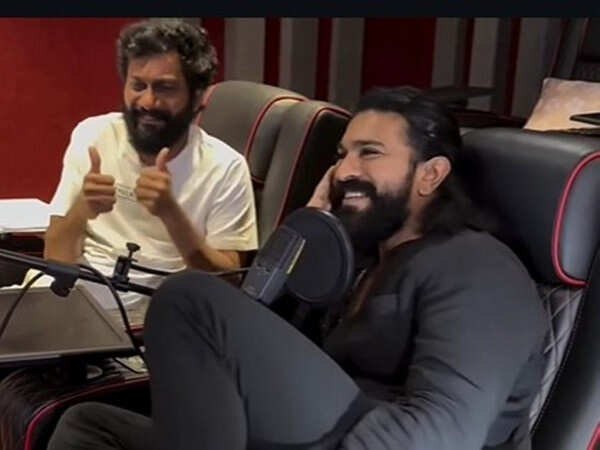
 For months, the makers of Peddi have kept fans guessing about the true genre of Ram Charan’s upcoming film. Early reports suggested that the Buchi Babu Sana directorial was a rustic sports action entertainer centred on cricket. The perception gained traction when the film’s title glimpse dropped in 2025. Later, the song Chikiri Chikiri showed Ram Charan performing a hook step with a cricket bat, and its viral popularity further cemented the belief that Peddi revolved heavily around the sport. However, fresh updates point to a surprising twist.

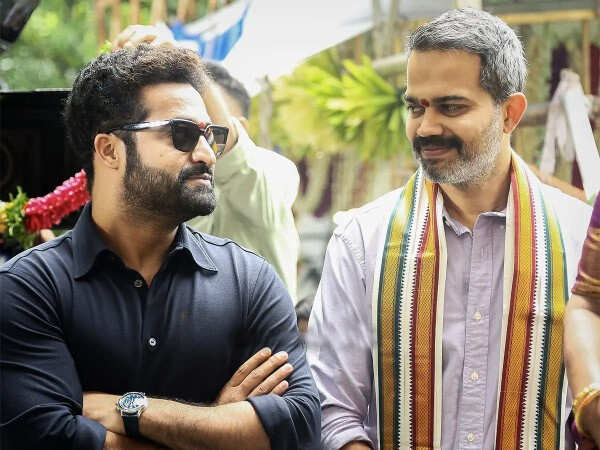
 The filming of Jr NTR’s collaboration with director Prashanth Neel, rumouredly titled Dragon, recently faced an unexpected hurdle. While the unit had been canning crucial action sequences in the semi-arid terrains of Jordan in February, the schedule was abruptly truncated during the final week of the month.